
Weekend Update – November 3, 2013

Some things are just unappreciated until they’re gone.

If you can remember those heady days of 2007, it seemed as if every day we were hitting new market highs and everyone was talking about it when not busy flipping houses.

Some will make the case that is the perfect example of a bubble about to burst, similar to when a bar of gold bullion appears on the cover of TIME magazine, just in time to mark the end of a bull run.

On the other hand, when everyone is suddenly talking about perhaps currently being in a bubble it may be a good time to plan for even more of a good thing.

That’s emblematic of the confusion swirling in our current markets. Earnings are up. Better than expected by most counts, yet revenues are down. The stock market can do only one thing and so it goes higher.

In case you haven’t been paying attention, 2013 has been a year of hitting record after record. Yet the buzz is absent, although house flipping is back. Not that I go to many social events but not many are talking about how wild the market has been. That’s markedly different from 2007.

Listening to those who purport to know about human behavior and markets, that means that we are not yet in a stock market bubble and as such, the market will only go higher, yet that’s at odds with the rampant bubble speculation that is being promoted in some media.

I’m a little more cynical. I see the paucity of excitement as being reflective of investors who have come to believe that consistently higher markets are an entitlement and have subsequently lost their true value. No one seems to appreciate a new record setting close, anymore. The belief in the right to a growing portfolio is no different from the right to use a calculator on an exam. Along with that right comes the loss of ability and appreciation of that ability.

Without spellchecker, the editors at Seeking Alpha would have a hard time distinguishing me from a third grader, but spelling really isn’t something I need to due. It’s just done for me.

While many were unprepared in 2007 because they were caught up in a bubble, 2013 may be different. In 2007 the feeling was that it could only get better and better, so why exercise caution? But in 2013 the feeling may be that there is nothing unusual going on, so what is there to be cautious about?

AS markets do head higher those heights are increasingly met with ennui instead of wonder and awe. It’s barely been more than five years since we last felt the wrath of an over-extended market but I’m certain that the new daily records will be missed once they’re gone.

As a normally cautious person when it comes to investing, but not terribly willing to sacrifice returns for caution my outlook changes with frequency as new funds find their way into my account after the previous week’s assignment of options I had sold.

This past week I didn’t have as many assignments as I had expected owing to some late price drops on Friday, so I’m not as likely to go on a spending spree this coming week, as I don’t want to dig deeply into my cash reserve. This week I’m inclined to think more in terms of dividend paying stocks and relatively few higher beta names, although opportunity is situational and Monday morning’s opening bell may bring surprise action. I appreciate surprise and for the record, I appreciate every single bit of share appreciation and income that comes my way as a gift from this market.

As usual, the week’s potential stock selections are classified as being in Traditional, Double Dip Dividend, Momentum and “PEE” categories this week (see details).

I currently own shares of MetLife (MET) and have done so several times this year. MetLife reported earnings this past week. They reported a nearly $2 billion turnaround in profits, but missed estimates, despite strength in every metric. They re-affirmed that a lower interest rate environment, as might be expected with a continuation of Quantitative Easing, could impact its assets’ performance in the coming year. That was the same news that created a buying opportunity in the previous quarter, so it should not have come as too much of a surprise. What did, however come as a surprise was the announcement that MetLife would no longer be offering earnings per share guidance. According to its CEO “we will instead expand our discussion of key financial metrics and business drivers, creating a more informed view of MetLife’s future prospects.” The price drop and it’s ex-dividend date this week make it a likely candidate for using my limited funds this week.

I’ve long believed that Robert ben Mosche, CEO of AIG (AIG) was something of a saint. Coming out of comfortable retirement in Croatia to attempt an AIG rescue, he continued on his quest even while battling cancer and still found the time to re-pay AIG’s very sizeable debt to US taxpayers. Who needs that sort of thing when you can live like royalty off the Mediterranean coast?

AIG was punished after reporting earnings this past week. It’s hard to say whether the in line earnings, but slightly lower revenue was to blame for the nearly 7% drop or whether joining forces with MetLife was to blame. Not that they literally joined forces, it’s just that ben Mosche announced that AIG will no longer comment on its “aspirational goals,” which was a way of saying that they too were no longer going to provide guidance. I haven’t owned shares in 2 months and that was at a lower price point than even after the large Friday drop, but I think the opportunity has re-arrived.

Wells Fargo (WFC) goes ex-dividend this week and as much as I’ve silently prayed for its share price to drop back to levels that I last owned them, it just hasn’t worked out that way. To a large degree Wells Fargo has stayed above the various banking controversies and has deflected much of the blame and scrutiny accorded others. At some point it becomes clear that prices aren’t likely to drop significantly in the near term, so it may be time to capitulate and get back on the wagon. However, what does give me some solace is that shares have trailed the S&P 500 during the three time frames that I have been recently using, each representing a near term top of the market; May 21, August 2 and September 19, 2013.

In the world of big pharma, Merck (MRK) has shared in little of the price strength seen by some others. In fact, of late, the
best Merck has been able to do to prompt its shares higher have all come on the less constructive side of the ledger. Only the announcement of workforce reductions and other cost cutting steps have been viewed positively.
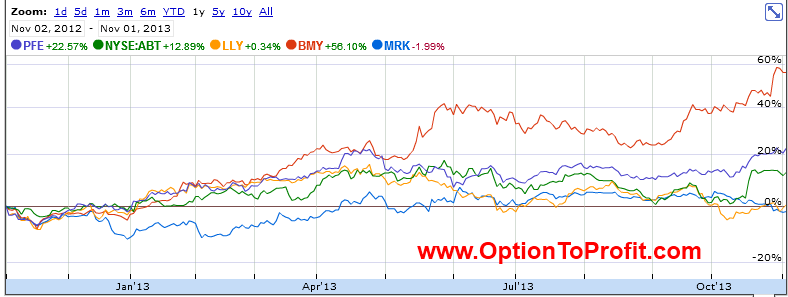
But at some point a value proposition is created which isn’t necessarily tied to pipelines or other factors pertinent to long term price health. In this case, a quick 7% price drop is enough to warrant consideration of a company paying an attractive dividend and offering appealing enough option premiums to sustain interest in shares even if they stagnate while awaiting the next price catalysts. Besides, if you’re selling covered calls, there’s nothing better than share price stagnation.

What is a week without drawing comparisons between Michael Kors (KORS) and Coach (COH)? Coach has become everyone’s favorite company to disparage, although on any given day it may exchange places with Caterpillar. Kors, is of course, the challenger that has displaced Coach in the hearts of investors and shoppers. Having sold Coach puts in advance of earnings and then purchasing shares even after those expired, those were assigned this past week. However, at this price level Coach is still an appealing covered option purchase and well suited for a short term strategy, even if there is validity to the thesis that it is ceding ground to Kors.

Kors, on the other hand, is doing everything right, including entering the S&P 500. It’s hard not to acknowledge its price ascent, even after a large secondary offering. While I know nothing of fashion and have no basis by which to compare Coach and Kors, I do know that as Kors reports earnings this week the option market is implying approximately 7.5% price move in either direction. However, anything less than a 10% decline in price can still deliver a 1% ROI

Williams Companies (WMB) is one of those companies that seems to fly under the radar. Although I’ve owned shares many times there has never been a reason compelling me to do so on the basis of its business fundamentals. Instead, ownership has always been prompted by an upcoming dividend or a sudden price reversal. In this case I just had shares assigned prior to earnings, which initially saw a big spike in price and then an equally large drop, bringing it right back to the level that I have found to be a comfortable entry point.

Riverbed Technology (RVBD) reported earnings last week and I did not purchase additional shares or sell puts, as I thought I might. Too bad, because the company acquitted itself well and shares moved higher. I think that shares are just starting and while RIverbed Technology has probably been my most lucrative trading partner over the years, purely on the basis of option premiums, this time around I am unlikely to write call options on all new shares, as I think $18 is the next stop before year end, particularly if the overall market doesn’t correct.

What can anyone add to the volumes that have been said about Apple (AAPL) and Intel (INTC)? Looking for insights is not a very productive endeavor, as the only new information is likely to currently exist only as insider information. Both are on recent upswings and both have healthy dividends that get my attention because of their ex-dividend dates this week. Intel offers nothing terribly exciting other than its dividend, but has been adding to its price in a stealth fashion of late, possibly resulting in the assignment of some of my current shares that represent one of the longest of my holdings, going back to September 2012. While I have always liked Intel it hasn’t always been a good covered call stock because when shares did drop, such as after earnings, the subsequent price climbs took far too long to continually be able to collect option premiums. However, without any foreseeable near term catalysts for a significant price drop it offers some opportunities for a quick premium, dividend and perhaps share appreciation, as well.

Finally, in its short history of paying dividends Apple’s shares have predominantly moved higher after going ex-dividend, although there was one notable exception. Given the factors that may be supporting Apple’s current price levels, including pressure from activist investors and Apple’s own buybacks, I’m not overly concerned about the single historical precedence and think that the triumvirate of option premium, dividend and share appreciation makes it a good addition to even a conservative portfolio.

Traditional Stocks: AIG, Merck, Williams Companies

Momentum Stocks: Coach, Riverbed Technology

Double Dip Dividend: Apple (ex-div 11/6), Intel (ex-div 11/5), MetLife (ex-div 11/6), Wells Fargo (ex-div 11/6)

Premiums Enhanced by Earnings: Michael Kors (11/5 AM)

Remember, these are just guidelines for the coming week. The above selections may become actionable, most often coupling a share purchase with call option sales or the sale of covered put contracts, in adjustment to and consideration of market movements. The overriding objective is to create a healthy income stream for the week with reduction of trading risk.

Implied Price Moves

On rare occasion I actually get some indication that someone is reading these articles.

In this case I was recently asked a question about “implied moves,” citing the fact that I refer to that concept with some frequency in articles. For me, that implied someone actually having read at least one article. The use of the word “frequency” further implied that I did so either on multiple occasions in a single article or perhaps in many articles.

That which is implied isn’t necessarily precise.

There are lots and lots of different metrics and measures that are used in assessing stock charts and stock fundamentals. I have long maintained doubts about the validity of many of those measures, at  least the ones most frequently cited and presented. It always appears that for every expert’s interpretation of data there is another equally esteemed expert who takes an opposing position.

For someone who had spent about 20 years in academic environments and who respects the “scientific method,” I prefer common sense approaches to investing.

You can be certain that for the widely used tools and measures everyone under the sun has already applied the tools and the chances of an eye popping discovery that flies below the radar is not likely. So why bother?

The same may or may not be true of more closely held metrics or proprietary tools. Presumably the PhDs in statistics, physics and applied mathematics are being paid princely sums for their algorithms because they produce results at the margins.

If you followed the announcement of this year’s Nobel Prize in Economics you may have thought it to be ironic that the prize was shared by Eugene Fama and Robert Schiller. The ironic part is that one was recognized for his work supporting rational markets, while the other was awarded on the basis of endorsing irrational markets.

So clearly black and white can be the same.

While I only passingly glance at charts and various measures and completely ignore the traditional measures used to characterize options, better known as “The Greeks,” I do consider the option market equivalent of crowd sourcing, better known as a measure of a stock’s  “implied price move.”

While I believe that the option market usually gets it wrong, which is a good thing, because those are the people that are buying the goods that you’re selling, the crowd does provide some guidance. As in real life, it’s often good to stay away from the crowd, despite the fact that crowds can create a sense of comfort or security.

Or frenzy.

In this case the guidance provided by option market participants is an estimation of how much the option market believes a stock’s price will move during the period in question by looking at both the bull and the bear perspective as based on the most fundamental of all criterion.

What is considered is the price that someone is willing to pay to either buy a call option or a put option at a specific strike price.

I only use “implied movement” when a known event is coming, such as earnings being released. I want to get an idea of just how much the option market believes that the stock is likely to move based on the event that is going to occur.

In articles I refer to the phenomenon of “Premiums Enhanced by Earnings” or “PEE.” During such times the uncertain way in which stocks may respond to earnings news drives option premiums higher. It’s all a case of risk and reward.

But because earnings introduces additional risk I look for a measure that may suggest to me that I have an advantage over the crowd.

The calculation of the “implied move” is very simple, but is most accurate for a weekly contract, because that minimizes the impact of time on option premium.

To begin, you just need to identify the strike price that is most close to the current share price and then find the respective call and put bid premiums. By adding those together and dividing by the strike price you arrive at the “implied move.” which tells you that the option market is anticipating a move in either direction of that magnitude.

IMPLIED PRICE MOVE = (Call bid + put bid)/Strike price,  where Strike price is that closest to current share price

The implied move is expressed as a percentage.

Using Facebook as an example, the graphic below was from the day prior to the announcement of earnings and with approximately 3 1/2 days left to expiration.

Facebook was trading at $49.53 and the $49.50 November 1, 2013 call option bid was $3.10, while the corresponding put option bid was $3.05


At a point that shares were trading at $49.53 and using the $49.50 strike level, the combined call and put premium of $6.20 would result in an implied move of approximately 12.5%. That would mean that the stock market was anticipating an earnings related trading range from approximately $43 to $56.

Great, but how do we capitalize on that bit of information, which may or may not have validity, especially since it is based on prices that in part are determined by option buyers, who frequently get it wrong?

I use my personal objective, which is a 1% ROI for each new trade.

In the case of Facebook, whether buying shares acc
ompanied by the sale of calls or simply selling puts, the ROI is based upon the premiums received, plus or minus capital gains or losses from the underlying shares and of course, trading costs.

In general, there is a slight advantage in earnings related trades to the sale of puts rather than using a covered call strategy. Doing so also tends to reduce transaction costs.

In the case of Facebook, the first strike price that would yield a 1% ROI is at $42, because the bid premium at that strike is $0.44 and the amount of cash put at risk is $42.

The key question then is whether that 1% ROI could be achieved by a position that is outside of the implied range. The further outside that range the more appealing the trade becomes.

Again, in this case, with shares trading at $49.53, it would require a 15.2% decline in price to trigger the possibility of assignment. That is outside the range that the crowd believes will be the case.

In this case, I’m currently undecided as to whether to make this trade because of other factors.

There are almost always other factors.

First, the positive factor is that I prefer to sell puts on shares that have already started showing weakness in advance of earnings. That increases the put premiums available and perhaps gets some of that weakness out of its system, as the more squeamish share holders are heading for the exits in a more orderly fashion, rather than doing it as part of a rushing crowd.

The negative factor is that tomorrow is another event that may impact the overall market. That is the release of the FOMC minutes. Although I don’t expect much of a reaction in the event of a surprise or nuanced language the market could drag Facebook along with it, possibly compounding any earnings related downdraft.

So in this case I’m likely to wait until after 2 PM tomorrow to make a decision.

By that time the likelihood of any FOMC related influence will be known, but there will also need to be a recalculation of implied move as premiums will change both related to any changes in share price, as well as to decreased option value related to the loss of an additional day of premium.

In general, everything else being equal, waiting to make such a trade reduces the ROI or increases the risk associated with the trade.

Aren’t you glad you don’t read these articles?

Weekend Update – October 27, 2013

Watching Congressional testimony being given earlier this week by representatives of the various companies who were charged with the responsibility of assembling a functioning web site to coordinate enrollment in the Affordable Care Act it was clear that no one understood the concept of responsibility.

They did, however, understand the concept of blame and they all looked to the same place to assign that blame.

As a result there are increased calls for the firing or resignation of Kathleen Sebelius, Secretary of Health and Human Services. After all, she, in essence, is the CEO.

On the other hand, it was also a week that saw one billionaire, Bill Gross, the “Bond King” of PIMCO deign to give unsolicited advice to another billionaire, Carl Icahn, in how he should use his talents more responsibly. But then again, the latter made a big splash last week by trying to convince a future billionaire, Tim Cook, of the responsible way to deal with his $150 billion of cash on hand. Going hand in hand with a general desire to impart responsibility is the tendency to wag a finger.

Taking blame and accepting responsibility are essentially the same but both are in rare supply through all aspects of life.

This was an incredibly boring week, almost entirely devoid of news, other than for earnings reports and an outdated Employment Situation Report. The torrent of earnings reports were notable for some big misses, lots of lowered guidance and a range of excuses that made me wonder about the issue of corporate responsibility and how rarely there are cries for firings or resignations by the leaders of companies that fail to deliver as expected.

For me, corporate responsibility isn’t necessarily the touchy-feely kind or the environmentalist kind, but rather the responsibility to know how to grow revenues in a cost-efficient manner and then make business forecasts that reflect operations and the challenges faced externally. It is upon an implied sense of trust that individuals feel a certain degree of comfort or security investing assets in a company abiding by those tenets.

During earnings season it sometimes becomes clear that living up to that responsibility isn’t always the case. For many wishing to escape the blame the recent government shutdown has been a godsend and has already been cited as the reason for lowered guidance even when the business related connection is tenuous. Instead of cleaning up one’s own mess it’s far easier to lay blame.

For my money, the ideal CEO is Jamie Dimon, of JP Morgan Chase (JPM). Burdened with the legacy liabilities of Bear Stearns and others, in addition to rogue trading overseas, he just continues to run operations that generate increasing revenues and profits and still has the time to accept responsibility and blame for things never remotely under his watch. Of course, the feeling of being doubly punished as an investor, first by the losses and then by the fines may overwhelm any feelings of respect.

Even in cases of widely perceived mismanagement or lack of vision, the ultimate price is rarely borne by the one ultimately responsible. Instead, those good earnings in the absence of revenues came at the expense of those who generally shouldered little responsibility but assumed much of the blame. While Carl Icahn may not be able to make such a case with regard to Apple, the coziness of the boardroom is a perfect place to abdicate responsibility and shift blame.

Imagine how convenient it would be if the individual investor could pass blame and its attendant burdens to those wreaking havoc in management rather than having to shoulder that burden of someone else’s doing as they watch share prices fall.

Instead, I aspire to “Be Like Jamie,” and just move on, whether it is a recent plunge by Caterpillar (CAT) or any others endured over the years.

As usual, the week’s potential stock selections are classified as being in Traditional, Double Dip Dividend, Momentum and “PEE” categories this week (see details).

Andrew Liveris, CEO of Dow Chemical (DOW) was everyone’s favorite prior to the banking meltdown and was a perennial guest on financial news shows. His star faded quickly when Dow Chemical fell to its lows during the financial crisis and calls for his ouster were rampant. Coincidentally, you didn’t see his ever-present face for quite a while. Those calls have halted, as Liveris has steadily delivered, having seen shares appreciate over 450% from the market lows, as compared to 157% for the S&P 500. Shares recently fell after earnings and is closing in to the level that I would consider a re-entry point. Now offering weekly option contracts, always appealing premiums and a good dividend, Dow Chemical has been a reliable stock for a covered option strategy portfolio and Andrew Liveris has had a reliable appearance schedule to match.

A company about to change leadership, Coach (COH) has been criticized and just about left for dead by most everyone. Coach reported earnings last week and for a short while I thought that the puts I had sold might get assigned or be poised for rollover. While shares recovered from their large drop, I was a little disappointed at the week ending rally, as I liked the idea of a $48 entry level. However, given its price history and response to the current level, I think that ownership is still warranted, even with that bounce. Like Dow Chemical, the introduction of weekly options and its premiums and dividend make it a very attractive stock in a covered call strategy. Unlike Dow Chemical, I believe its current price is much more attractive.

I’m not certain how to categorize the CEO of Herbalife (HLF). If allegations regarding the products and the business model prove to be true, he has been a pure genius in guiding share price so much higher. Of course, then there’s that nasty fact that the allegations turned out to be true.

Herbalife reports earnings this week and if you have the capacity for potential ownership the sale of out of the money puts can provide a 1.2% return even of shares fall 17%. The option market is implying a 10% move. That is the kind of differential that gets my attention and may warrant an investment, even if the jury is still out on some of the societal issues.

In the world of coffee, Dunkin Brands (DNKN) blamed K-Cups and guided toward the lower end of estimates. Investors didn’t care for that news, but they soon got over it. The category leader, Starbucks (SBUX) reports earnings this week. I still consider Howard Schultz’s post-disappointing earnings interview of 2012 one of the very best in addressing the issues at hand. But it’s not Starbucks that interests me this week. It’s Green Mountain Coffee Roasters (GMCR). Itself having had some questionable leadership, it restored some credibility with the appointment of its new CEO and strengthening its relationships with Starbucks. Shares have fallen about 25% in the past 6 weeks and while not reporting its own earnings this week may feel some of the reaction to those from Starbucks, particularly as Howard Schultz may characterize the nature of ongoing alliances. Green Mountain shares have returned to a level that I think the adventurous can begin expressing interest. I will most likely do so through the sale of puts, with a strike almost 5% out of the money being able to provide a 1.2% ROI. The caveat is that CEO Brian Kelley may soon have his own credibility tested as David Einhorn has added to his short position and has again claimed that there are K-cup sales discrepancies. Kelley did little to clear up the issue at a recent investor day meeting.

Baxter International (BAX) has held up reasonably well through all of the drama revolving around the medical device tax and the potential for competition in the hemophilia market by Biogen Idec (BIIB). WIth earnings out of the way and having approached its yearly low point I think that it is ready to resume a return to the $70 range and catching up to the S&P 500, which it began to trail in the past month when the issues of concern to investors began to take root.

MetLife (MET) has settled into a trading range over the past three months. For covered calls that is an ideal condition. It is one of those stocks that I had owned earlier at a much lower price and had assigned. Waiting for a return to what turned out to be irrationally low levels was itself irrational, so I capitulated and purchased shares at the higher level. In fact, four times in the past two months, yielding a far better return than if shares had simply been bought and held. Like a number of the companies covered this week it has that nice combination of weekly option contracts, appealing premiums and good dividends.

Riverbed Technology (RVBD) reports earnings this week, along with Seagate Technology (STX). Riverbed is a long time favorite of mine and has probably generated the greatest amount of premium income of all of my past holdings. However, it does require some excess stomach lining, especially as earnings are being released. I currently own two higher cost lots and uncharacteristically used a longer term call option on those shares locking in premium in the face of an earnings report. However, with recent price weakness I’m re-attracted to shares, particularly when a 3 week 1.7% ROI can be obtained even if shares fall by an additional 13%. In general, I especially like seeing price declines going into earnings, especially when considering the sale of puts just in advance of earnings. Riverbed Technology tends to have a history of large earnings moves, usually due to providing pessimistic guidance, as they typically report results very closely aligned with expectations.

Seagate Technology reports earnings fresh off the Western Digital (WDC) report. In a competitive world you might think that Western Digital’s good fortunes would come at the expense of Seagate, but in the past that hasn’t been the case, as the companies have traveled the same paths. With what may be some of the surprise removed from the equation, you can still derive a 1% ROI if Seagate shares fall less than 10% in the earnings aftermath through the sale of out of the money put contracts.

ConAgra (CAG) and Texas Instruments (TXN) both go ex-dividend this week. I think of them both as boring stocks, although Texas Instruments has performed nicely this year, while ConAgra has recently floundered. On the other hand, Texas Instruments is one of those companies that has fallen into the category of meeting earnings forecasts in the face of declining revenues by slashing worker numbers.

Other than the prospect of capturing their dividends I don’t have deeply rooted interest in their ownership, particularly if looking to limit my new purchases for the week. However, any opportunity to get a position of a dividend payment subsidized by an option buyer is always a situation that I’m w
illing to consider.

Finally, as this week’s allegation that NQ Mobile (NQ), a Chinese telecommunications company was engaged in “massive fraud” reminds us, there is always reason to still be circumspect of Chinese companies. While the short selling firm Muddy Waters has been both on and off the mark in the past with similar allegations against other companies they still get people’s attention. The risk of investing in companies with reliance on China carries its own risk. YUM Brands (YUM) has navigated that risk as well as any. With concern that avian flu may be an issue this year, that would certainly represent a justifiable shifting of blame in the event of reduced revenues. At its recent lower price levels YUM Brands appears inviting again, but may carry a little more risk than usual.

Traditional Stocks: Baxter International, Dow Chemical, MetLife

Momentum Stocks: Coach, Green Mountain Coffee Roasters, YUM Brands

Double Dip Dividend: ConAgra (ex-div 10/29), Texas Instruments (ex-div 10/29)

Premiums Enhanced by Earnings: Herbalife (10/28 PM), Riverbed Technology (10/28 PM), Seagate Technology (10/28 PM)

Remember, these are just guidelines for the coming week. The above selections may become actionable, most often coupling a share purchase with call option sales or the sale of covered put contracts, in adjustment to and consideration of market movements. The overriding objective is to create a healthy income stream for the week with reduction of trading risk.

I Love Caterpillr

That may be a bit of an over-statement. There’s probably a psychiatric diagnosis for someone who professes deep emotional attachment to inanimate objects.
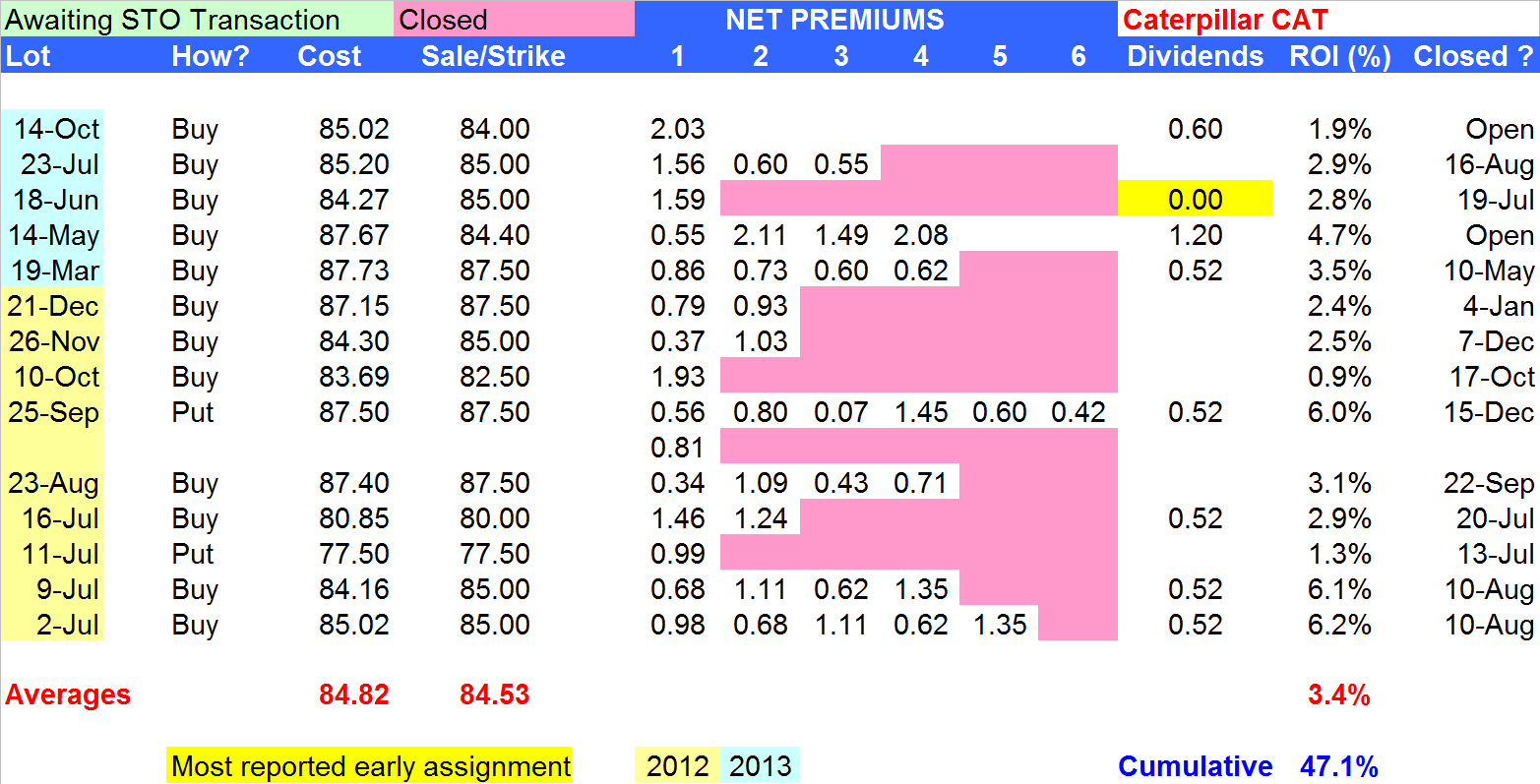
But when it comes to being a poster child for a covered option strategy, not too many can do a better job of demonstrating what is possible than Caterpillar (CAT).

Caterpillar reported earnings this morning and by noon its shares were about 5% lower. Its earnings and its reduced guidance were not the sort of things that inspire confidence. It’s CEO, Douglas Oberhelman, has been vilified, pilloried and himself been used as a poster child of an “out of touch” CEO in the past. Today’s news confirms that feeling for many. If there is such a thing as a “rational market,” today’s response is reflective of that kind of market.

Even objective people, such as Herb Greenberg of TheStreet.com described Oberhelman’s appearance on CNBC this morning as seeming or sounding “distraught.” That’s not a terribly good image to present if one’s objective is to inspire confidence in leadership and offer support for share price.

Caterpillar has long been the stock that everyone loves to hate. Down almost 6% year to date, essentially all of it coming today, it has certainly lagged the broader market and has had very tangible opportunity costs, even prior to today’s disappointments.

The smart money bid shares up quite strongly yesterday, approaching $90, a level not seen in 7 months. Presumably, it was the smart money, because it seems unlikely that individual investors would commit with such urgency in advance of a scheduled risk factor.

Certainly, the very high profile position taken by famed short seller, Jim Chanos, calling a short of Caterpillar as his best trade idea of 2014 and pointing out that Oberhelman “routinely misses forecasts,” hasn’t done much to propel shares forward.

But that’s the point.

What has made Caterpillar such a wonderful covered option stock, whether owning shares and selling calls or selling puts, is its mediocrity. It has simply traded in a narrow price range alternating between disappointment and hope. That creates the perfect environment in which to put a stock to work, not be capital appreciation of shares, but rather through production of premium income and dividends.

In the example illustrated below, representing Trading Alerts sent to subscribers during a 15 month period, there were 14 different occasions initiating new positions or selling puts. The average share price was slightly above today’s noon time price of Caterpillar shares. In essence indicating no movement in price over that time. Including dividends, however, Caterpillar shares would have shown a 2.4% ROI during that period.

By contrast, the approach of serial purchase of shares or sale of puts, awaiting assignment or rolling over option contracts when possible, as expiration occurs or is likely to occur has had an ROI of 47%, assuming equal lots of shares purchased in all transactions. During that same time period the S&P 500 appreciated 30.8%

In the example above very little of the gain can be attributed to capital appreciation of shares. In fact, most of the share purchases was coupled with the sale of in the money or near the money options in an effort to optimize option premiums at the expense of capital gains.

Over the course of the time period evaluated Caterpillar shares did reach a high of $99 on February 1, 2013. Perhaps not coincidentally, that occurred during a period of time that I didn’t own shares, having had shares assigned in early January 2013 and not finding a comfortable re-entry point until March.

For the buy and hold investor with perfect timing who had purchased shares on July 2, 2013 and sold them on February 1, 2013, the ROI including dividends would have been 18.9% for the 7 month period.

I’m one usually loathe to annualize, because I believe it tends to inflate returns, but assuming the 18.9% return could be maintained for an entire year, the annual ROI would have been 32.4%

Not shabby, but remember, that required perfect timing and the ability, discipline and foresight to sell at the top and further assumed that performance could be replicated.

Compare that to sticking with the mediocrity exhibited by Caterpillar and using it as a tool of convenience. Trading in and out of positions as its price indicated, rather than based on technical or fundamental factors. That can be left to the smart money.

With shares taking today’s hit I’m likely to consider adding shares, with already two open lots in hand, one of which is set to expire next week at $84 and the other at the end of the November 2013 cycle with an $87.50 strike price.

If not now, the one thing that I feel fairly certain about is that Caterpillar will present other opportunities and price points at which to find entry and capitalize on its inability to thrive in a thriving market.

Thank you, Doug Oberhelman. We need more CEOs who can walk that share price tight wire and stay within narrow confines. It would take the strain of thought and luck out of the investing process.


Weekend Update – October 20, 2013

With the S&P 500 having reached an all time high this past week you could certainly draw the conclusion that a government shutdown is a good thing and flirting with default is a constructive strategy. At a reported cost of only $24 Billion associated with closure and nothing more than a symbolic “Fitch slap” credit watch issued, perhaps we should look forward to the next potential round in just a few months.
For me, this past week marked the slowest week of opening new positions that I can recall since the 2009 market bottom. Although history suggests that the eleventh hour is a charm, the zeal of some more newly elected officials was reminiscent of a theological premise that believes in order to save it you must first destroy the world. That kind of uncertainty is the kind in which you get your affairs in order rather than embarking on lots of new and exciting initiatives.

With manufactured uncertainty temporarily removed the market can focus on earnings and other things that most of us believe are somewhat important.

One thing that will be certain is that wherever possible the next earnings season will attempt to lay some blame for any disappointments upon the government shutdown. This past week it certainly didn’t take Stanley Black and Decker (SWK) and eBay (EBAY) very long to already take advantage of that excuse. Who knew that government purchasing agents were unable to use eBay for Blackhawk helicopter replacement parts during their unexpected furlough?

As with the previous earnings season the financial sector started off the reports in a promising way, although early in the season the results are mixed, with some significant surges and plunges. What is clear is that investors are paying particular attention to guidance.

One earnings report that caught my attention was from Pet Smart (PETM). My father always believed that no matter what the economic environment, people would always find the wherewithal to spend on the pets and their kids. Pet Smart’s disappointing earnings focused on a “challenged consumer” and lower customer traffic. That can’t be a good sign. If pets are going wanting what does that portend for the rest of us?

Yet, on the other hand, Align Technology (ALGN) discussed last week, was a different story. Certainly representing discretionary spending and not benefiting from any provisions in the Affordable Care Act, their orthodontic appliances see no barriers from the economy ahead, as they reported great earnings and guidance.

Also clouding the picture, perhaps both literally and figuratively, is the positive guidance provided by Peabody Energy (BTU). For a nation that has been said to “move on coal,” that has to be a signal of something positive going forward.

This week, with lots of cash from assignments of October 2013 option contracts, I’m anxious to get back to business as usual, but still have a bit of wariness. However, despite the appearances of a reluctant consumer, I’m encouraged by recent activity in the speculative portion of my portfoli0, enough so to consider adding to those positions, even at market highs.

As usual, the week’s potential stock selections are classified as being in Traditional, Double Dip Dividend, Momentum and “PEE” categories this week (see details).

The news from Peabody Energy in addition to some recent price stabilization in Walter Energy (WLT), Cliffs Natural Resources (CLF) and Freeport McMoRan (FCX) have me in a hopeful mood after long having suffered with positions in all three.

A year ago at this time I believed that Freeport McMoRan would be among the best performers in 2013, but subsequent to that it has only recently started on its recovery from the price plunge it sustained when announcing plans to acquire Plains Exploration and Production, as it planned to expand its asset base to include oil and natural gas. While the long term vision may be someday vindicated, 2013 has not been a stellar year. But, like some others this week, there has been a steady strengthening in its price, despite significantly lower gold, oil and copper prices, year to date. While its dividend has made holding shares marginally tolerable through the year, I think it is now ready to start a sustained climb and it offers appealing call premiums to create income or provide downside protection. Earnings are reported this week, but the option market is not expecting a very large move.

Another company slowly climbing higher, but still with a great distance to travel is Walter Energy . In addition to suffering through a proxy fight this year and significant challenges to management, declining coal prices and a slashed dividend, I believe that it is also poised to continue climb higher. I recently tested the waters and added shares along with selling in the money calls. Those were just assigned, but I think that I’m ready to dip deeper.

Sticking to the same theme, Cliffs Natural Resources goes hand in hand with Walter Energy, at least in its price behavior and disappointments. I
t too has slashed its dividend and its CEO has retired. Like Walter Energy, I recently started adding shares and had them assigned this week. Cliffs reports earnings this week and unlike Freeport McMoRan, the option market is expecting a larger price move.

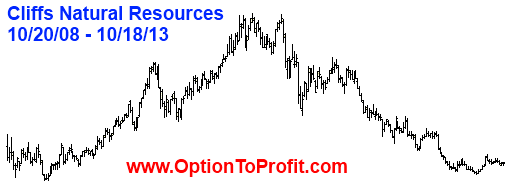
While I rarely do more than glance at charts, in the case of Cliffs Natural Resources the 5 Year price chart may suggest a long term pattern that has shares at the beginning of a sustained climb higher.

As with many positions that are preparing to report earnings, I typically consider potential entry through the sale of put options.

Also reporting earnings this week is Cree (CREE). Thanks to legislation its LED light bulbs have become ubiquitous in home improvement stores and homes. It has the features of companies that make potentially alluring earnings trades. In this case, this always volatile moving company can sustain up to a 14% price decline and still return a 1% ROI for the week. The only real consideration is that it is capable of making that decline a reality, so if selling puts you do have to be prepared to take ownership.

While already having reported earnings and falling into the “disappointing” category, Fastenal (FAST), which I look at as being an economic barometer kind of company has already started regaining its price decline. It will be ex-dividend this week offering an additional reason to consider its purchase, even though I already own lower priced shares and rarely buy additional lots at higher prices. However, with W.W. Grainger (GWW) recently reporting positive earnings I’m encouraged that Fastenal will follow, but in the meantime the dividend and option premium make it easier to wait.

Also going ex-dividend this week is Williams-Sonoma (WSM). I considered its purchase last week, but it fell victim to a week of my inaction. While perhaps at risk to suffer from decreased spending at some higher end stores it has already fallen about 11% from its recent high point. However, since it reports earnings just prior to the expiration of the November 2013 option cycle, I might consider utilizing a December 2013 covered call sale.

The Gap (GPS) isn’t at risk of losing too many high end customers, it has just been losing customers, at least on the basis of its most recent monthly report. It is one of those retailers that still reports monthly comparison figures. That’s just one more bullet that needs to be dodged in addition to potential surprises during earnings season. Shares went precipitously lower with its most recent retail report and caught me along with it. It is near a price support level and represents an opportunity to either purchase additional shares to attempt to offset paper losses of an earlier lot or to establish an initial covered position.

While eBay may not sell used Blackhawk helicopter parts it somehow found a way to link its coming fortunes to the government shutdown. Suffering a significant price drop following earnings and guidance shares were once again in a channel of great familiarity. Having traded reliably in the $50-$52.50 range the sight of it falling was well received. However, late in the trading session on Friday someone else must have seen the same appeal as shares suddenly jumped $1.65 in about 20 minutes. That takes away some of the appeal. What takes away more of the appeal was the explanation by CEO Donahoe that spurred the surge, when he explained that he and his CFO did not mean to sound so dour about holiday prospects, it’s just that they both had colds.

On the other hand UnitedHealth Group (UNH) is a company that may be able to justifiably point its finger at the Federal government when it reports earnings again in January 2014. Already suffering a nearly 10% drop in the past week related to 2014 guidance, UnitedHealth is a major player in the options available on the Affordable Health Care Act exchanges. While perhaps not being able to blame the shutdown for any revenue related woes, disappointing enrollment statistics may be in the making. The additional price drop on Friday, following the large drop on Thursday may be related to enrollment challenges rather than projections of lower Medicare funding in the coming year. However, nearing a price support and following such a large price drop provides a combination that makes ownership appealing. Perhaps eBay employees should consider signing up en masse in the event they are all prone to colds that effect their ability to perform. In enough numbers that may be helpful to UnitedHealth Group’s 2014 revenues.

Of course, while the market seemed to rejoice at what could only be construed as the return to health of the eBay executives, Groupon (GRPN) is another example of a stock whose price has returned to more lofty levels following surgical removal of its CEO. It is one of a handful of stocks that I sold last year taking a capital loss and swore that I would never buy again. Now down about 15% from its recent high, which itself was up approximately 500% from its not too distant low, Groupon is a different company in leadership, product and prospects. While still a risky position

Finally, a name that everyone seems to disparage these days is Coach (COH). While there is certainly sufficient reason to believe that retailers, even the higher end retailers are being challenged, Coach is beginning to be perceived as taking a back seat to retailer Michael Kors (KORS). SHares have certainly been volatile, especially at earnings and Coach reports earnings this week. Having owned shares a number of times in the past year, my preference is to sell puts in advance of earnings in anticipation of a large drop. Currently, the option market is implying nearly a 9% move. A 1% ROI for the week can be obtained through such a sale if the price drop is less than 12%.

Traditional Stocks: eBay, The Gap, United Health Group

Momentum Stocks: Groupon, Walter Energy

Double Dip Dividend: Fastenal (ex-div 10/23), Williams Sonoma (ex-div 10/23)

Premiums Enhanced by Earnings: Coach (10/22 AM), Freeport McMoRan (10/22), Cree (10/22 PM), Cliffs Natural Resources (10/24 PM)

Remember, these are just guidelines for the coming week. The above selections may become actionable, most often coupling a share purchase with call option sales or the sale of covered put contracts, in adjustment to and consideration of market movements. The overriding objective is to create a healthy income stream for the week with reduction of trading risk.

Weekend Update – October 13, 2013

This week I’m choosing “risk on.”

For about 6 months I’ve been overly cautious, having evolved from a fully invested trader to one starting most weeks at about 40% cash reserves and maintaining about 25-30% by week’s end after initiating new positions.

Despite the belief that something untoward was right around the corner, the desire for current income through the purchase of stocks and the sale of options has been strong enough to temper the heightened caution on an ongoing basis for much of the past half year.

With uncertainty permeating the market’s mood, eased by late last week’s glimmer of hope that perhaps a short term debt ceiling increase may be at hand, “risk on” isn’t the most likely of places to find me playing with my retirement funds, but that’s often where it’s the most interesting, especially if the risk is one of perception more than one of probability.

While we may all have different operational definitions of what constitutes “risk” I consider beta, upcoming known market or stock moving events, the unknown, past price history and relative performance. Tomorrow the formula may be entirely different, as may tolerance for risk or willingness to burn down the cash reserves.

However, trying to dispassionately look at the current market and all of the talk about a correction, one metric that I’ve been using for the past few months reminds me that we’re doing just fine and that risk is still tolerable, even in the context of uncertainty.

Although I continue to believe that we can’t just keep moving higher, I’m not quite as dour when seeing that we are essentially at the same levels the S&P 500 stood on May 21, 2013 and June 18, 2013.

Those dates reflect relative high points, each of which gave way to the FOMC minutes or a press conference by Federal Reserve Chairman Bernanke.

In fact, we’re actually at a higher level than either of those two previous peaks, now trailing only the all time high of September 18, 2013 by less than 1.5%. So all in all, not too bad, especially since that 50 Day Moving Average that was breached by the S&P 500 earlier in the week was quickly remedied and the 200 Day Moving Average remains relatively distant.

From May 21 to June 5, then from June 18 to June 24, August 2 to 27 and finally September 19 to October 6, we have gone down a combined 16.7% in a cumulative trading period of 13 weeks or the equivalent of a quarter.

What more do you want? Armageddon?

For the past few months I’ve been focusing increasingly on new positions that have been trading below the May and June highs and preferably under-performing the S&P 500 at the same time. However, within that framework I’ve focused increasingly on near term dividend paying stocks and those more likely to fall into the “Traditional” category, typically low beta and attempting to avoid any known short term risk factors.

That has meant fewer “Momentum” positions and fewer earnings related trades. But up until Friday’s continuation of the hope induced rally, I had a number of “Momentum” stocks on my radar, all of which I had already owned and anticipated being assigned, but ripe for re-purchase in the pursuit of risk heightened premiums, but with less risk than readily apparent.

As it turned out Abercrombie and Fitch (ANF) got caught up in The Gaps’ same stores problem and whip-sawed in trading and I ultimately rolled over the position. Meanwhile, Mosaic (MOS) fell as investors were somehow surprised that Potash (POT) adjusted its guidance downward to reflect lower prices stemming from a collapse of the cartel.

As it would turn out Phillips 66 (PSX) was assigned, but soared, making it too expensive for repurchase, but that can change very quickly.

This week there are two deadlines. One is the end of the October 2013 option cycle, but the other is October 17, 2013, which Treasury Secretary Jack Lew proclaimed to be the day after which none of his “tricks” would be able to sustain the Treasury’s count and be able to pay our bills.

In a word? That’s when we would see the United States go into default on its obligations.

Under Senate questioning last week Lew acquitted himself quite well and demonstrated that he wasn’t very patient with regard to suffering fools. Uncharacteristically there appeared to be less self-aggrandizing statements in the form of questions coming from the committee members.

It may not be entirely coincidental that minutes after Lew’s appearance, House Speaker Boehner’s office announced that the Speaker would be making a statement reflecting upcoming meetings with the Administration, reflecting the possibility of some agreement.

For those that remember past such budgetary crises, you’ll recall that the market typically reacted to the hopes and then crashed along with the dashed hopes, in an eerily rhythmic manner.

On Saturday morning, word came from Eric Cantor (R-VA) that President Obama rejected the House offer. Unusually, GOP leadership skipped the opportunity to step up to the microphone to push their version of righteousness.

This week, in anticipation of the possibility of dashed hopes as may come from an appearing setback, my definition of “risk
on” includes positions already trading at depressed levels.

As usual, the week’s potential stock selections are classified as being in Traditional, Double Dip Dividend, Momentum and “PEE” categories this week (see details).

For dividend lovers this week offers Footlocker (FL), Colgate (CL) and Caterpillar (CAT). All under-performing the S&P 500 YTD.

Colgate, however, is higher than its June 2013 high and has a surprisingly high beta, despite the perceived sedate nature of being a consumer defensive stock. Perhaps that combination makes it a “risk on” position for me. Coupled with a dividend that is lower than the overall S&P 500 average it may not readily appear to be worth the time, but then again, how much additional downside should accrue from a US default?

I already own two lots of Footlocker and three is generally my limit, as it precluded including Mosaic in this week’s recommendations. Footlocker doesn’t report earnings until the December 2013 option cycle, so a little bit of risk is removed, although in the world of retail you are always at risk for any of your competitors that may still report monthly comparison data, just look at the pall created by The Gap (GPS) and L Brands (LTD) this past week.

While a pall was created by L Brands and it is higher than those referenced high points it is now down a tantalizing 10% in a week’s time. I’ve already owned shares on five separate occasions this year and have been waiting for an opportunity to do so again. It is a generally reliably trading stock that had simply climbed too far and for a month’s time traveled only in a single direction. That’s rarely sustainable. The combination of premium and dividend makes L Brands worthy of consideration in a sector that has been challenged of late. The lack of weekly options makes ownership less stressed by day to day events for those otherwise inclined to like weekly options.

Not to be outdone, Joy Global (JOY) is a stock that’s been worth owning on 7 distinct occasions this year. It has consistently traded in tight range and has been able to find its way home if temporarily wandering. High beta, well underperforming the S&P 500 and lower than both of the two earlier market high points continues to make it an appealing short term selection, especially with earnings still so far off in the future.

I’ve been waiting to add shares of Caterpillar for a while, having owned it only four times in 2013, as compared to nine occasions in 2012. However, the upcoming dividend makes another purchase more likely. Despite the thesis advanced by short seller Jim Chanos against Caterpillar, it has, thus far continued to maintain its existence in a tight trading range, making it an excellent covered option candidate.

JP Morgan Chase (JPM) reported its earnings this past Friday and reported a loss for the first time under Jamie Dimon’s watch. Regardless of your position on the merits of the myriad of legal and regulatory cases which have resulted in spectacular legal fees and fines, JP Morgan has acquitted itself nicely on the bottom line. While there is still unknown, but tangible punishment ahead, for which shareholders are doubly brutalized, I think a sixth round of share ownership is warranted at this price level.

Williams Sonoma (WSM) was one of the first stocks that I purchased specifically to attempt to capture its dividend and have it partially underwritten by an option premium. It fell a bit by the wayside as weekly options appeared on the scene. However, as uncertainty creeps into the market there is a certain comfort that comes from a monthly or even longer term option contract. WHile it has come down nearly 15% in the past two months and is now priced lower than during the May and June market highs, Williams Sonoma’s dirty little secret is that it has still outperformed the S&P 500 YTD by a whisker.

SanDisk (SNDK) had its eulogy written many years ago when flash memory was written off as being simply a commodity. Always volatile, especially in response to earnings, which have seen plunges on each of those last two occasions, now may not be the time to believe that “the third time is a charm,” although I do. Despite that, my participation, if any, would be in the sale of out of the money puts, as the options market is implying a move of approximately 7% and that may not be aggressive enough, given past history.

FInally, Align Technology (ALGN) reports earnings this week. In the business of making orthodontic therapy so easy that even a monkey could do it, the company’s prospects have significantly improved as its treatment solutions are increasingly geared toward children. That’s important because their traditional customer base, adults, views orthodontic treatment as discretionary and, therefore, represents an economically sensitive purchase. But most anyone with kids knows that orthodontic treatment isn’t discretionary at all. It can be as close to life and death as you would like to experience. This kind of orthodontic care represents a new profit center for many dental offices and a boon to Align Technology. While I expect good earnings numbers, shares have already had a 13% price decline in the past two weeks. I would most likely consider entering a position by means of selling out of the money puts. In this case for a single week’s position, if unassigned, as much as a 12% price drop could still yield a 1.3% ROI, as the options market is implying a 9% e
arnings related move.

Traditional Stocks: JP Morgan, L Brands, Williams Sonoma

Momentum Stocks: Joy Global

Double Dip Dividend: Caterpillar (ex-div 10/17), Colgate (ex-div 10/18), Footlocker (ex-div 10/16)

Premiums Enhanced by Earnings: Align Technology (10/17 PM), SanDisk (10/16 PM)

Remember, these are just guidelines for the coming week. The above selections may become actionable, most often coupling a share purchase with call option sales or the sale of covered put contracts, in adjustment to and consideration of market movements. The overriding objective is to create a healthy income stream for the week with reduction of trading risk. 

Weekend Update – October 6, 2013

This is the time of year that one can start having regrets about the way in which votes were cast in prior elections.
Season’s Misgivings

The sad likelihood, however, is that officials elected through the good graces of incredibly gerrymandered districts are not likely to ever believe that their homogeneous and single minded neighbors represent thoughts other than what the entire nation shares.

That’s where both parties can at least agree that is the truth about the other side.

Living in the Washington, DC area the impact of a federal government shutdown is perhaps much more immediately tangible than in a “geometric shape not observed in nature” congressional district elsewhere. However, there is no doubt that a shutdown has adverse effect on GDP and that impact is cumulative and wider spreading as the shutdown continues.

It’s unfortunate that elected officials seem to neither notice nor care about direct and indirect impact on individuals and financial institutions. In war that sort of thing is sanitized by referring to it as “collateral damage.” As long as it’s kept out of sight and in someone else’s congressional district it doesn’t really exist.

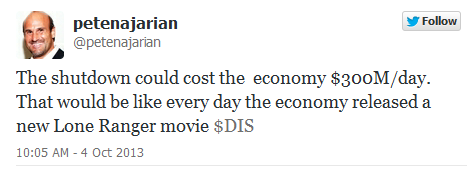
Pete Najarian put it in terms readily understandable, much more so than when some tried expressing the cost of a shutdown in terms of drag on quarterly GDP.

Of course, the real challenge awaits as we once again are faced with the prospect of having insufficient cash to pay debts and obligations. But for what it’s worth at least the rest of the world gets a much needed laugh and boost in national ego, while McGraw Hill Financial (MHFI) and others ponder the price of their calling it as they see it.

At the moment, that’s probably not what the economy needs, but in the perverse world we live in that may mean continued Federal Reserve intervention in Quantitative Easing. While “handouts” are decried by many who don’t see a detriment to a government shutdown, the Federal Reserve handout is one that they are inclined to accept, as long as it helps to fuel the markets.

However, as we are ready to enter into another earnings season this week many are mindful of the fairly lackluster previous earnings season that just ended. While the markets have recently been riding a wave of unexpected good news, such as no US intervention in Syria, continued Quantitative Easing and the disappearance of Lawrence Summers from the landscape, we are ripe for disappointment. We were spared any potential disappointment on Friday morning as the release of the monthly Employment Situation Report fell victim to someone being furloughed.

So what would be more appropriate than to re-introduce the concept of stock fundamentals, such as earnings, into the equation? During this past summer, when our elected officials were on vacation, that’s pretty much where we focused our attention as the world and the nation were largely quiet places. While no one is particularly effusive about what the current stream of reports will offer, a market that truly discounts the future already has its eyes set on the following earnings season that may begin to bear the brunt of any trickle down from a prolonged government shutdown.

At the moment, sitting on cash reserves, I am willing to recycle funds from shares that have been assigned this Friday (October 4, 2013), but am not willing to dip further into the pile until seeing some evidence of a bottoming to the current process that had the S&P 500 drop 2.7% since September 19, 2013 until Friday’s nice showing pared the loss down to 2%. But I need more evidence than a tepid one day respite, just as it will take more than a resolution to the current congressional impasse to believe that we wouldn’t be better served by an unelected algorithm.

As usual, the week’s potential stock selections are classified as being in Traditional, Double Dip Dividend, Momentum and “PEE” categories this week (see details).

I’m certain many people miss the days when a purchase of shares in Apple (AAPL) was a sure thing. While I like profits as much as the next person, I also enjoy the hunt and from that perspective I think that Apple shares are far more interesting now as we just passed the one year anniversary of having reached its peak price and tax related selling capitalizing on the loss will likely slow. Suddenly it’s becoming like many other stocks and financial engineering is beginning to play a role in attempts to enhance shareholder value.

Without passing judgment on the merits of the role of activist investors it doesn’t hurt to have additional factors that can support share price, particularly at times that the market itself may be facing weakness. Apple has increasingly been providing opportunities for short term gains as its price undulates with the tide that now includes more than just sales statistics and product releases. Capital gains or shares, an attractive dividend and generous option premiums make its ownership easier to consider at current prices. However, with earnings scheduled to be reported on October 22, 2013 I would likely focus on the sale of weekly option contracts as Apple is prone to large earnings related moves.

While Apple has done a reasonable job in price recovery over the past few months amid questions regarding whether its products were still as fashionable as they had been, Abercrombie and Fitch (ANF) hasn’t yet made that recovery from its most recent earnings report that saw a more than 20% price drop. As far as I know, and I don’t get out very much, talks of it no longer being the “cool” place to buy clothes aren’t the first item on people’s conversational agenda. The risk associated with ownership is always present but is subdued when earnings reports are still off in the distance, as they are currently. In the meantime,
Abercrombie and Fitch always offers option premiums that help to reduce the stress associated with share ownership.

Ironically, the health care sector hasn’t be treating me terribly well of late, perhaps being whipsawed by the fighting on Capitol Hill over the Affordable Care Act and proposed taxes on medical devices. Additionally, a government shutdown conceivably slows the process whereby regulated products can be brought to the market. Abbott Labs (ABT), whose shares were recently assigned at $35 has subsequently dropped about 5% and will be going ex-dividend this week. Although the dividend isn’t quite as rich as some of the other major pharmaceutical companies after having completed a spin-off earlier in the year, I think the selling is done and overdone.

For me, a purchase of MetLife (MET) is nothing more than replacing shares that were just assigned after Friday’s opportune price surge and that have otherwise been a reliable creator of income streams from dividends and option premiums. At the current price levels MetLife has been an ideal covered call stock having come down in price in response to fears that in a reduced interest rate environment its own earnings will be reduced.

International Paper (IP) is an example of a covered call strategy gone wrong, as the last time I owned it was about a year ago having had shares assigned just prior to its decision to go on a sustained rise higher. While frequently cited by detractors as an argument against a covered option strategy, the reality is that such events don’t happen terribly often, nor does the investor have to eschew greed as share price is escalating or exercise perfect timing. to secure profits before they evaporate. I’ve waited quite a while for its share price to drop, but it is still far from where I last owned them. Still, the current price drop helps to restore the appeal.

Being levered to China or even being perceived as levered to the Chinese economy can either be an asset or a liability, depending on what questionable data is making the rounds at any given moment. Joy Global (JOY) is one of those companies that is heavily levered to China, but even when the macroeconomic news seems to be adverse the shares are still able to maintain itself within a comfortably defined trading range. With Friday’s strong close my shares were assigned, but I would like to re-establish a position, particularly at a price point below $52.50. If it stays true to form it will find that level sooner rather than later making it once again an appealing purchase target and source of option related income.

With the start of a new earnings season one stock that I’ve been longing to own again starts out the season. YUM Brands (YUM) is an always interesting stock to own due to how responsive it is to any news or rumors coming from China. Over the past year it’s been incredibly resilient to a wide range of reports that you would think were being released in an effort to conspire against share price. Food safety issues, poor drink selection during heat waves and Chinese economic slow down have all failed to keep the share price down. While the current price is near the top of its range I think that expectations have been set on the low side. In addition to reporting earnings this week shares also go ex-dividend the following day.

A little less exciting, certainly as compared to Abercrombie and Fitch is The Gap (GPS). In a universe of retailers going through violent price swings, The Gap has been an oasis of calm. It goes ex-dividend this week and if it can maintain that tight trading channel it would be an ideal purchase as part of a covered call strategy.

While The Gap isn’t terribly exciting, Molson Coors (TAP) and Williams Co. (WMB) are even less so. While I usually start thinking about either of them in the period preceding a dividend payment they have each found a price level that has offered some stability, thereby providing some additional appeal in the process that includes sale of near the money calls.

Finally, I have a little bit of a love-hate relationship with Mosaic (MOS). The hate part is only recent as shares that I’ve owned since May 2013 have fallen victim to the collapse of the potash cartel. In a “what have you done for me lately” kind of mentality that kind of performance makes me forget how profitable Mosaic had been as a covered call holding for about 5 years. However, the recent “love” part of the equation has come from the serial purchase of shares at these depressed levels and collecting premiums in alternation with their assignment. I have been following shares higher with such purchases as there is now some reason to believe that the cartel may not be left for dead.

Traditional Stocks: International Paper, Molson Coors, Williams Co.

Momentum Stocks: Apple, Joy Global, MetLife, Mosaic

Double Dip Dividend: Abbott Labs (ex-div 10/10), The Gap (ex-div 10/11), YUM Brands (ex-div 10/9)

Premiums Enhanced by Earnings: YUM Brands (10/8 PM)

Remember, these are just guidelines for the coming week. The above selections may become actionable, most often coupling a share purchase with call option sales or the sale of covered put contracts, in adj
ustment to and consideration of market movements. The overriding objective is to create a healthy income stream for the week with reduction of trading risk.

Double Dipping Demystified

I’ve had a number of people ask about the concept behind “Double Dip Dividends”

A good place to begin, is here.

In a nutshell some stocks have a little bit of a disconnect between the option premium and share price during the period of time that they’re going ex-dividend. What happens is that a portion of the dividend reduction in the share price is actually incorporated into the premium, when by all rights it really shouldn’t be. In effect the premium is enriched by an amount that partially offsets the reduction in share price as a result of paying the dividend.

People that refer to efficient pricing in markets conveniently overlook the particular advantages that can be had with regular dividend payments.

Note that I said “regular” dividends. The concept does not apply to special dividends that are greater than $0.125/share. In those cases the strike prices are adjusted downward to reflect the distribution of a special dividend, while such adjustment isn’t made in strike prices for regular dividends.

When stocks go ex-dividend there are some guidelines that can tell you whether your shares are likely to be assigned early if they are in the money as trading closes prior to going ex-dividend.

 How far in the money are the shares?

The further in the money after deducting the amount of the dividend, the more likely they will be assigned.

 How much time is still remaining on the contract?

The more time remaining the less likely you will see early assignment.


Obviously there are less clear cut combinations, such as being deeply in the money, but having lots of time remaining.

For example, a handful of people reported early assignment of all or some of their Cisco shares this morning which closed at $23.43 Monday evening and was paying a $0.17 dividend.

After deducting the dividend shares were still $0.26 in the money, although there was risk that shares could have traded lower today. On the other hand there were 4 days remaining on the contract.

Beyond those factors are individual considerations, such as how much the individual holding contracts paid for the contracts and whether that person could make more money by simply selling his contracts versus exercising the contract, collecting the dividend and then either selling or holding the underlying shares.

Let’s look at JP Morgan, which is trading ex-dividend tomorrow (October 2, 2013).

For those watching such things you may have noticed that in the final minute of trading on Tuesday, JPM shares went up $0.09 to end the day at $51.95. If you had sold the $51.50 option expiring on Friday, the critical share price would be $51.88, since the dividend was for $0.38.

Everything else being equal, you might see early assignments at JPM prices as low as $51.88.

But let’s dissect the situation further.

Since the October 4, 2013 $51.50 call option has been trading the lowest price anyone paid for it was $0.39, while the high price was $1.20

With shares closing at $51.96 on the day prior to going ex-dividend it’s price will be re-set $0.38 lower to $51.58 as trading opens on Wednesday October 2, 2013. That $0.38 decrease from Tuesday’s close to Wednesday’s opening in the pre-market represents the dividend.

Currently, the $51.50 option bid at Tuesday’s close  is $0.47, which means that there is only $0.01 of time value, as the remainder is intrinsic value, as shares closed $0.46 in the money

Remember, just yesterday we sold calls at $0.52 when shares were trading at $51.65 ($0.15 intrinsic value, $0.37 time value). A portion of that time value was due to the dividend of $0.38, however at a share price of $51.65 no rational person would exercise early to get the dividend and end up holding shares the following morning priced at $51.27 that he had to pay $51.50 to obtain and also paid a premium to purchase the options.

So from an option holder’s perspective when would it make sense to exercise the option early?

Assuming you can sell the shares for $51.58 tomorrow morning that represents an $0.08 profit from the $51.50 strike price that they paid when exercising. Add to that the $0.38 dividend to get a total of $0.46 profit.

But the lowest anyone paid for the right to do any of this was the $0.39 option premium meaning that there would be a potential for only $0.07 profit for those that timed it just perfectly.

But that profit margin, available only to some of those having bought options assumes that shares will open at least at $51.58 or higher. What the person considering the early exercise thinks about is also what is the chance that once I take hold of shares it will go down in value before I have a chance to sell the shares? Is it worth the $0.07 profit or even less?

The closer the opening price will be to the strike pr
ice the greater is that likelihood, which means taking a loss on the shares in which they just took ownership. On top of that is the cost incurred in having to purchase shares. Remember that option buyers typically  find great appeal in leveraging their investment, perhaps by 10 times or more. They don’t get much delight in buying stocks, even if only for minutes, if it means introducing portfolio risk and only getting 2x leverage.

So while JP Morgan essentially closed $0.08 in the money that makes it a risk factor for early assignment.

But there are still 3 days left on the contract. That argues against assignment.

After that it becomes luck of the draw. How much did your contract holder pay for his contracts? Anyone who paid  more than $0.46 for their options would have been better off closing their position by selling the contract for $0.47 than to exercise early.

The likelihood is that there are more options holders who purchased their options at prices greater than the low point of $0.39, so the number of individuals in a position to rationally act and exercise early would be relatively small.

My expectation is that most people will not be subject to early assignment, but I did find the last minute surge in share price very curious and made me wonder whether it was related to the ex-dividend date.

Occasionally you will also see early assignments that are completely irrational and less occasionally not see early assignments when they would have been completely rational. You can be certain that those were always products of an individual investor. While one is maddening, the other can be a nice surprise..

For those wondering about Cisco, the lowest price paid for the October 4, 2013 $23 options was $0.20. If selling shares at $23.26 that would have represented possibly a $0.26 profit (if shares didn’t head lower), plus $0.17 dividend, minus $0.20 option premium paid yielding a potential $0.23 profit per share. Of course the high price paid for option contracts was $1.18. For those paying anything more than $0.43 for their options they would have been better off simply trading out of their position and closing their option rather than trying to capture the dividend and assume the risk of ownership.

While having early assignment can sometimes be frustrating, especially when there is a last day surge in share price, as occurred with Dow Chemical last week, when able to capture both the dividend and a premium enhanced by the pricing inefficiency it is a thing of beauty.


Wednesday Morning Postscript:  The first thing I do on ex-dividend mornings is to check to see whether I still have all of my shares. In this case the JPM shares have stayed intact. For anyone who decided to exercise their options the pre-market is indicating a loss of $0.27 bringing shares to $51.31. Suddenly, the thin profit that a small portion of option buyers deciding to exercise thought they had last night has become a paper loss and they would find themselves regretting the decision to exercise for the sake of securing the dividend. Holding the security for a option buyer means that at least $2575 of his money is now tied up and possibly generating margin interest costs and is unable to be further leveraged in order to buy more option contracts.

Most rational contract holders would have considered that possibility very strongly before making the decision and would likely have opted to not exercise, as a result.

Weekend Update – September 29, 2013

“There’s always a calm before the storm” is a fairly well known saying that doesn’t always accurately define a sequence of events.

Are all storms preceded by a period of calm? Is calm always followed by a storm?

The predictive capability of a period of calm hasn’t necessarily been validated among meteorological circles.

Being a meteorologist, however, is very similar to being a stock analyst or a market technician. No one really expects you to get it right, because you get it wrong so often. Besides, you would have to be a fool to fully predicate your actions on their prognostications. Neither group tends to publicly sit down and review the signals that had them sending the wrong messages.

Other than that meteorologists often get their wardrobes provided at no cost, while market analysts often get unlimited supplies of antacids. Meteorologists, though often wrong, are still very often beloved by their audience. I’m not certain the same can be said for stock analysts.

This past week was a forgettable one in just about all aspects. It was a week of calm, at least as far as potentially market moving news tend to go. Yet even in the midst of a sea of calm, the market was down over 1% and was unable to hold the 1700 level on the S&P 500, bringing us back to a level last seen about 10 days ago, when all was sunny.

While meteorologists often look to macro events, such as “El Nino,” or even global warming, the macro events that may move our markets are many and varied, but none seem to have paid a call this week. In fact, even factors that in the past sent chills of fear and uncertainty into the hearts of investors, such as a government shutdown or impending default on US obligations, have thus far barely elicited a yawn.

The perfect storm of good news and absence of bad news has simply continued. Aalthough this week was one of relative calm it’s hard to not notice dark clouds on the horizon, most of which are preceded by the fear of “what if.” What if tapering begins? What if the government is shut down? What if there is a government default?

Maybe that’s why Goldman Sachs (GS) just recommended the use of portfolio protective puts and that sentiment was quickly echoed by many that had access to a microphone. Coming in advance of the beginning of the new earnings season it reminds us that the just completed earnings season had few reasons to believe that growth was the trend at hand.

Of course, one could also be of the opinion that with everyone rallying to secure their protective puts this could be the perfect time to prepare for another market move higher.

In an effort to hedge the hedge, I am continuing to keep my cash reserves at relatively high levels but am still confident that with each week there are reasonably attractive trades that have a degree of safety and can create current income streams to help offset any market weakness.

If there is calm ahead, I prefer to look for stocks this week that are somewhat boring and have been trading in a reasonably narrow range. That kind of calm is just the tonic for covered option strategies.

This week the potential stock selections are restricted to the “Traditional” category, as no appealing choices were found in the Double Dip Dividend, Momentum and “PEE” categories this week (see details).

On an otherwise bad day to end the week, Microsoft (MSFT) danced to its own drummer, as Steve Ballmer, the outgoing CEO performed one of his characteristic morale raising dances at what is likely to be the final annual company wide meeting at which he presides. Reportedly, the day’s bump in share price came as the rumor regarding Ford (F) CEO Alan Mulally made the rounds indicating that his interest in assuming the position at Microsoft was strengthening. While it seems difficult to understand the synergy it may simply be another example of the market’s appetite for an anti-Ballmer. But without regard to immediate stories regarding transition in leadership, Microsoft just continues to offer a good combination of option premiums and dividends at this level, as it further commits itself toward creating its own ecosystem, perhaps not with an eye on increasing marketshare, but rather on retaining the loyalty of customers who might otherwise feel the lure of the competition.

While it was a good day for Microsoft it wasn’t a very good day for Intel (INTC). While the past years have seen close correlation between the fortunes of Intel and Microsoft, they certainly diverged this week. Part of the reason was some concern regarding a delay in the start of “Intel TV,” a web based television service which was thought to be a remedy for its poorly diversified revenue sources. Intel has demonstrated some resilience in the $22.50 range and like Microsoft offers a good combination of option premiums and dividends.

I liked Dow Chemical (DOW) enough to buy it last week in the hopes of capturing its dividend and option premium. However, a late afternoon spike in its share price right before going ex-dividend resulted in early assignment of shares. Following Friday’s sharp price decline, it”s right back to where it started. Still attractive, but without the dividend. It stands in sharp distinction to many of the companies that I’ve been considering over the past two months in that it s current share price is higher than where it stood at a recent market top on May 21, 2013 when the market reacted to FOMC minutes and a Ben Bernanke press conference by embarking on a quick 4% decline.

While I liked Deere (DE) last week and almost always find myself liking it, I didn’t purchase shares last week in an attempt to capture the dividend. Sometimes, especially for stocks above $50 the nearest strike prices are too far away from the current share price to offer a premium that offers sufficient reward for the risk undertaken. That was the case last week. However, if the lower prices to close the week hold at the open of this week and remain near the strike, I think the timing may be just right to add shares of Deere.

As far as boring stocks go, Mondelez (MDLZ) is boring in everything other than its name. Even Nelson Peltz’s self-serving attempts to move share price by discussing why he believed it was an ideal take-over target for Pepsi (PEP) did nothing to stir share price in any meaningful or sustained way. That kind of price stability is ideally suited for a covered option strategy.

Retail has been a difficult sector recently, especially teen retail. However, just as Mondelez can make boring become interesting, so too can The Gap (GPS) make boredom the new chique. Well down from a brief earnings fueled rise, shares appear to have support at the $40 level and won’t face the challenge of earnings until mid-way through the November 2013 option cycle. In the interim, it also goes ex-dividend during the October 2013 cycle.

Following its recent earnings related drop Darden Restaurants (DRI) is trading at a much more appealing level. From a covered option trader’s perspective the strike prices below the $50 level, graduated in single dollars is much more attractive and offers many more opportunities than the sparser ones available above $50. While Darden may also be a boring kind of pick it’s interest level is also enhanced by a very nice dividend that comes during the October cycle.

Finally, Barclays (BCS) may have qualified as a “Momentum” selection based on its recent price movements but once the dust settles it should start trading in a more sedate manner. In addition to various legal worries and the backdrop of lethargic European economies, Barclays recently announced the need to meet increased capital reserve requirements. Doing so through the issuance of stock is never a great way to see shares appreciate. However, the issuance of “rights” to existing shareholders entitling them to purchase shares at approximately a 40% discount helped to drive up share price

Traditional Stocks: Barclays, Deere, Darden, Dow Chemical, Intel, Microsoft, Mondelez, The Gap

Momentum Stocks: none

Double Dip Dividend: none

Premiums Enhanced by Earnings: none

Remember, these are just guidelines for the coming week. The above selections may be become actionable, most often coupling a share purchase with call option sales or the sale of covered put contracts, in adjustment to and consideration of market movements. The over-riding objective is to create a healthy income stream for the week with reduction of trading risk.


Weekend Update – September 22, 2013

Generally, when you hear the words “perfect storm,” you tend to think of an unfortunate alignment of events that brings along some tragedy. While any of the events could have created its own tragedy the collusion results in something of enormous scale.

For those that believe in the wisdom that can be garnered from the study of history, thus far September 2013 has been at variance with the conventional wisdom that tell us September is the least investor friendly month of the year.

What has thus far made this September different, particularly in contrast to our experience this past August, has been a perfect storm that hasn’t come.

Yet, but the winds are blowing.

Barely three weeks ago we were all resolved to another bout of military action, this time in Syria. History does tend to indicate that markets don’t like the period that leads up to hostilities.

Then we learned that the likely leading contender to assume the Chairmanship of the Federal Reserve, Larry Summers, withdrew his name from consideration of the position that has yet to confirm that its current Chairman will be stepping down. For some reason, the markets didn’t like prospects of Larry Summers being in charge but certainly liked prospects of his being taken out of the equation.

Then we were ready to finally bite the bullet and hear that the Federal Reserve was going to reduce their purchase of debt obligations. Although they never used the word “taper” to describe that, they have made clear that they don’t want their actions to be considered as “tightening,” although easing on Quantitative Easing seems like tightening to me.

There’s not too much guidance that we can get from history on how the markets would respond to a “taper,” but the general consensus has been that our market climb over the past few years has in large part been due to the largesse of the Federal Reserve. Cutting off that Trillion dollars each year might drive interest rates higher and result in less money being pumped into equity markets.

What we didn’t know until the FOMC announcement this past Wednesday was what the market reaction would be to any announcement. Was the wide expectation for the announcement of the taper already built into the market? What became clear was that the market clearly continues to place great value on Quantitative Easing and expressed that value immediately.

As long as we’re looking at good news our deficit is coming down fast, employment seems to be climbing, the Presidents of the United States and Iran have become pen pals and all is good in the world.

The perfect storm of good news.

The question arises as to whether any eventual bad news is going to be met with investors jumping ship en masse. But there is still one thing missing from the equation. One thing that could bring us back to the reality that’s been missing for so long.

Today we got a glimpse of what’s been missing. The accelerant, if you will. With summer now officially over, at least as far as our elected officials go, the destructive games have been renewed and it seems as if this is just a replay of last year.

Government shutdowns, debt defaults and add threats to cut off funding for healthcare initiatives and you have the makings of the perfect storm, the bad kind, especially if another domino falls.

Somewhat fortuitously for me, at least, the end of the September 2013 option cycle has brought many assignments and as a result has tipped the balance in favor of cash over open positions.

At the moment, I can’t think of a better place to be sitting as we enter into the next few weeks and may find ourselves coming to the realization that what has seemed to be too good to be true may have been true but could only last for so long.

While I will have much more cash going into the October 2013 cycle than is usually the case and while I’m fully expecting that accelerant to spoil the party, I still don’t believe that this is the time for a complete buying boycott. Even in the middle of a storm there can be an oasis of calm.

As usual, the week’s potential stock selections are classified as being in Traditional, Double Dip Dividend, Momentum and “PEE” categories this week (see details).

After Friday’s loss, I have a difficult time in not being attracted to the idea of adding shares of Caterpillar (CAT). It has been everyone’s favorite stock to deride for its dependence on the Chinese economy and for its lack of proactive leadership in the past year. Jim Chanos publicly proclaimed his love for Caterpillar as his great short thesis for the coming year. Since it has trailed the S&P 500 by 16% on a year to date basis there may be good reason to believe that money goes into Caterpillar shares to die.

However, it has been a perfect stock with which to apply a serial covered option strategy. In 13 trades beginning July 2012, for example, it has demonstrated a 44.9% ROI, by simply buying shares, collecting dividends and premiums and then either re-purchasing shares or adding to existing shares. In that same time the index was up 28%, while Caterpillar has lost 3%.

It’s near cousin Deere (DE) also suffered heavily in Friday’s market and has also been an excellent covered option trade over the past year. Enhancing its appeal this week is that it goes ex-dividend. I currently own shares, but like Caterpillar, in smaller number than usual and purchases would provide the additional benefit of averaging down cost, although I rarely combine lots and sell options based on average cost.

Also going ex
-dividend this week is Dow Chemical (DOW). This has been one of those companies that for years has been one of my favorite to own using the covered option strategy. However, unlike many others, it hasn’t shown much propensity to return to lower price levels after assignment. I don’t particularly like admitting that there are some shares that don’t seem to obey the general rule of gravity, but Dow Chemical has been one of those of late. I also don’t like chasing such stocks particularly in advance of what may be a declining market. However, with the recent introduction of weekly options for Dow Chemical I may be more willing to take a short term position.

YUM Brands (YUM) is similar in that regard to Dow Chemical. I’ve been waiting for it to come down to lower price levels, but just as it had at those lower levels, it proved very resilient to any news that would send its shares downward for a sustained period. As with Caterpillar, YUM Brands is tethered to Chinese news, but even more so, as in addition to economic reports and it’s own metrics, it has to deal with health scares and various food safety issues that may have little to no direct relationship to the company. YUM Brands does help to kick off the next earnings season October 8th and also goes ex-dividend that same week.

Continuing along with that theme, UnitedHealth Group (UNH) just hasn’t returned to those levels at which I last owned shares. In fact, in this case it’s embarrassing just how far its shares have come and stayed. What I can say is that if membership in the Dow Jones Index was responsible, then perhaps I should have spent more time considering its new entrants. However, with the Affordable Care Act as backdrop and now it being held hostage by Congressional Republicans, shares have fallen about 6% in the past week.

Mosaic (MOS) is among the companies that saw its share price plummet upon news that the potash cartel was collapsing. Having owned much more expensive shares at that time, I purchased additional shares at the much lower level in the hope that their serial assignment or option premium generation would offset some of the paper losses on the older shares. Although that has been successful, I think there is continuing opportunity, even as Mosaic’s price slowly climbs as the cartel’s break-up may not be as likely as originally believed.

If you had just been dropped onto this planet and had never heard of Microsoft (MSFT) you might be excused for believing this it was a momentum kind of stock. Between the price bounces that came upon the announcement of the Nokia (NOK) purchase, CEO Ballmer’s retirement, Analyst’s Day and the announcement of a substantial dividend increase, it has gyrated with the best of them. Those kinds of gyrations, while staying within a nicely defined trading range are ideal for a covered option strategy.

Cypress Semiconductor (CY) goes ex-dividend this week. This is a stock that I frequently want to purchase but am most likely to do so when its purchase price is near a strike level. That’s especially true as volatility is low and there is less advantage toward the use of in the money options. With a nice dividend, healthy option premiums, good leadership and product ubiquity, this stock has traded reliably in the $10-12 range to also make it a very good covered option strategy stock selection.

Every week I feel a need to have something a little controversial, as long as there’s a reasonable chance of generating profit. The challenge is always in finding a balance to the risk and reward. This week, I was going to again include Cliffs Natural Resources, as I did the previous week, however a late plunge in share price, likely associated with reports that CHinese economic growth was not going to include industrial and construction related growth, led to the need to rollover those shares. I would have been happy to repurchase shares, but not quite as happy to add them.

Fortunately, there’s always JC Penney (JCP). It announced on Friday that it was seeking a new credit line, just as real estate concern Vornado (VNO) announced its sale of all its JC Penney stake at $13. Of course the real risk is in the company being unable to get the line it needs. While it does reportedly have nearly $2 billion in cash, no one wants to see starkly stocked shelves heading into the holidays. WHether through covered options or the sale of put options, JC Penney has enough uncertainty built into its future that the premium is enticing if you can accept the uncertainty and the accompanying risk.

Finally, I had shares of MetLife (MET) assigned this past week as it was among a handful of stocks that immediately suffered from the announcement that there would be no near term implementation of the “taper.” The thesis, probably a sound one was that with interest rates not likely to increase at the moment, insurance companies would likely derive less investment related income as the differential between what they earn and what they pay out wouldn’t be increasing.

As that component of the prefect storm is removed one would have to believe that among the beneficiaries would be MetLife.

Traditional Stocks: Caterpillar, MetLife, Microsoft, UnitedHealth Group

Momentum Stocks
: JC Penney, Mosaic, YUM Brands

Double Dip Dividend: Cypress Semiconductor (ex-div 9/24), Deere (ex-div 9/26), Dow Chemical (ex-div 9/26)

Premiums Enhanced by Earnings: none

Remember, these are just guidelines for the coming week. The above selections may be become actionable, most often coupling a share purchase with call option sales or the sale of covered put contracts, in adjustment to and consideration of market movements. The over-riding objective is to create a healthy income stream for the week with reduction of trading risk.