

Weekend Update – August 18, 2013

I believe, although I could be mistaken, that an original version of the Bible suggested that “an octogenarian shall lead them.”

Last week I was wondering where the next catalyst was going to come from.

After a couple of years of headline grabbing events and man made disasters such as “Fiscal Cliff” and “Sequestration,” it was actually good to have a summer off. We didn’t even have the obligatory Greek banking crisis this August. The downside, of course, is that there’s nothing to react toward. Instead, stocks have had to trade on such fundamentals and basics as valuation and earnings. As with many traditions, there are fewer and fewer people who can remember the origins of such things.

If you can remember back almost a year, Apple (AAPL) was just hitting $700/share and it was the reason you could have discounted the other 499 stocks that comprised the S&P 500. As went Apple, so went the health of the overall market.

It was a simpler time.

Things have changed, but then came news that Carl Icahn had put together a “large” Apple position. Then came word the Leon Cooperman, Chairman of Omega Advisors, was equally ebullient about Apple.

Its shares immediately shot up an immediate $22 upon a simple Icahn Tweet. The “Cooperman Bump” was good for another 2%, but he’s much younger.

Wonderful. We needed market leadership and Apple was ready to take the reigns once again thanks to a couple of guys who have a combined 147 years between them. Can George Soros be far behind? Based on what his ownership had done for JC Penney (JCP) shares before he curiously added 2 million shares during the course of his divorce from a much younger Bill Ackman, you would probably prefer that he kept his distance if you were long Apple shares.

As it turns You can’t predicate an entire market on the basis of a nearly octogenarian investor’s lust for overseas cash piles. While Apple piled up even more cash reserves, it also added on to its share value while the market had a recently rare triple digit move downward and just came off its worst week in 2013.

That wasn’t supposed to happen. He was supposed to lead us to a better place where we know only of profits, dividends and buybacks. A place where we are always renewed and bathed in truth.

For me the market starts anew every week as I scan to see what positions have been assigned due to the sale of call options. As occasionally happens when a monthly cycle ends my world is essentially recreated, but you never know where the truth lies. What I do know is that far fewer of my positions were assigned this week than I had expected, even with the gift of Icahn.

With continually competing voices citing reasons we go higher matched off with equally compelling reasons we go lower, the standoff is as old as that between good and evil, but suddenly evil is looking stronger.

While it may seem inviting to have an octogenarian activist lead the way, the greatest likelihood is that such a shepherd has his own interests more at heart than that of his willing flock.

As usual, the week’s potential stock selections are classified as being in Traditional, Double Dip Dividend, Momentum and “PEE” selections this week (see details).

While my preference ordinarily is to focus on selling weekly options, given some uncertainty last week, I may look to sell more monthly contracts as a defensive measure in the event of a short term downturn.

In the past year the astute have noted that “as goes Google (GOOG), so does Apple not follow,” as the prevailing thesis was that it was not possible to be invested in them concurrently. While recent attention has deservedly shifted to Apple as it’s price moved higher on news of a new iPhone and then Icahn’s position, so too has attention shifted away from Google.

I haven’t owned shares of Google in more than a year and even though it has advanced steadily since then, its recent 6% decline is enough to get me interested once again. With the next lower support level nearly $100 away the risk may be greater than the underlying “beta” might suggest, but perhaps at any sign of Apple infatuation cooling we all know where the money has to be going.

If you have the stomach for such things JC Penney reports earnings this week. I own shares, including some bought just this week and subsequently assigned. However, had you asked me a few weeks ago, I would have believed that JC Penney comparative quarter results were going to be very positive. But once the high profile dissension from Bill Ackman, calling for a speedy appointment of a permanent CEO became known and that short term melodrama played itself out, my opinion changed considerably. It would seem unlikely that such internal controversy would arise before a surprisingly good earnings report.

However, for the adventurous selling puts expiring August 23, 2013 can return an 1.3% ROI and leave you without the need to own shares if a post-earnings related drop ends up being less than 25% The options market is anticipating a 17.5% decline.

Among the walking wounded this week was Macys (M). I’ve been waiting a long time for an opportunity to own shares again, although those opportunities usually come when bad news is at hand. In this instance it was the same as had wounded numerous others this earnings season. With no other distractions during a quiet late summer people actually pay attention to such mundane things as earnings and guidance. In this case, they didn’t like what they heard, but that has by and large been the lot of retailers of late. Under the leadership of Terry Lundgren you do have to believe that if any retailer will be able to pull out from underneath the doldrums, it will be Macys.

Another of my favorite retailers, especially coming off price weakness, like most everything this past week, is Coach (COH). However, as with many of the stocks in this week’s listing, the challenge is whether what appears to be value pricing is instead, a value trap, as an overall declining market takes the good along with the bad lower. With an almost 14% drop since its earnings, Coach has had a head start on any
general decline which gives me some solace if investing new funds.

Following Cisco’s (CSCO) disappointing earnings report, which may have added fuel to the market’s weakness, the technology sector didn’t fare terribly well. John Chambers, the CEO has alternated from genius to out of touch and back to genius in the span of just a few years, but may now be returning to the “out of touch” category in the eyes of some.

However, for me, he evoked an image of Hoard Schultz, chairman of Starbucks (SBUX), who a number of quarters ago following a brutal reaction to a disappointing earnings report, provided one of the most ardent defenses of his company and why the reaction was so wrong. If you had faith in Schultz, you were well rewarded. I think Chambers offered a similar post-earnings response and despite te immediate concerns there is reason for following his zeal.

Oracle (ORCL) on the other hand, may offer a better return, based upon the option premiums which may reflect an earnings report near the end of the September 2013 option cycle. It’s often difficult to distinguish its CEO, Larry Ellison, from its product, but he was in the news this week with sometimes less than flattering comments about Apple and Google. The last times Oracle disappointed with its earnings reports Ellison didn’t follow the Schultz lead and instead, pointed fingers. WHile I may be looking for more monthly options during this week’s trading activity, an Oracle trade may be an exception.

Among the vanquished last week was Seagate Technology (STX). It’s 27% decline, however started in mid-July. I owned shares the previous week and they were assigned. Seagate is another position that I would strongly consider as a candidate for weekly option sales, particularly if using deep in the money strikes.

McGraw Hill FInancial (MHFI) goes ex-dividend this week and has been on a nice ride ever since the initial reaction to news that their role in the financial meltdown was to be investigated. In fact, it recently surpassed that point from which it fell off the cliff upon the news. Normally that would be a warning signal for me, however, shares have recently scaled back 5%. I think that McGraw Hill was unduly punished by the market and still, in fact, has catching up to do, despite its great run since February 2013, when there was a near immediate realization that the reaction was well overdone.

I’m a little ambivalent about adding additional shares of Transocean (RIG to my two existing lots. Just a few days earlier I felt reasonably assured that the $47 lot would be assigned. At that time I was already thinking of re-purchasing shares in order to capture the upcoming dividend. Also in the Icahn stable of companies in his radar scope, Transocean hasn’t fared quite as well as others, and has not yet increased its dividend as Icahn suggested, although its change has come to its executive offices. Together with Halliburton (HAL) and British Petroleum (BP), Transocean is one of the “Evil Troika” that consistently offers a good place to park money owing to its narrow trading range, option premiums and dividend payout.

Finally, although Mosaic (MOS) has appeared in each of the past two weekly articles, its selection never gets old as long as it keeps doing what it has so reliably done ever since news of the dismantling of the potash cartel became known. In this case, what it has done after suffering a 20% plunge is to slowly begin raising the bar higher as questions arise regarding the ability of the cartel to stay asunder. For the past three weeks I’ve erased substantial paper losses by adding shares and selling in the money calls whose premiums are enhanced by fear and uncertainty of what tomorrow will bring. The pattern that Mosaic has been taking is essentially two steps forward and one step back and that is just perfect for executing a serial covered call strategy that hopefully follows shares back

Traditional Stocks: Cisco, Google, Macys, Oracle

Momentum Stocks: Coach, Mosaic, Seagate Technology

Double Dip Dividend: McGraw Hill FInancial (ex-div 8/22 $0.28), Transocean (ex-div 8/21 $0.56)

Premiums Enhanced by Earnings: JC Penney (8/20 AM)

Remember, these are just guidelines for the coming week. The above selections may be become actionable, most often coupling a share purchase with call option sales or the sale of covered put contracts, in adjustment to and consideration of market movements. The over-riding objective is to create a healthy income stream for the week with reduction of trading risk.
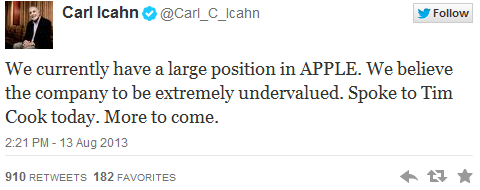
 

Carl Icahn Spells the End of an Era at Apple

This afternoon came news via a simple 140 space statement that Carl Icahn currently had “a large position” in Apple (AAPL).

By all accounts his discussion with CEO Tim Cook were cordial. Icahn himself, in another 140 space blast referred to it as “nice,” and he anticipated speaking to Cook again shortly.

I currently own Apple shares that somewhat surprisingly weren’t assigned away from me last week in an effort to grab the dividend. Considering that shares were trading at about $465 prior to the ex-dividend and the strike price sold was $450, my expectation had been that assignment was a certainty. Especially since option premiums were no longer showing any time premium with such a deep in the money option.

But as many know when it comes to Apple stock, rational thought isn’t always a hallmark of ownership.

I still think back to a comment made to an earlier Seeking Alpha article I had written in May 2012, when Apple was trading at about $575

“I guess it’s hard to not have a certain bias towards a company that has turned $30,000 of your dollars into $600,000 and may if things go right turn it into a $1,000,000.”

I always wondered whether that individual had taken interim profits or whether subsequent to May 2012 had secured some profits as Apple dropped some 200 points. The fact that its author was a CPA wasn’t lost upon me.

At the time, I thought that an investing strategy of hoping to turn $30,000 into $1,000,000 was irrational, just as turning $600,000 into $1,00,00 was irrational.

What was abundantly clear, as I took a cynical view of Apple shares in repeated articles when analysts were calling for a $1,000 stock price was that emotion was at work among many investors. Part of the emotion was the fervent belief that Apple could only keep innovating and would always be an aspirational product with great margins.

However, one refrain that repeatedly was played was that Apple shares were destined to go much higher, based on an absurdly low price to earnings ratio.

The contention was that one the market starting placing a value on Apple shares more consistent with other technology stocks, Apple would soar far above its current level.

Of course, the seemingly rational analysis dismissed the fact that the market may in fact, have been rational in giving Apple a P/E in the 12 range, just like any well regarded retailer.

A retailer? Apple is a retailer and not a technology company? Granted, it is no longer “Apple Computer,” but why should Apple be considered anything but a technology company?

That’s where Carl Icahn comes in.

Despite his recent foray into Dell Computer (DELL), his history as an activist shareholder has not included many companies in the technology arena.

Icahn refers to Apple as being “undervalued” but he isn’t looking at a low P/E to buttress his opinion. He is looking at a continuing large cash position that he envisions as a means of expanding the already large share buyback, that to many has already been the source of Apple strength going from its near term lows to $450.

This is not a case of finding fault with leadership, this is not a case of someone seeking to prevent shareholders from being robbed blind in an insider buyout deal. Apple is very different from Dell in so many ways.

This is all about leveraging cash, without regard to product pipeline and without regard to product margins. This isn’t about cutting expenses or changing direction. It is as pure as you can get – it is about cash.

Icahn cares nothing about this company other than for the cash it holds. Cash which is unleveraged isn’t worth very much to him or anyone else. It certainly adds nothing to a company’s P/E.

Icahn cares nothing about this company other than for the cash it holds. Cash which is unleveraged isn’t worth very much to him or anyone else. It certainly adds nothing to a company’s P/E. It’s time to face the fact that the stock market has been entirely rational in assigning Apple the P/E it has for these past years. It was not going to ever be considered a technology company again. It is a retailer with a narrow range of products which are bought at the whims of a fickle consumer.

While not terribly different from David Einhorn’s earlier attempt to wiggle cash out of the Apple coffers, Icahn is relentless and scrappy. What starts as perhaps a nice discussion can quickly go elsewhere.

While there is a quick pop in Apple shares in the aftermath of the announcement and while I anticipate shares to move even higher, this is the end for the Apple that you knew and loved. It wasn’t the death of Steve Jobs, but rather the indirect impact of his absence that spells the end, as Apple becomes like so many other companies simply nothing more than a vessel for someone that will have as limited interest as a pedestrian day trader.

While I’ve believed that Apple was an eminently good trading stock once in went down below the $450 level in February 2013, I think that in the very near term its suitability as a trade is even further enhanced, despite the large move higher this afternoon.

In fact, in the case of Apple, I would even co
nsider the rare decision to purchase shares without immediate and concomitant sale of call options.

As long as Carl Icahn is on your side, you may as well consider him in the same vein as those who warn that you should “never fight the Fed,”  even if you believe Apple is too large for even Carl Icahn to take on. That’s because this is now also a new era of cooperative behavior (against Bill Ackman, at least), where the big boys are capable of joining forces these days and will do so like vultures when there’s cash to be had.

The only caveat is that it’s not likely that you’ll enjoy dreams of turning $30,000 into a $1,000,00 and so I would be all for taking profits wherever they present themselves.


Week in Review (August 5 – 9, 2013 Reprint)


Option to Profit Week in ReviewAugust 5 – 9, 2013 
NEW POSITIONS/STO NEW STO ROLLOVERS CALLS ASSIGNED/PUTS EXPIRED CALLS EXPIRED/PUTS ASSIGNED CLOSED
7 / 8 1 3 4 / 1 0 / 0 0


Weekly Up to Date Performance

August 5 – 9, 2013

For the week, new purchases returned to its usual ways and well exceeded the time adjusted S&P 500 in a week that the market had a negative tone, but still showed great resilience.

New positions beat the adjusted index by 2.7%, and also bested the unadjusted index by  an even larger 3.1%.  But just as I used JC Penney as an excuse last week for trailing the overall market, this week’s results are skewed by having used a number of September 17, 2013 option contracts. That actually added almost 1% to the results.

Adjusting for time, to a standard weekly observation period the week’s new positions beat the adjusted S&P 500 by 1.7% and the unadjusted index by 2.1%.

The market showed an adjusted loss of  0.6% for the week, while the unadjusted S&P 500 lost 1.1%.  New purchases gained 2.1% for the week, well above the threshold, even when adjusting for extended options.

For positions opened in 2013 and subsequently closed, performance exceeded that of the S&P 500 by 0.5%. They are up 2.7% out-performing the market by 20.6%.

Well, this week was more like it, although I’m still upset about JC Penney, particularly the silence this past week regarding its vendor’s lending facility remains unanswered. Besides that, the soap opera was amusing and at least offered a brief window to sell some call options as Bill Ackman helped to temporarily raise share price by being Bill Ackman. Of course that only lasted about a day as shares went down because Bill Ackman acted like Bill Ackman.

Additionally, it was a week where we may have gotten a message that things aren’t as dour in China as we have believed. For me, that would be wonderful, because much of my 2013 thesis was based on better than expected outcomes from China. So far, that hasn’t been a good call, but I remain patient (and stubborn).

But otherwise, this was a week that demonstrates why a weak or declining market may have value and benefit that if alternating with an advancing market can create returns well in excess of the apparent net.

For much of 2013 that hasn’t been the case as alternating markets just haven’t been the norm as they usually are.

Every now and then when I need confirmation that sometimes the sum of the parts is far greater than the whole I look at historical returns and remind myself that a stock doesn’t have to move anywhere in order to be a profit generating machine.

Lately I’ve been looking for confirmation with great regularity.

As much as it’s convenient to try and read into this week’s weak performance, it’s probably not a good idea to do so.

With the August 2013 option cycle expiring next Friday, I’m simply hopeful that the market will maintain enough integrity to see many positions assigned.

That was also my hope at the end of June, but the Federal Reserve got in the way and prices dropped just in time to help reduce the number of assignments, so I’m not counting on anything.

Since I’m not reading much into the lack of strength this week, I still plan to follow the same pattern as with the past two months, looking to reduce cash from about 40% to 25% over the course of the week.

The question and where I’ve been varying the approach recently is deciding between weekly or monthly contracts when both are available.

I do want to have weekly contracts in the mix because they form the basis for cash flow necessary to both replenish cash reserves and fund new investments,  if they’re assigned.

Now, the really big news is that next week’s first new position will be the 500th since expanding the service from being shared among only a small group of insiders to opening it up to outside subscribers 15 months ago.

Thank you for making it possible and providing reason to continue an implausible venture

Initially intended to provide a basis for subscribers to “graduate” after a few months, and the Informational web site continues to list that as the objective, a large core of subscribers have been here for all 499 trades.

That level of trust and confidence, together with the comments I receive are incredibly gratifying (as are the subscription fees).

Thank you. Looking forward to the next 500.


This week’s details may be seen in the Weekly Performance spreadsheet * or in the PDF file, as well as as in the summary.below

(Note: Duplicate mention of positions reflects different priced lots):


New Positions Opened:  ANF, GMCR (puts), FL, LO, MOS, MRO, PSX, WNR

Puts Closed in order to take profits:  none

Calls Rolled over, taking profits, into the next weekly cycle:  CAT

Calls Rolled over, taking profits, into extended weekly cycle: none

Calls Rolled over, taking profits, into the monthly cycle:  WNR, X

Calls Rolled Over, taking profits, into a future monthly cycle:  none

Calls Rolled Up, taking net profits into same cyclenone

Put contracts sold and still open: none

Put contracts expired: GMCR

Long term call contracts sold:  none

Calls Assigned:  ANF, EBAY, MOS, STX

Calls Expired:  none

Puts Assigned:  none

Stock positions Closed to take profits:  none

Stock positions Closed to take losses: none

Calls Closed to Take Profits: none

Ex-dividend Positions:  AAPL (ex-div 8/8 $3.05), BP (ex-div 8/7 $0.54), INTC (ex-div 8/5 $0.22), STX (ex-div 8/25 $0.38)

Some did report early assignment of AAPL (which was expected), in addition to early assignment of INTC (which was not expected). The early assignment of INTC was a small minority, while the number reporting early assignment of AAPL was more sizable, but less than a majority of respondents.


For the coming week the existing positions have lots that still require the sale of contracts:   CLF,  DE, FCX,  INTC, JCP, MCP, MOS, PBR, SHLD, WLT, WY, X (See “Weekly Performance” spreadsheet or PDF file)


* If you don’t have a program to read or modify spreadsheets, you can download the OpenOffice Suite at no cost.


Weekend Update – August 11, 2013

I like to end each week taking a look at the upcoming week’s economic calendar just to have an idea of what kind of curveballs may come along. It’s a fairly low value added activity as once you know what is in store for the coming week the best you can do is guess about data releases and then further guess about market reactions.

Just like the professionals.

That’s an even less productive endeavor in August and this summer we don’t even have much in the way of extrinsic factors, such as a European banking crisis to keep us occupied in our guessing. In all, there have been very few catalysts and distractions of late, hearkening back to more simple times when basic rules actually ruled.

In the vacuum that is August you might believe that markets would be inclined to respond to good old fundamentals as histrionics takes a vacation. Traditionally, that would mean that earnings take center stage and that the reverse psychology kind of thinking that attempts to interpret good news as bad and bad news as good also takes a break.

Based upon this most recent earnings season it’s hard to say that the market has fully embraced traditional drivers, however. While analysts are mixed in their overall assessment of earnings and their quality, what is clear is that earnings don’t appear to be reflective of an improving economy, despite official economic data that may be suggesting that is our direction.

That, of course, might lead you to believe that discordant earnings would put price pressure on a market that has seemingly been defying gravity.

Other than a brief and shallow three day drop this week and a very quickly corrected drop in May, the market has been incredibly resistant to broadly interpreting earnings related news negatively, although individual stocks may bear the burden of disappointing earnings, especially after steep runs higher.

But who knows, maybe Friday’s sell off, which itself is counter to the typical Friday pattern of late is a return to rational thought processes.

Despite mounting pessimism in the wake of what was being treated as an unprecedented three days lower, the market was able to find catalysts, albeit of questionable veracity, on Thursday.

First, news of better than expected economic growth in China was just the thing to reverse course on the fourth day. For me, whose 2013 thesis was predicated on better than expected Chinese growth resulting from new political leadership’s need to placate an increasingly restive and entitled society, that kind of news was long overdue, but nowhere near enough to erase some punishing declines in the likes of Cliffs Natural Resources (CLF).

That catalyst lasted for all of an hour.

The real surprising catalyst at 11:56 AM was news that JC Penney (JCP) was on the verge of bringing legendary retail maven Allen Questrom back home at the urging of a newly vocal Bill Ackman. The market, which had gone negative and was sinking lower turned around coincident with that news. Bill Ackman helped to raise share price by being Bill Ackman.

Strange catalyst, but it is August, after all. In a world where sharks can fall out of the sky why couldn’t JC Penney exert its influence, especially as we’re told how volatile markets can be in a light volume environment? Of course that bump only lasted about a day as shares went down because Bill Ackman acted like Bill Ackman.The ensuing dysfunction evident on Friday and price reversal in shares was, perhaps coincidentally mirrored in the overall market, as there really was no other news to account for any movement of stature.

With earnings season nearly done and most high profile companies having reported, there’s very little ahead, just more light volume days. As a covered option investor if I could script a market my preference would actually be for precisely the kind of market we have recently been seeing. The lack of commitment in either direction or the meandering around a narrow range is absolutely ideal, especially utilizing short term contracts. That kind of market present throughout 2011 and for a large part of 2012 has largely been missing this year and sorely missed. Beyond that, a drop on Fridays makes bargains potentially available on Mondays when cash from assigned positions is available.

As usual, the week’s potential stock selections are classified as being in Traditional, Double Dip Dividend and Momentum, with no “PEE” selections this week. (see details).

For an extended period I’ve been attempting to select new positions that were soon to go ex-dividend as a means to increase income, offset lower option premiums and reduce risk, while waiting for a market decline that has never arrived.

This week, I’m more focused on the two selections that are going ex-dividend this coming week, but may have gotten away after large price rises on Thursday.

Both Cliffs Natural Resources and Microsoft (MSFT) were beneficiaries of Chinese related ne
ws. In Cliffs Natural’s case it was simply the perception that better economic news from China would translate into the need for iron ore. In Microsoft’s case is was the introduction of Microsoft Office 365 in China. Unfortunately, both stocks advanced mightily on the news, but any pullback prior to the ex-dividend dates would encourage me to add shares, even in highly volatile Cliffs, with which I have suffered since the dividend was slashed.

A bit more reliable in terms of dividend payments are Walgreens (WAG), Chevron (CVX) and Phillips 66 (PSX).

Although I do like Walgreens, I’ve only owned it infrequently. However, since beginning to offer weekly options I look more frequently to the possibility of adding shares. Despite being near its high, the prospect of a short term trade in a sector that has been middling over the past week, with a return amplified by a dividend payment, is appealing.

Despite being near the limit of the amount of exposure that I would ordinarily want in the Energy Sector, both Chevron and Phillips 66 offer good option premiums and dividends. The recent weakness in big oil makes me gravitate toward one of its members, Chevron, however, if forced to choose between just one to add to my portfolio, I prefer Phillips 66 due to its greater volatility and enhanced premiums. I currently own Phillips 66 shares but have them covered with September call contracts. In the event that I add shares I would likely elect weekly hedge contracts.

If there is some validity to the idea that the Chinese economy still has some life left in it, Joy Global (JOY), which is currently trading near the bottom of its range offers an opportunity to thrive along with the economy. Although the sector has been relatively battered compared to the overall market, option premiums and dividends have helped to close that gap and I believe that the sector is beginning to resemble a compressed spring. On a day when Deere (DE) received a downgrade and Caterpillar was unable to extend its gain from the previous day, Joy Global moved strongly higher on Friday in an otherwise weak market.

Oracle (ORCL) is one of the few remaining to have yet reported its earnings and there will be lots of anticipation and perhaps frayed nerves in advanced for next month’s report, which occurs the day prior to expiration of the September 2013 contract.

You probably don’t need the arrows in the graph above to know when those past two earnings reports occurred. Based Larry Ellison’s reaction and finger pointing the performance issues were unique to Oracle and one could reasonably expect that internal changes have been made and in place long enough to show their mark.

Fastenal (FAST) is just a great reflection of what is really going on in the economy, as it supplies all of those little things that go into big things. Without passing judgment on which direction the economy is heading, Fastenal has recently seemed to established a lower boundary on its trading range after having reported some disappointing earnings and guidance. Trading within a defined range makes it a very good candidate to consider for a covered option strategy

What’s a week without another concern about legal proceedings or an SEC investigation into the antics over at JP Morgan Chase (JPM)? While John Gotti may have been known as the “Teflon Don,” eventually after enough was thrown at him some things began to stick. I don’t know if the same fate will befall Jamie Dimon, but he has certainly had a well challenged Teflon shell. Certainly one never knows to what degree stock price will be adversely impacted, but I look at the most recent challenge as just an opportunity to purchase shares for short term ownership at a lower price than would have been available without any legal overhangs.

Morgan Stanley (MS), while trading near its multi-year high and said to have greater European exposure than other US banks, continues to move forward, periodically successfully testing its price support.

With any price weakness in JP Morgan or Morgan Stanley to open the week I would be inclined to add both, as I’ve been woefully under-invested in the Finance sector recently.

While retailers, especially teen retailers had a rough week last week, Footlocker (FL) has been a steady performer over the past year. A downgrade by Goldman Sachs (GS) on Friday was all the impetus I needed and actually purchased shares on Friday, jumping the gun a bit.

Using the lens of a covered option seller a narrow range can be far more rewarding than the typical swings seen among so many stocks that lead to evaporation of paper gains and too many instances of buying high and selling low. Some pricing pressure was placed on shares as its new CEO was rumored a potential candidate for the CEO at JC Penney. However, as that soap opera heats up, with the board re-affirming its support of their one time CEO and now interim CEO, I suspect that after still being in limbo over poaching Martha Stewart products, JC Penney will not likely further go where it’s unwelcome.

Finally, Mosaic (M
OS
) had a good week after having plunged the prior week, caught up in the news that the potash cartel was falling apart. Estimates that potash prices may fall by 25% caused an immediate price drop that offered opportunity as basically the fear generated was based on supposition and convenient disregard for existing contracts and the potential for more rationale explorations of self-interest that would best be found by keeping the cartel intact.

The price drop in Mosaic was reminiscent of that seen by McGraw Hill FInancial (MHFI) when it was announced that it was the target of government legal proceedings for its role in the housing crisis through its bond ratings. The drop was precipitous, but the climb back wonderfully steady.

I subsequently had Mosaic shares assigned in the past two weeks, but continue to hold far more expensively priced shares. I believe that the initial reaction was so over-blown that even with this past week’s move higher there is still more ahead, or at least some price stability, making covered options a good way to generate return and in my case help to whittle down paper losses on the older positions while awaiting some return to normalcy.

Traditional Stocks: Fastenal, Footlocker, JP Morgan, Morgan Stanley, Oracle

Momentum Stocks: Joy Global, Mosaic

Double Dip Dividend: Chevron (ex-div 8/15), Phillips 66 (ex-div 8/14), Walgreen (ex-div 8/16)

Premiums Enhanced by Earnings: none

Remember, these are just guidelines for the coming week. The above selections may be become actionable, most often coupling a share purchase with call option sales or the sale of covered put contracts, in adjustment to and consideration of market movements. The over-riding objective is to create a healthy income stream for the week with reduction of trading risk.



Weekend Update – August 4, 2013

To summarize: The New York Post rumors, “The Dark SIde” and the FOMC.

This was an interesting week.

It started with the always interesting CEO of Overstock.com (OSTK) congratulating Steve Cohen, the CEO of SAC Capital, on his SEC indictment and invoking a reference to Star Wars to describe Cohen’s darkness, at least in Patrick Byrne’s estimations.

It ended with The New York Post, a one time legitimate newspaper suggesting that JC Penney (JCP) had lost the support of CIT (CIT), the largest commercial lender in the apparel industry, which is lead by the charisma challenged past CEO of The NYSE (NYX) and Merrill Lynch, who reportedly knows credit risk as much as he knows outrageously expensive waiting room and office furniture.

The problem is that if CIT isn’t willing to float the money to vendors who supply JC Penney, their wares won’t find their way into stores. Consumers like their shopping trips to take place in stores that actually have merchandise.

At about 3:18 PM the carnage on JC Penney’s stock began, taking it from a gain for the day to a deep loss on very heavy volume, approximately triple that of most other days.

Lots of people lost lots of money as they fled for the doors in that 42 minute span, despite the recent stamp of approval that George Soros gave to JC Penney shares. His money may not have been smart enough in the face of yellow journalism fear induced selling.

The very next morning a JC Penney spokesperson called the New York Post article “untrue.” It would have helped if someone from CIT chimed in and set the record straight. While the volume following the denial was equally heavy, very little of the damage was undone. As an owner of shares, Thane’s charisma would have taken an incredible jump had he added clarity to the situation.

So someone is lying, but it’s very unlikely that there will ever be a price to be paid for having done so. Clearly, either the New York Post is correct or JC Penney is correct, but only the New York Post can hide behind journalistic license. In fact, it would be wholly irresponsible to accuse the article of promoting lies, rather it may have recklessly published unfounded rumors.

By the same token, if the JC Penney response misrepresents the reality and is the basis by which individuals chose not to liquidate holdings, the word “criminal” comes to my mind. I suppose that JC Penney could decide to create a “Prison within a Store” concept, if absolutely necessary, so that everyday activities aren’t interrupted.

For the conspiracy minded the publication of an article in a “reputable” newspaper in the final hour of trading, using the traditional “unnamed sources” is problematic and certainly invokes thoughts of the very short sellers demonized by Patrick Byrne in years past.

Oh, and in between was the release of the FOMC meeting minutes, which produced a big yawn, as was widely expected.

I certainly am not one to suggest that Patrick Byrne has been a fountain of rational thought, however, it does seem that the SEC could do a better job in allaying investor concerns about an unlevel playing field or attempts to manipulate markets. Equally important is a need to publicly address concerns that arise related to unusual trading activity in certain markets, particularly options, that seem to occur in advance of what would otherwise be unforeseen circumstances. Timing and magnitude may in and of themselves not indicate wrongdoing, but they may warrant acknowledgement for an investing public wary of the process. A jury victory against Fabrice Tourre for fraud is not the sort of thing that the public is really looking for to reinforce confidence in the process, as most have little to no direct interaction with Goldman Sachs (GS). They are far more concerned with mundane issues that seem to occur with frequency.

Perhaps the answer is not closer scrutiny and prosecution of more than just high profile individuals. Perhaps the answer is to let anyone say anything and on any medium, reserving the truth for earnings and other SEC mandated filings. Let the rumors flow wildly, let CEOs speak off the top of their heads even during “quiet periods” and let the investor beware. By still demanding truth in filings we would still be at least one step ahead of China.

My guess is that with a deluge of potential misinformation we will learn to simply block it all out of our own consciousness and ignore the need to have reflexive reaction due to fear or fear of missing out. In a world of rampantly flying rumors the appearance of an on-line New York Post article would likely not have out-sized impact.

Who knows, that might even prompt a return to the assessment of fundamentals and maybe even return us to a day when paradoxical thought processes no longer are used to interpret data, such that good news is actually finally interpreted as good news.

I conveniently left out the monthly Employment Situation Report that really ended the week, but as with ADP and the FOMC, expectations had already been set and reaction was muted when no surprises were in store. The real surprise was the lack of reaction to mildly disappointing numbers, perhaps indicating that we’re over the fear of the known.

As usual, the week’s potential stock selections are classified as being in Traditional, Double Dip Dividend, Momentum or “PEE” categories. (see details).

One of last week’s earnings related selections played true to form and dropped decidedly after earnings were released. Coach (COH) rarely disappoints in its ability to display significant moves in either direction after earnings and in this case, the disappointment was just shy of the $52.50 strike price at which I had sold weekly puts. However, with the week now done and at its new lower price, I think Coach represents a good entry point for new shares. With its newest competitor, at least in the hearts of stock investors, Michael Kors (KORS) reporting earnings this week there is a chance that Coach may drop if Kors reports better than expected numbers, as the expectation will be that it had done so at Coach’s expense. For that reason I might consider waiting until Tuesday morning before deciding whether to add Coach to the portfolio.

Although I currently own two higher priced lots of its shares, I purchased additional shares of Mosaic (MOS) after the plunge last week when perhaps the least known cartel in the world was poised for a break-up. While most people understand that the first rule of Cartel Club is that no one leaves Cartel Club, apparently that came as news to at least one member. The shares that I purchased last week were assigned, but I believe that there is still quite a bit near term upside at these depressed prices. While theories abound, such as decreased fertilizer prices will lead to more purchases of heavy machinery, I’ll stick to the belief that lower fertilizer prices will lead to greater fertilizer sales and more revenue than current models might suggest.

Barclays (BCS) is emblematic of what US banks went through a few years ago. The European continent is coming to grips with the realization that greater capitalization of its banking system is needed. Barclays got punished twice last week. First for suggesting that it might initiate a secondary offering to raise cash and then actually releasing the news of an offering far larger than most had expected. Those bits of bad news may be good news for those that missed the very recent run from these same levels to nearly $20. Shares will also pay a modest dividend during the August 2013 option cycle, but not enough to chase shares just for the dividend.

Royal Dutch Shell (RDS.A) released its earnings this past Thursday and the market found nothing to commend. On the other hand the price drop was appealing to me, as it’s not every day that you see a 5% price drop in a company of this caliber. For your troubles it is also likely to be ex-dividend during the August 2013 option cycle. While there is still perhaps 8% downside to meet its 2 year low, I don’t think that will be terribly likely in the near term. Big oil has a way of thriving, especially if we’re at the brink of economic expansion.

Safeway (SWY) recently announced the divestiture of its Canadian holdings. As it did so shares surged wildly in the after hours. I remember that because it was one of the stocks that I was planning to recommend for the coming week and then thought that it was a missed opportunity. However, by the time the market opened the next morning most of the gains evaporated and its shares remained a Double Dip Dividend selection. While its shares are a bit higher than where I most recently had been assigned it still appears to be a good value proposition.

Baxter International (BAX) recently beat earnings estimates but wasn’t shown too much love from investors for its efforts. I look at it as an opportunity to repurchase shares at a price lower than I would have expected, although still higher than the $70 at which my most recent shares were assigned. In this case, with a dividend due early in September, I might consider a September 17, 2013 option contract, even though weekly and extended weekly options are available.

I currently own shares of Pfizer (PFE), Abbott Labs (ABT) and Eli Lilly (LLY) in addition to Merck (MRK), so I tread a little gingerly when considering adding either more shares of Merck or a new position in Bristol Myers Squibb (BMY), while I keep an eye of the need to remain diversified. Both of those, however, have traded well in their current price range and offer the kind of premium, dividend opportunity and liquidity that I like to see when considering covered call related purchases. As with Baxter, in the case of Merck I might consider selling September options because of the upcoming dividend.

Of course, to balance all of those wonderful healthcare related stocks, following its recent price weakness, I may be ready to add more shares of Lorillard (LO) which have recently shown some weakness. The last time its shares showed some weakness I decided to sell longer term call contracts that currently expire in September and also allow greater chance of also capturing a very healthy dividend. As with some other selections this month the September contract may have additional appeal due to the dividend and offers a way to collect a reasonable premium and perhaps some capital gains while counting the days.

Finally, Green Mountain Coffee Roasters (GMCR) is a repeat of last week’s earnings related selection. I did not sell puts in anticipation of the August 7, 2013 earnings report as I thought that I might, instead selecting Coach and Riverbed Technology (RVBD) as earnings related trades. Inexplicably, Green Mountain shares rose even higher during that past week, which would have been ideal in the event of a put sale.

However, it’s still not to late to look for a strike price that is beyond the 13% implied move and yet offers a meaningful premium. I think that “sweet spot” exists at the $62.50 strike level for the weekly put option. Even with a 20% drop the sale of puts at that level can return 1.1% for the week.

The announcement on Friday afternoon that the SEC was charging a former Green Mountain low level employee with insider trading violations was at least a nice cap to the week, especially if there’s a lot more to come.

Traditional Stocks: Barclays, Baxter International, Bristol Myers Squibb, Lorillard, Merck, Royal Dutch Shell, Safeway

Momentum Stocks: Coach, Mosaic

Double Dip Dividend: Barclays (ex-div 8/7)

Premiums Enhanced by Earnings: Green Mountain Coffee Roasters (8/7 PM)

Remember, these are just guidelines for the coming week. Some of the above selections may be sent to Option to Profit subscribers as actionable Trading Alerts, most often coupling a share purchase with call option sales or the sale of covered put contracts. Alerts are sent in adjustment to and consideration of market movements, in an attempt to create a healthy income stream for the week with reduction of trading risk.
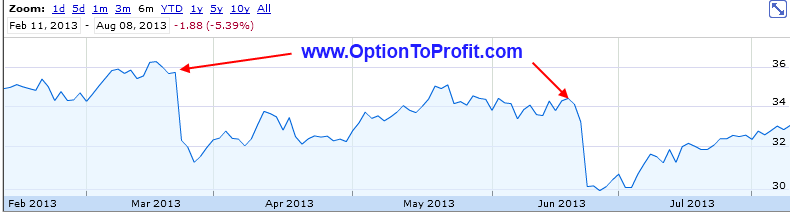
 

Jumping Into the Market

Maybe coincidentally, but over the past two days I’ve had a number of subscribers mention that they had a large amount of cash to invest.

That isn’t unusual. Whether as a result of a 401k rollover, an inheritance or just having sat on the sidelines for a while or saving up for just the right moment, it happens.

Additionally, looking at a market that seems to be able to fight off any attempts to make it back down makes people want to be a part of the fun and that means putting to money into play and to work at the same time.

And you know what? It is fun, at least until you lose some money.

I have always believed that we all come pre-packaged with bad luck and that we have to take actions to minimize the bad luck. Admittedly, it’s not really about luck but rather bad judgment, emotions or other factors that somehow seem to conspire to get in the way of forward progress.

For those with a big pile of cash and the inclination to put the money into the stock market I don’t really think there is anything like a good time or a bad time. I think it’s always a good time, as long as you follow some rules.

  • What are your objectives?

Everyone should have identifiable objectives. Are you seeking to create income streams in addition to capital appreciation? Are you looking to generate capital appreciation and are less concerned about income?

If you’re going to be selling covered options understanding what it is that you hope to achieve will determine, to a degree, what kind of strike prices you may utilize and what portion of your shares held will be hedged with option sales.


  • What are your goals?

Once you know what you are seeking in broad terms, quantifying those objectives is a good idea.. Whether it’s on the basis of comparing performance to an index or whether your income stream meets your needs, goals are the report card necessary to know whether you’re on the right path.


  • Don’t put all of your money in at once

Part of that feeling that bad luck is pervasive is the belief that If I had a big lump sum of money to invest I would probably do so at the very peak of the market and the following day my big lump sum would be that much less.

Most everyone empathized with the George Costanza character on Seinfeld when he finally came to the realization that he was far better off doing exactly the opposite of what his instincts led him to do.

I suppose that it is possible that the very next day the market could sky rocket, but ask yourself, given your luck, which direction do you think that it would go if you made the commitment?

That’s what I thought.


  • Keep some money back in reserve

When looking to put a large amount of money to work the first thing I think about is how much I want to keep in reserve in the event of a sudden decline in stock prices that may represent an opportunity. Even though you’re thinking about putting your money to work, simply think of reserve cash as a sector that is part of an overall strategy to be diversified.

To make this simple, lets talk about a hypothetical $100,000 that’s begging for a home.


  • Don’t invest your rainy day fund

Let’s also assume that this is purely discretionary money. That is, there is virtually no chance that you would have to turn to it to meet an expected or even an unexpected expense. I’ve made that mistake and I never want to make it again. In fact, when I made the mistake the market was at unheard of levels in October 1987. No one in his right mind thought that we would ever look backward again. It was a time of incredible optimism and freely flowing margin.


  • Don’t use the financial world’s answer to “Hamburger Helper”

Don’t use margin. Leverage is for other people, like those who buy options. I hate to harp on the concept of luck, but you just know that as soon as you start to leverage up will be the very moment that the market heads lower. The use of margin just serves to magnify your losses and you get to pay interest for that privilege.

Normally, I have been 100% invested over the past years,  aiming to end each week with a 20-40% turnover of portfolio from assignments and then quickly re-investing that money. But the past few months I’ve tried to bring my cash up to a 40% level at the end of each option cycle and have then proceeded to try and get the level down to about 25-30% cash. That’s because I want at least 25% cash in the event of unexpected opportunities. You may have a different amount to keep in reserve, but whatever it is, keep something. In hindsight, there’s probably very little reason to ever be fully invested.

So let’s use that amount in this example, such that of the original $100,000, I would seek to keep $25,000 available for unforeseen bargains.


  • Have a timeframe for your investment strategy

That means I have $75,000 to invest, but next I need to know over what period of time I want to funnel the money into the market. Doing so is the same as the well known “dollar cost averaging” technique. But you really need to have the discipline not to chase the market if it keeps going higher and you have to resist throwing all of your money in because you’re afraid of missing out. That’s called “FOMO,” the fear of missing out. It’s like envy and is definitely one of the seven deadly sins.

To make the math easy, let’s just assume that I want to have my $75,000 fully invested over a period of 5 weeks.

That means that I can commit $15,000 each week to new positions (or to add to existing positions).


  • Be diversified by sector

The first thing that you may see is that $15,000 isn’t that much to begin a diversified investment plan.

The next issue that becomes part of the equation is just how do you achieve diversification when you’re just starting out. That’s especially true if you’re also selling options, because there is a minimum number of shares that need to be purchased, yet your funds may be limited.

For those selling options, there’s also a good chance that your brokerage rewards you with lower total commissions per contract based on the number of contracts transacted.

Pricing power is always nice but sometimes purchasing more than 100 shares of a specific stock may put you over that $15,000 weekly limit.

More importantly, putting all of your weekly eggs into a single stock puts you hostage to that stock and leaves you entirely undiversified.

In such situations, I think you’re better off giving up some pricing power on commissions, accepting a lower ROI in return for being able to buy more than a single stock with your weekly allocation.

Again, think about your luck. The stock or the sector that you would have happily thrown all of your money toward may have picked just the wrong time to fall out of investor favor. Unless there’s a  generalized market downturn, the chances of picking two out of favor sectors just before they go out of favor is less likely, even with your luck.

And when I say “your luck,” I mean my luck, too.


  • Be diversified by risk

Part of having a diversified portfolio is not only doing so by sector, but also by risk.

For example, you know that I classify selections as either being “TRADITIONAL” or “MOMENTUM.” The TRADITIONAL category encompasses shares that are less likely to have minute to minute gyrations, or at least are more likely to revert to their mean more quickly than a MOMENTUM kind of stock.

Think of Dow Chemical as a TRADITIONAL stock and Abercrombie and Fitch as a representative MOMENTUM stock. Although Dow Chemical is currently trading with a “beta” of 1.58, as opposed to Abercrombie and Fitch’s 1.30, that measure of volatility is somewhat misleading, as anyone owning both knows that Dow Chemical will typically let you sleep more soundly at night.

Certainly their respective option premiums tell the story. Dow Chemical is simply less risky. Do you want a portfolio full of Dow Chemicals or do you want a portfolio full of Abercrombie and Fitchs?

When you set up your portfolio give strong consideration to having the risk profile of your holdings reflect your own temperament for risk.


  • Don’t stress over predictable gyrations

Stock prices go up and stock prices go down. It’s a very predictable process.

The Biblical story goes that whenever King Solomon felt extremely happy or extremely sad, he would look at his ring, which was engraved with the expression “This too shall pass.”

If the gyrations bother you, consider using longer term duration option contracts. For example, a large adverse move in share price may create less anxiety when there is a monthly contract with weeks to go as opposed to a weekly contract with only a day left until expiration. Plenty can happen over the course of weeks, while it’s much less likely that significant movement will happen in a single day.


  • Have an exit plan

For those exercising a buy and hold strategy the conventional wisdom has always been that the individual investor rarely knows when to exit a position, whether to take profits or limit losses.

There is relatively little conventional wisdom that I agree with, but this is one of the ones that I can’t find fault with. Among the things that I love about covered options is that you define an exit strategy as soon as you open the position. It’s called the strike price.You define your ROI and your time frame, although it doesn’t always work out
as planned.

But in the world of “Buy and Hold,” it’s not just that the individual investor doesn’t know when to exit, neither does their investment advisor. That’s especially true when it comes to locking in profits and less so when it comes to exiting losing positions.

Professional advisors typically use a variation of the old Bernard Baruch axiom that you should liquidate positions when they hit 10% losses.

That’s great, but of course, you know that with our luck that is the precise time that the stock begins its recovery.

Again, look at enough stocks and you’ll notice that most don’t stay depressed forever. In hindsight, how many times have you sold shares at a loss and then watched them recover?

While you’re doing that little mental exercise, how many times have you watched your paper gains evaporate and then come back and maybe evaporate again? It’s as if taking profits is a bad thing.

Now add another piece of pessimism to the mix. What makes you believe that the same person that selected a loser of a stock that is now down 10% suddenly has the skill and intelligence to exchange that stock for a winner? With my luck I tend to think that I would simply exchange it for something that was about to begin its price descent.

I don’t abide by the Bernard Baruch rule, but that has potential consequences. Some stocks simply don’t recover or take a very long time to do so and may also become non-performing assets.

I generally sell big losers in order to take advantage of tax codes that allow a portion of the losses to receive favorable tax credits, but that may not be appropriate for everyone or for every kind of account.

So set your own limits. Is it 10%, 15% 25%? But whatever it is, apply it consistently. Don’t fall prey to using a rational thought process to decide which to sell and which to keep.


Weekend Update – July 28, 2013

Stocks need leadership, but it’s hard to be critical of a stock market that seems to hit new highs on a daily basis and that resists all logical reasons to do otherwise.

That’s especially true if you’ve been convinced for the past 3 months that a correction was coming. If anything, the criticism should be directed a bit more internally.

What’s really difficult is deciding which is less rational. Sticking to failed beliefs despite the facts or the facts themselves.

In hindsight those who have called for a correction have instead stated that the market has been in a constant state of rotation so that correction has indeed come, but sector by sector, rather than in the market as a while.

Whatever. By which I don’t mean in an adolescent “whatever” sense, but rather “whatever it takes to convince others that you haven’t been wrong.”

Sometimes you’re just wrong or terribly out of synchrony with events. Even me.

What is somewhat striking, though, is that this incredible climb since 2009 has really only had a single market leader, but these days Apple (AAPL) can no longer lay claim to that honor. This most recent climb higher since November 2012 has often been referred to as the “least respected rally” ever, probably due to the fact that no one can point a finger at a catalyst other than the Federal Reserve. Besides, very few self-respecting capitalists would want to credit government intervention for all the good that has come their way in recent years, particularly as it was much of the unbridled pursuit of capitalism that left many bereft.

At some point it gets ridiculous as people seriously ask whether it can really be considered a rally of defensive stocks are leading the way higher. As if going higher on the basis of stocks like Proctor & Gamble (PG) was in some way analogous to a wad of hundred dollar bills with lots of white powder over it.

There have been other times when single stocks led entire markets. Hard to believe, but at one time it was Microsoft (MSFT) that led a market forward. In other eras the stocks were different. IBM (IBM), General Motors (GM) and others, but they were able to create confidence and optimism.

What you can say with some certainty is that it’s not going to be Amazon (AMZN), for example, as you could have made greater profit by shorting and covering 100 shares of Amazon as earnings were announced. than Amazon itself generated for the quarter. It won’t be Facebook (FB) either. despite perhaps having found the equivalent of the alchemist’s dream, by discovering a means to monetize mobile platforms.

Sure Visa (V) has had a remarkable run over the past few years but it creates nothing. It only facilitates what can end up being destructive consumer behavior.

As we sit at lofty market levels you do have to wonder what will maintain or better yet, propel us to even greater heights? It’s not likely to be the Federal Reserve and if we’re looking to earnings, we may be in for a disappointment, as the most recent round of reports have been revenue challenged.

I don’t know where that leadership will come from. If I knew, I wouldn’t continue looking for weekly opportunities. Perhaps those espousing the sector theory are on the right track, but for an individual investor married to a buy and hold portfolio that kind of sector rotational leadership won’t be very satisfying, especially if in the wrong sectors or not taking profits when it’s your sector’s turn to shine.

Teamwork is great, but what really inspires is leadership. We are at that point that we have come a long way without clear leadership and have a lot to lose.

So while awaiting someone to step up to the plate, maybe you can identify a potential leader from among this week’s list. As usual, the week’s potential stock selections are classified as being in Traditional, Double Dip Dividend, Momentum or “PEE” categories (see details).

ALthough last week marked the high point of earnings season, I was a little dismayed to see that a number of this week’s prospects still have earnings ahead of them.

While I have liked the stock, I haven’t always been a fan of Howard Schultz. Starbucks (SBUX) had an outstanding quarter and its share price responded. Unfortunately, I’ve missed the last 20 or so points. What did catch my interest, however, was the effusive manner in which Schultz described the Starbucks relationship with Green Mountain Coffee Roasters (GMCR). In the past shares of Green Mountain have suffered at the ambivalence of Schultz’s comments about that relationship. This time, however, he was glowing, calling it a “Fantastic relationship with Green Mountain and Brian Kelly (the new CEO)… and will only get stronger.”

Green Mountain reports earnings during the August 2013 option cycle. It is always a volatile trade and fraught with risk. Having in the past been on the long side during a 30% price decline after earnings and having the opportunity to discuss that on Bloomberg, makes it difficult to hide that fact. In considering potential earnings related trades, Green Mountain offers extended weekly options, so there are numerous possibilities with regard to finding a mix of premium and risk. Just be prepared to own shares if you opt to sell put options, which is the route that I would be most likely to pursue.

Deere (DE) has languished a bit lately and hasn’t fared well as it routinely is considered to have the same risk factors as other heavy machinery manufacturers, such as Caterpillar and Joy Global. Whether that’s warranted or not, it is their lot. Deere, lie the others, trades in a fairly narrow range and is approaching the low end of that range. It does report earnings prior to the end of the monthly option cycle, so those purchasing shares and counting on assignment of weekly options should be prepared for the possibility of holding shares through a period of increased risk.

Heading into this past Friday morning, I thought that there was a chance that I would be recommending all three of my “Evil Troika,” of Halliburton (HAL), British Petroleum (BP) and Transocean (RIG). Then came word that Halliburton had admitted destroying evidence in association with the Deepwater disaster, so obviously, in return shares went about 4% higher. WHat else would anyone have expected?

With that eliminated for now, as I prefer shares in the $43-44 range, I also eliminated British Petroleum which announces earnings this week. That was done mostly because I already have two lots of shares. But Transocean, which reports earnings the following week has had some very recent price weakness and is beginning to look like it’s at an appropriate price to add shares, at a time that Halliburton’s good share price fortunes didn’t extend to its evil partners.

Pfizer (PFE) offers another example of situations I don’t particularly care for. That is the juxtaposition of earnings and ex-dividend date on the same or consecutive days. In the past, it’s precluded me from considering Men’s Warehouse (MW) and just last week Tyco (TYC). However, in this situation, I don’t have some of the concerns about share price being dramatically adversely influenced by earnings. Additionally, with the ex-dividend date coming the day after earnings, the more cautious investor can wait, particularly if anticipating a price drop. Pfizer’s pipeline is deep and its recent spin-off of its Zoetis (ZTS) division will reap benefits in the form of a de-facto massive share buyback.

My JC Penney (JCP) shares were assigned this past week, but as it clings to the $16 level it continues to offer an attractive premium for the perceived risk. In this case, earnings are reported August 16, 2013 and I believe that there will be significant upside surprise. Late on Friday afternoon came news that David Einhorn closed his JC Penney short position and that news sent shares higher, but still not too high to consider for a long position in advance of earnings.

Another consistently on my radar screen, but certainly requiring a great tolerance for risk is Abercrombie and Fitch (ANF). It was relatively stable this past week and it would have been a good time to have purchased shares and covered the position as done the previous week. While I always like to consider doing so, I would like to see some price deterioration prior to purchasing the next round of shares, especially as earning’s release looms in just two weeks.

Sticking to the fashion retail theme, L Brands (LTD) may be a new corporate name, but it retains all of the consistency that has been its hallmark for so long. It’s share price has been going higher of late, diminishing some of the appeal, but any small correction in advance of earnings coming during the current option cycle would put it back on my purchase list, particularly if approaching $52.50, but especially $50. Unfortunately, the path that the market has been taking has made those kind of retracements relatively uncommon.

In advance of earnings I sold Dow Chemical (DOW) puts last week. I was a little surprised that it didn’t go up as much as it’s cousin DuPont (DD), but finishing the week anywhere above $34 would have been a victory. Now, with earnings out of the way, it may simply be time to take ownership of shares. A good dividend, good option premiums and a fairly tight trading range have caused it to consistently be on my radar screen and a frequent purchase decision. It has been a great example of how a stock needn’t move very much in order to derive outsized profits.

MetLife (MET) is another of a long list of companies reporting earnings this week, but the options market isn’t anticipating a substantive move in either direction. Although it is near its 52 week high, which is always a precarious place to be, especially before earnings, while it may not lead entire markets higher, it certainly can follow them.

Finally, it’s Riverbed Technology (RVBD) time again. While I do already own shares and have done so very consistently for years, it soon reports earnings. Shares are currently trading at a near term high, although there is room to the upside. Riverbed Technology has had great leadership and employed a very rational strategy for expansion. For some reason they seem to have a hard time communicating that message, especially when giving their guidance in post-earnings conference calls. I very often expect significant price drops even though they have been very consistent in living up to analyst’s expectations. With shares at a near term high there is certainly room for a drop ahead if they play true to form. I’m very comfortable with ownership in the $15-16 range and may consider selling puts, perhaps even for a forward month.

Traditional Stocks: Deere, Dow Chemical, L Brands, MetLife, Transocean

Momentum Stocks: Abercrombie and Fitch, JC Penney

Double Dip Dividend: Pfizer (ex-div 7/31)

Premiums Enhanced by Earnings: Green Mountain Coffee Roasters (8/7 PM), Riverbed Technology (7/30 PM)

Remember, these are just guidelines for the coming week. Some of the above selections may be sent to Option to Profit subscribers as actionable Trading Alerts, most often coupling a share purchase with call option sales or the sale of covered put contracts. Alerts are sent in adjustment to and consideration of market movements, in an attempt to create a healthy income stream for the week with reduction of trading risk.

 

Weekend Update – July 21, 2013

This week may have marked the last time Ben Bernanke sits in front of far less accomplished inquisitors in fulfilling his part of the obligation to provide congressional testimony in accordance with law.

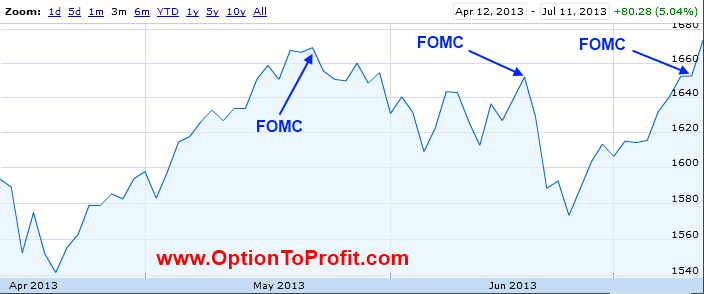

The Senate, which in general is a far more genteel and learned place was absolutely fawning over the Federal Reserve Chairman who is as good at playing close to the vest as anyone, whether its regarding divulging a time table for the feared “tapering” or an indication of whether he will be leaving his position.

If anything should convince Bernanke to sign up for another round it would be to see how long the two-faced good will last and perhaps give himself the opportunity to remind his detractors just how laudatory they had been. But I can easily understand his taking leave and enjoying the ticker tape, or perhaps the “taper tick” parade that is due him.

But in a week when Treasury Secretary Jack Lew and Bernanke had opportunities to move the markets with their appearances, neither said anything of interest, nor anything that could be mis-interpreted.

Instead, at the annual CNBC sponsored “Delivering Alpha Conference” the ability of individuals such as Jim Chanos and Nelson Peltz to move individual shares was evident. What is also evident is that based upon comparative performance thus far in 2013, there aren’t likely to be many ticker tape parades honoring hedge fund managers and certainly no one is going to honor an index.

As usual, the week’s potential stock selections are classified as being in Traditional, Double Dip Dividend, Momentum or “PEE” categories. There are many potential earnings related trades this week beyond those listed in this article for those interested in that kind of trade. (see details).

A portion of this week’s selections reflect the recently wounded, but certainly not mortally, from recent disappointing earnings. While there may not be any victory tours coming anytime soon for some of them, it’s far too short sighted to not consider the recent bad news as a stepping stone for short term opportunism.

In terms of absolute dollars lost, it’s hard to imagine the destruction of market capitalization and personal wealth at the hands of Microsoft (MSFT), Intel (INTC) and eBay (EBAY). While no one is writing an epitaph for eBay, there are no shortage of obituary writers for Microsoft and Intel. However, although most all businesses will someday go that path, I don’t think that any of that triumvirate are going to do so anytime soon, although Microsoft’s nearly 11% drop on Friday was more than the option market anticipated. It was also more than an innocent cough and may not be good for Steve Ballmer’s health.

Since my timeframe is usually short, although I do currently have shares of Intel that will soon pass their one year anniversary, I don’t think their demise or even significantly more deterioration in share price will be anytime soon. All offer better value and appealing option premiums for the risk of a purchase. Additionally, both Intel and Microsoft have upcoming dividends during the August cycle that simply adds to the short term appeal. My eBay shares were assigned on Friday, but I have been an active buyer in the $50-52.50 range and welcomed its return to that neighborhood.

I currently own some shares of Apple (AAPL) and sold some $450 August 17, 2013 calls in anticipation of its upcoming earnings. While I normally prefer the weekly options, the particular shares had an entry of $445 and haven’t earned their keep yet from cumulative option premiums. The monthly option instead offered greater time protection from adverse price action, while still getting some premium and perhaps a dividend, as well. However, with earnings this week, the more adventurous may consider the sentiment being expressed in the options market that is implying a move of approximately 5% upon earnings. Even after Friday’s 1% drop following some recent strength, I found it a little surprising at how low the put premiums are compared to call options, indicating that perhaps there is some bullish sentiment in anticipation of earnings. I simply take that as a sign of the opposite and would expect further price deterioration.

I’m always looking to buy or add shares of Caterpillar (CAT). I just had some shares assigned in order to capture the dividend. After Chanos‘ skewering of the company and its rapid descent as a direct result, I was cheering for it to go down a bit further so that perhaps shares wouldn’t be assigned early. No such luck, even after such piercing comments as “they are tied to the wrong products, at the wrong time.” I’m not certain, but he may have borrowed that phrase from last year when applied to Hewlett Packard (HPQ). For me, the various theses surrounding dependence on China or the criticisms of leadership have meant very little, as Caterpillar has steadfastly traded in a well defined range and have consistently offered option premiums upon selling calls, as well as often providing an increasingly healthy dividend. To add a bit to the excitement, however, Caterpillar does report earnings this week, so some consideration may be given to the backdoor path to potential ownership through the sale of put options.

While Chanos approached his investment thesis from the short side, Nelson Peltz made his case for
Pepsico’s (PEP) purchase of Mondelez (MDLZ). My shares of Mondelez were assigned today thanks to a price run higher as Peltz spoke. I never speculate on the basis of takeover rumors and am not salivating at the prospect of receiving $35-$38 per share, as Peltz suggested would be an appropriate range for a, thus far, non-receptive Pepsico to pay for Mondelez ownership. Despite the general agreement that margins at Mondelez are low, even by industry standards, it has been trading ideally for call option writers and I would consider repurchasing shares just to take advantage of the option premiums.

Fastenal (FAST) is just one of those companies that goes about its business without much fanfare and it’s shares are still depressed after offering some reduced guidance and then subsequently reporting its earnings. It goes ex-dividend this week and offers a decent monthly option premium during this period of low volatility. Without signs of industrial slowdowns it is a good place to park assets while awaiting for some sanity to be restored to the markets.

Although I’ve never been accused of having fashion sense Abercrombie and Fitch (ANF) and Michael Kors (KORS) are frequently alluring positions, although always carrying downside risk even when earnings reports are not part of the equation. I have been waiting for Kors to return to the $60 level and it did show some sporadic weakness during the past week, but doggedly stayed above that price.

Abercrombie and Fitch is always a volatile position, but offers some rewarding premiums, as long as the volatility does strike and lead to a prolonged dip. It reports earnings on August 14, 2013 and may also provide some data from European sales and currency impacts prior to that. Kors also reports earnings during the AUgust cycle and ant potential purchases of either of these shares must be prepared for ownership into earnings if weekly call contracts sold on the positions are not assigned.

Finally, it’s hard to find a stock that has performed more poorly than Cliffs Natural Resources (CLF). Although no one has placed blame on its leadership, in fact, they have been lauded for expense controls during demand downturns, it didn’t go unnoticed that shares rallied when the CEO announced his upcoming retirement. It also didn’t go unnoticed that China, despite being in a relative downturn, purchased a large portion of the nickel, a necessary ingredient for steel, available on the London commodity market. For the adventurous, Cliffs reports earnings this week and seems to have found some more friendly confines at the $16 level. The option market expects a 9% move in either direction. A downward move of that amount or less could result in a 1% ROI for the week, if selling put options. I suspect the move will be higher.

Traditional Stocks: Caterpillar, eBay, Intel. Microsoft, Mondelez

Momentum Stocks: Abercrombie and Fitch, Michael Kors

Double Dip Dividend: Fastenal (ex-div 7/24 $0.25)

Premiums Enhanced by Earnings: Apple (7/23 PM), Cliffs Natural Resources (7/25 PM)

Remember, these are just guidelines for the coming week. Some of the above selections may be sent to Option to Profit subscribers as actionable Trading Alerts, most often coupling a share purchase with call option sales or the sale of covered put contracts. Alerts are sent in adjustment to and consideration of market movements, in an attempt to create a healthy income stream for the week with reduction of trading risk.

Disclosure: I am long AAPL, FAST, CAT, CLF, INTC. I wrote this article myself, and it expresses my own opinions. I am not receiving compensation for it (other than from Seeking Alpha). I have no business relationship with any company whose stock is mentioned in this article.


Weekend Update – July 14, 2013

Blame “The Big Man.”

For some, “The Big Man” may refer to a personal deity. For others, the late saxophonist for The E Street Band.

While I have abiding faith in each of those, there’s no doubt in my mind that Ben Bernanke is “The Big Man.”

While the stock market soared to a new high just two months after its most recent high, it shouldn’t be lost on too many people that the Chairman of the Federal Reserve was at the center of the move down from the highs as well as the move beyond the high.

Just take a quick look at the journey of the S&P 500 from its high on May 21, 2013 to its new high on July 11, 2013.

Guess who got the blame for those drops? That’s right. Ben Bernanke in what was obviously a slam dunk example of cause and effect, at least based on the fervor with which fingers were pointed.

But on the heels of Thursday’s march to record heights very few of those fingers were pointed in Bernanke’s general direction or heaping praise upon him.

After Thursday’s close, one well known individual only begrudgingly gave Bernanke credit for the gains, suggesting that it was unexpectedly good earnings that drove the rally. In her questioning of interview guests, her phrasing of the question to get their opinions on the root cause of the day’s rally trailed off as mentioning Bernanke as a possible catalyst.

You can argue cause or correlation, but to me it’s clear. Especially when you consider that the most extreme moves, on June 20 and July 11, 2013 came after some words from the Chairman in complement of the committee minutes.

What isn’t clear is what exactly Bernanke said that made this month any different and resulted in a market making new highs. Did he speak more slowly? Did he enunciate more clearly?

When the most recent minutes were released it came as somewhat of a surprise that so much attention within the FOMC was spent on how the markets react to words. The concern that FOMC members had for the words used by its members, especially its Chairman, was evident in the text of the minutes.

Words. Words that are interpreted at will. Words that are interpreted in context, out of context, on the basis of breathing patterns and cadence.

But to show how long we have come, at least no one is interpreting policy on the basis of the thickness of Bernanke’s attaché case.

What’s also not clear to me is how “credible” individuals can make comments, such as “by offering so much information in such a muddled fashion, they have made policy less transparent,” in reference to the FOMC by a Bank of America (BAC) official. Compare that to the complaints levied against predecessor Alan Greenspan, whose leadership and obtuse pronouncements were criticized for their lack of transparency.

But that is the general theme. There is no “winning,” despite how simple Charlie Sheen made it sound during manic periods. As Federal Reserve Chairman, Ben Bernanke is criticized roundly regardless of what he says or does, as if he is pushing the “enter” key to get those algorithms running a muck when the outcome is bad and criticized when the results are pleasing.

Perhaps I listen and read with a very different set of filters, but the metrics and criteria for a tapering of Quantitative Easing seems to be clearly defined. It is the policy that everyone loves to hate, but most of all, really love, at least when it comes to personal fortunes. The conflict within must be terrible, when on the one hand you have disdain for the interference but really love the results. It’s probably similar to how noted politicians may feel when engaging in illegal acts between consenting adults when they have sworn to uphold those laws.

While my personal fortune has improved this week, I too am conflicted. I’m certainly happy about the gains, but would like to see somewhat of a resting period. With these sudden gains I stand to see too many positions assigned next week with the expiration of the July 2013 option cycle. Of course, I felt the same way last month, until I got what I wished for well in excess of my wishes, following the June 2012 FOMC minutes and Bernanke’s press conference, just 2 days prior to monthly expiration. Suddenly, the number of assignments was far fewer than anticipated.

Beyond that, I still have memories of a similar rapid recovery from a 5% drop in 2012 that saw me also wishing for a breather, only to see the bottom fall out from under and drag the market down 9%.

Surely there is something than can make us all happy. It just appears to not be Ben Bernanke unless he calls it a public service career, although I certainly wouldn’t be among those looking forward to that outcomeCertainly not like a ubiquitous and noted gold enthusiast who commented “the good news is at least that Ben Bernanke is leaving,” when asked who he thought might be replacing him.

As usual, the week’s potential stock selections are classified as being in Traditional, Double Dip Dividend, Momentum or “PEE” categories. (see details).

As has been the case several times over the past few months it sometimes gets more chall
enging to discover potential bargains at mountain tops when you can still see the valley below. This week the general trend is looking for low beta and high yield stocks.

The contrarian in me always looks at stocks that have received analysts downgrades. On Friday, both Bristol Myers Squibb (BMY) and Target (TGT) had that honor. Fortunately, Target’s first CEO and a member of the original Dayton family of owners who passed away this week didn’t have to suffer the indignity of a downgrade. Although both Bristol Myers and Target are both up from recent dips and approaching 52 weeks highs, of late they have also fared well during market declines. While I prefer either of these low beta stocks on the immediate period before an ex-dividend date, I actually would have much preferred that they reacted more negatively to the downgrades, but in a strong market they may simply be a case of “high and going higher,” while perhaps also having some downside resistance.

Another pharmaceutical company that has my attention this week is GlaxoSmithKline. Its chart looks just like that of Bristol Myers, but has the added benefit of an expected dividend payment during the August 2013 option cycle, although like Bristol Myers will also add some earnings related risk during that cycle. It tends to match the S&P 500 during downward moves, so Bristol Myers may have an edge in that regard if you have room for only one more pharmaceutical in your portfolio. However, the dividend, i believe may outweigh that consideration, especially if you believe that the overall market is headed higher.

I don’t very often own shares of any of the major oil and gas companies other than British Petroleum (BP) and it has been many years since I’ve owned Royal Dutch Shell (RDS.A), although there is rarely a week that I haven’t checked its chart and performance. Keeping with the theme, its low beta and very generous dividend, which is likely during the August 2013 cycle make it an appealing consideration.

Caterpillar (CAT) has been cited almost on a daily basis as being one of the worst performers of the S&P 500, at lest prior to last week’s strong performance. Caterpillar, which only has a very small portion of its overall business dependent on the Chinese economy hasn’t been able to escape the perception that it is intimately tied to that market and has been held hostage by that weakness and uncertainty. I almost always own shares and currently have two lots. Despite last week’s strong move and the relatively high beta, I may add additional shares as they are ex-dividend during the week offering an increased payout.

Cheniere Energy Partners (CQR), which operates liquefied natural gas terminals, is a good example of a low beta/high dividend company. It has been reliably paying a consistently sized dividend since going public in 2007, currently a 5.6% yield. Although it does report earnings on August 2, 2013 and has in the past exhibited some greater volatility with earnings, it is also expected to go ex-dividend during the August 2013 option cycle. It also tends to do well in down markets, which has appeal for me since I’m still somewhat nervous about what tomorrow may bring, even if Bernanke stays silent.

Darden Restaurants (DRI) is a company that I usually only consider purchasing in order to capture its dividend. I did consider it recently for that purpose, but didn’t buy the shares. Now, instead, I’ve come to appreciate it on its own merits. Those include a low beta, a nice call premium for the remaining week of the monthly option cycle and freedom from earnings reports until sometime in September, as Darden was among the last to report earnings in the immediately prior earnings season.

I love trading shares or buying puts in Abercrombie and Fitch (ANF). Of course, doing so runs counter to the pursuit of low beta positions, but it does offer a small dividend. Its volatility is what makes it a frequently good trade when selling either covered calls or puts. The risk tends to come with earnings and occasionally they do pre-release information, especially regarding European operations and currency risk, typically two weeks before earnings, which are currently scheduled for August 14, 2013.

For those with strong constitutions, there is VMWare (VMW) which will report earnings on July 23, 2013, the first week of the August 2013 cycle. Its shares still haven’t recovered from the loss related to February 2013 earnings, as there is increasing concern that its proprietary product no longer can sustain growth against competition for the cloud by Microsoft (MSFT), Oracle (ORCL) and Amazon (AMZN).

For the final week of the July 2013 option cycle, prior to earnings, for those believing that VMWare will delay any substantive move until after earnings, there is an opportunity for the short term trade which includes the sale of calls. However, if purchased shares are not assigned, earnings related risk is of concern.

Finally, there are many high profile companies reporting earnings this coming week, many of whom trade with high beta and have had recent large gains. However, the option premium pricing of out of the money puts, which I typically like to sell to exploit earnings, are very inexpensive, indicating continuing bullish sentiment.

Two exceptions are SanDisk (SNDK) and Align Technology (ALGN).

As perhaps expected, they are neither low beta, nor offer high dividend yields, or any yield for that matter. Both SanDisk and Align Technology are significantly higher over the past two months, both hovering at 20% gains since early May 2013 and easily outperforming the S&P 500 during that period. The worries of years past that SanDisk was doomed as flash memory was going to become a commodity hasn’t quite worked out as predicted.

As a lapsed Pediatric Dentist, I’m very familiar with Align Technologies “even a monkey can perform Orthodontics” technology and it has recently expanded its product portfolio and is increasingly enticing non-specialists to adopt the product in the hopes of creating new profit centers within office practices.

If either is a case of “high and going higher,” then selling out of the money puts expiring this coming Friday is certainly a consideration and a relatively simple way to generate premium income. If either is poised to give back recent gains Align Technology offers a better risk to reward experience as you can generate approximately 0.9% ROI for the week if shares drop less than 15%. However, the additional caveats for both of these is that they do tend to underperform in a dropping market.

Traditional Stocks: Bristol Myers, Cheneire Energy Partners, Darden Restaurants, GlaxoSmithKline, Royal Dutch Shell, Target

Momentum Stocks: Abercrombie and Fitch, VMWare

Double Dip Dividend: Caterpillar (7/18 $0.60)

Premiums Enhanced by Earnings: Align Technology (7/18 PM), SanDisk (7/17 PM)

Remember, these are just guidelines for the coming week. Some of the above selections may be sent to Option to Profit subscribers as actionable Trading Alerts, most often coupling a share purchase with call option sales or the sale of covered put contracts. Alerts are sent in adjustment to and consideration of market movements, in an attempt to create a healthy income stream for the week with reduction of trading risk.


Weekend Update – July 7, 2013

Much has been made of the recent increase in volatility.

As someone who sells options I like volatility because it typically results in higher option premiums. Since selling an option provides a time defined period I don’t get particularly excited when seeing large movements in a share’s price. With volatility comes greater probability that “this too shall pass” and selling that option allows you to sit back a bit and watch to see the story unwind.

It also gives you an opportunity to watch “the smart money” at play and wonder “just how smart is that “smart money”?

But being a observer doesn’t stop me from wondering sometimes what is behind a sudden and large movement in a stock’s price, particularly since so often they seem to occur in the absence of news. They can’t all be “fat finger ” related. I also sit and marvel about entire market reversals and wildly alternating interpretations of data.

I’m certain that for a sub-set there is some sort of technical barrier that’s been breached and the computer algorithms go into high gear. but for others the cause may be less clear, but no doubt, it is “The Smart Money,” that’s behind the gyrations so often seen.

Certainly for a large cap stock and one trading with considerable volume, you can’t credit or blame the individual investor for price swings, especially in the absence of news. Since for those shares the majority are owned by institutions, which hopefully are managed by those that comprise the “smart money” community, the large movements certainly most result in detriment to at least some in that community.

But what especially intrigues me is how the smart money so often over-reacts to news, yet still can retain their moniker.

This week’s announcement that there would be a one year delay in implementing a specific component of the Affordable Care Act , the Employer mandate, resulted in a swift drop among health care stocks, including pharmaceutical companies.

Presumably, since the markets are said to discount events 6 months into the future, the timing may have been just right, as a July 3, 2013 announcement falls within that 6 month time frame, as the changes were due to begin January 1, 2014.

By some kind of logic the news of the delay, which reflects a piece of legislation that has regularly alternated between being considered good and bad for health care stocks, was now again considered bad.

But only for a short time.

As so often is seen, such as when major economic data is released, there is an immediate reaction that is frequently reversed. Why in the world would smart people have knee jerk reactions? That doesn’t seem so smart. This morning’s reaction to the Employment Situation report is yet another example of an outsized initial reaction in the futures market that saw its follow through in the stock market severely eroded. Of course, the reaction to the over-reaction was itself then eroded as the market was entering into its final hour, as if involved in a game of volleyball piting two team of smart money against one another.

Some smart money must have lost some money during that brief period of time as they mis-read the market’s assessment of the meaning of a nearly 200,000 monthly increase in employment.

After having gone to my high school’s 25th Reunion a number of years ago, it seemed that the ones who thought they were the most cool turned out to be the least. Maybe smart money isn’t much different. Definitely be wary of anyone that refers to themselves as being part of the smart money crowd.

As usual, the week’s potential stock selections are classified as being in Traditional, Double Dip Dividend, Momentum or “PEE” categories. (see details).

As a caveat, with Earnings Season beginning this week some of the selections may also be reporting their own earnings shortly, perhaps even during the July 2013 option cycle. That knowledge should be factored into any decision process, particularly since if you select a shorter term option sale that doesn’t get assigned, since yo may be left with a position that is subject to earnings related risk. By the same token, some of those positions will have their premiums enhanced by the uncertainty associated with earnings.

Both Eli Lilly (LLY) and Abbott Labs (ABT) were on my list of prospective purchases last week. Besides being a trading shortened week in celebration of the FOurth of July, it was also a trade shortened week, as I initiated the fewest new weekly positions in a few years. Both shares were among those that took swift hits from fears that a delay in the ACA would adversely impact companies in the sector. In hindsight, that was a good opportunity to buy shares, particularly as they recovered significantly later in the day. Lilly is well off of its recent highs and Abbott Labs goes ex-dividend this week. However, it does report earnings during the final week of the July 2013 option cycle. I think that healthcare stocks have further to run.

AIG (AIG) is probably the stock that I’ve most often thought of buying over the past two years but have too infrequently gone that path. While at one time I thought of it only as a speculative position it is about as mainstream as they come, these days. Under the leadership of Robert Ben Mosche it has accomplished what no one believe was possible with regard to paying back the Treasury. While its option premiums aren’t as exciting as they once were it still offers a good risk-reward proposition.

Despite having given up on “buy and hold,” I’ve almost always had shares of Dow Chemical (DOW) over the past 5 years. They just haven’t been the same shares f
or very long. It’s CEO, Andrew Liveris was once the darling of cable finance news and then fell out of favor, while being roundly criticized as Dow shares plummeted in 2008. His star is pretty shiny once again and he has been a consistent force in leading the company to maintain shares trading in a fairly defined channel. That is an ideal kind of stock for a covered call strategy.

The recent rise in oil prices and the worries regarding oil transport through the Suez Canal, hasn’t pushed British Petroleum (BP) shares higher, perhaps due to some soon to be completed North Sea pipeline maintenance. British Petroleum is also a company that I almost always own, currently owning two higher priced lots. Generally, three lots is my maximum for any single stock, but at this level I think that shares are a worthy purchase. With a dividend yield currently in excess of 5% it does make it easier to make the purchase or to add shares to existing lots.

General Electric (GE) is one of those stocks that I only like to purchase right after a large price drop or right before its ex-dividend date. Even if either of those are present, I also like to see it trading right near its strike price. Its big price drop actually came 3 weeks ago, as did its ex-dividend date. Although it is currently trading near a strike price, that may be sufficient for me to consider making the purchase, hopeful of very quick assignment, as earnings are reported July 19, 2013.

Oracle (ORCL) has had its share of disappointments since the past two earnings releases. Its problems appear to have been company specific as competitors didn’t share in sales woes. The recent announcement of collaborations with Microsoft (MSFT and Salesforce.com (CRM) says that a fiercely competitive Larry Ellison puts performance and profits ahead of personal feelings. That’s probably a good thing if you believe that emotion can sometimes not be very helpful. It too was a recent selection that went unrequited. Going ex-dividend this week helps to make a purchase decision easier.

This coming week and next have lots of earnings coming from the financial sector. Having recently owned JP Morgan Chase (JPM) and Morgan Stanley (MS) I think I will stay away from those this week. While I’ve been looking for new entry points for Citigroup (C) and Bank of America (BAC), I think that they’re may be a bit too volatile at the moment. One that has gotten my attention is Bank of New York Mellon (BK). While it does report earnings on July 17, 2013 it isn’t quite as volatile as the latter two banks and hasn’t risen as much as Wells Fargo (WFC), another position that I would like to re-establish.

YUM Brands (YUM) reports earnings this week and as an added enticement also goes ex-dividend on the same day. People have been talking about the risk in its shares for the past year, as it’s said to be closely tied to the Chinese economy and then also subject to health scare rumors and realities. Shares do often move significantly, especially when they are stoked by fears, but YUM has shown incredible resilience, as perhaps some of the 80% institutional ownership second guess their initial urge to head for the exits, while the “not so smart money” just keeps the faith.

Finally, one place that the “smart money” has me intrigued is JC Penney (JCP). With a large vote of confidence from George Soros, a fellow Hungarian, it’s hard to not wonder what it is that he sees in the company, after all, he was smart enough to have fled Hungary. The fact that I already own shares, but at a higher price, is conveniently irrelevant in thinking that Soros is smart to like JC Penney. In hindsight it may turn out that ex-CEO Ron Johnson’s strategy was well conceived and under the guidance of a CEO with operational experience will blossom. I think that by the time earnings are reported just prior to the end of the August 2013 option cycle, there will be some upward surprises.

Traditional Stocks: Bank of New York, British Petroleum, Dow Chemical, Eli Lilly, General Electric,

Momentum Stocks: AIG, JC Penney

Double Dip Dividend: Abbott Labs (ex-div 7/11), Oracle (ex-div)7/10)

Premiums Enhanced by Earnings: YUM Brands (7/10 PM)

Remember, these are just guidelines for the coming week. Some of the above selections may be sent to Option to Profit subscribers as act
ionable Trading Alerts, most often coupling a share purchase with call option sales or the sale of covered put contracts. Alerts are sent in adjustment to and consideration of market movements, in an attempt to create a healthy income stream for the week with reduction of trading risk.