
Ellison Fiddles While Oracle Burns

Maybe I belong to a different generation, but I have certain expectations regarding behavior and responsibility, especially when other’s are your subordinates and maybe even extending to your shareholders.

As a short term holding I’ve always looked to Oracle (ORCL) as a potential addition to my portfolio that relies on the use of a covered call strategy.

While I have often thought of buying Oracle shares, in 2013 I’ve only done so twice, this most recent occasion being in advance of its earnings report. In hindsight, however, I wish I had done so much more frequently because of how mediocre its price performance has been.

As a covered option trader I like mediocrity, at least when it comes to share price. That’s the perfect price behavior to be able to buy shares and sell calls or simply sell puts and collect premiums, sometimes dividends and sometimes small capital gains on shares with relatively little fear of large price swings downward. With little movement in underlying shares you can do so over and over again.

Oracle was truly perfect, that is of course, as long as you ignore the two earnings reports prior to Wednesday evening’s numbers being released.

Any company can see its shares tumble after releasing earnings or providing guidance. In fact, it doesn’t even take bad numbers to do so. All it takes is for disappointment or unmet expectations to permeate the crowd. After all, the saying “buy on the rumor and sell on the news” got its start in the aftermath of what would seem like paradoxical behavior from investors.

So I think a company can sometimes be excused for what happens to its shares after earnings.

What I have a harder time excusing is the excoriating finger pointing that came on that occasion six moths ago when Oracle shares plummeted in what appeared to be a company specific issue, as its competitors didn’t fair as poorly in their reports and didn’t suffer similar market misfortunes.

Larry Ellison, the CEO, blamed his salesforce for the quarter. He cited their lack of urgency which allowed third quarter sales to slip into the fourth quarter. I don’t really now how Oracle’s sales force is compensated, but deferring sales is not a typical strategy.

When the next earnings report was released this time Ellison blamed Oracle’s performance on the poor global economic environment, stating “It was clearly an economic issue, not a product, competitive issue,” during the ensuing conference call. That, of course, despite the fact, that once again the competition seemed to not experience the same issues. I guess those sales that previously had been said to slip into this quarter remained slipped.

Surely they would show up for the next earnings report.
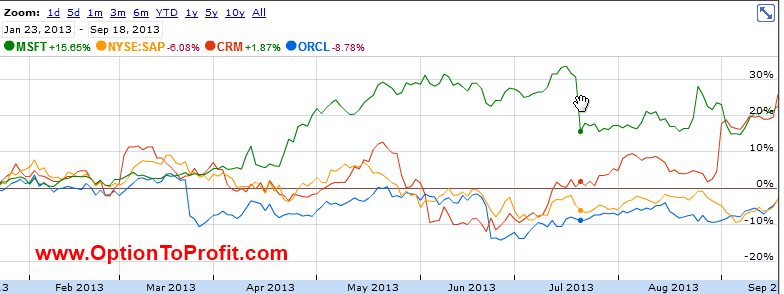
AS CEO it’s probably easier pointing fingers at others. That’s certainly the strategy that ruling despots use when there’s a need to deflect criticism or place blame to account for the wheat crop shortage.

At the very least Ellison has at least been visible, perhaps too visible. The world learned of his purchase of 97% of the Hawaiian island, Lanai and wondered at that point whether his attention would be diverted from the job of running Oracle, notwithstanding the presence of its President, Mark Hurd.

He was all too visible recently when referring to Google (GOOG) CEO Larry Page as “acting evil” and questioned the ability of Apple (AAPL) to survive in the absence of Steve Jobs.

In a way, perhaps that kind of presence is preferable to the CEO that fails to make any statements following tragic events on one of his cruise liners, not once, but on two occasions. Maybe Ellison won some new customers over with his goodwill.

But here we were, on the day that Oracle was primed to report earnings yet again. For my money, and I did buy shares on Monday, it was inconceivable to me that someone with as much at stake, especially on a reputational level would allow a third successive disappointing report. Whether by slashing costs, financial optics or perhaps by virtue of those sales that slipped from one quarter to the next and then to this one, I was certain that there would be no repeat of the embarrassing price slides the last two times.

Funny thing, though.

Instead of being an integral part of the earnings report and guidance, Larry Ellison was cheering on the crew of Oracle Team USA in a losing effort at today’s America’s Cup race.

Again, call me old fashioned, but I like to see my CEOs involved in what may have a substantive effect on my fortunes.

The good news is that Oracle didn’t have a meltdown after reporting its earnings. In fact shares went higher until reversing the course when the conference call started and the new disappointments were made known, including guiding significantly lower growth than had been expected.

To give Ellison some benefit of the doubt, perhaps he knew that the initial response wou
ld be relatively muted and his presence was unnecessary. Besides, was he going to be able to have credibility going back to the well again and blaming macroeconomic business conditions?

Not with me, he wouldn’t.

With two days to go until expiration of the weekly options I had sold I expect to be able to extricate myself from the position relatively easily and show a profit for the effort.

In all likelihood I’ll also look for any other opportunity to purchase shares because sometimes mediocrity is the gift that just keeps giving. As long as Ellison will be fiddling and paying attention elsewhere, I don’t mind an Oracle that simply treads water and stays in place, although I’m sure that the Larry Ellison of old would never have accepted or allowed that kind of an existence.

Herb Greenberg, of TheStreet.com is once again soliciting nominations for the worst CEO of the year. As far as I know the rules don’t exclude absentee CEOs. While Oracle is only trailing the S&P 500 by approximately 19% YTD and is certainly performing better than other companies with less than capable management, the shame factor is worthy of your vote.

Weekend Update – September 15, 2013

Month after month of seeing market gains finally came to an end in August. The streak had started in November 2012 and for those who are prone to remember oddities, we even had a string of 20 consecutive gaining Tuesdays during that span.

Of course we also eclipsed the 2007 Dow Jones and S&P 500 highs and subsequently did so on repeated occasions, all while “Chicken Littles” like me kept waiting for the correction that never came.

The small head fake correction that began near the end of May was barely a blip and was quickly erased as more new highs were established, but the trading patterns of August seemed to indicate that perhaps the rally was getting tired and the market not only began sputtering, but also lost ground as Syrian related tensions were in the air.

Anxious to see a modest correction so that I would finally have something constructive to do with the cash I had been raising, I wasn’t terribly happy with what would come in September, with the first seven trading days having seen gains.

Not only did they make gains, but there were three consecutive triple digit gains. Adding insult to injury was the root cause of those triple digit gains.

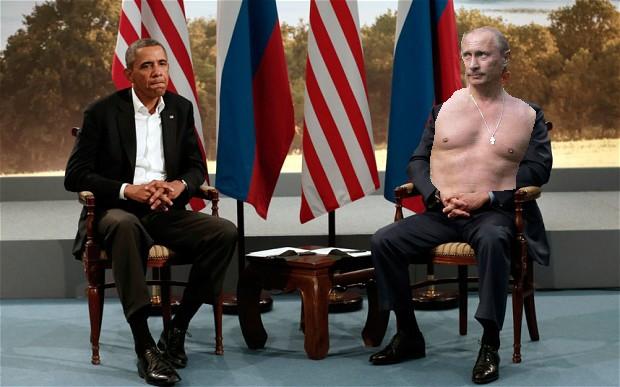
While avoiding the use of military force, at least in the near term, is somewhat comforting, the very idea that a Russian proposed plan could avert military action against Syria was about as implausible as anything that occurred in the 20th or 21st centuries, with the possible exception of the Russian President speaking directly to American citizens through an op-ed piece in the New York TImes (NYT).

Russian peace plan? Can those words even possibly all be in a single paragraph?

But with fear centered around uncertainty regarding military action against Syria temporarily tabled, the market ignored August and also ignored the historical nature of Septembers past. By Friday morning, just seconds after the opening bell, all of August’s losses had been recovered.

Somehow, I am neurologically incapable of saying “Thank you, Vladimir.”

Instead, the increasingly nervous part of me wonders what there is that awaits that will continue to send markets higher? Are there unseen catalysts or are there now more opportunities for disappointment, particularly if Russian efforts, inspired by an off the cuff remark by Secretary of State Kerry, prove to be inadequate?

I’ve been asking questions in a similar vein for months now, but the answer has always been in the affirmative, even if the catalysts weren’t always apparent.

Of course, now there’s also the question of the market’s reaction to the expected announcement of the nomination of Lawrence Summers as the next Federal Reserve Chairman. The rumor that such an announcement would come today was denied, but that should come as no surprise, as President Obama had his heart set on doing so by attaching a banner to a Tomahawk missile.

If Syria fails to deliver a market correction and neither fear of the “Taper” nor the nomination of Summers can do so, at least we will have Congress back and fully engaged so that a new round of budget crises can at least allow the market to bounce up and down, which is far more healthy for someone relying on a covered option strategy. If that happens, I can hold my head up high and point to a momentary drop lower and sat “See? That correction.”

As usual, the week’s potential stock selections are classified as being in Traditional, Double Dip Dividend, Momentum and “PEE” categories this week (see details).

I’ve only opened a limited number of new positions in the last few weeks and don’t anticipate seeing that pattern change this week, unless there is a substantive near term correction to last week’s price increases. Those increases, for example, are the reason why I have no Double Dip Dividend selections this coming week, as the risk of experiencing some price pullbacks outweighs the benefits of garnering option premiums and dividends. As it is, instead of the usual number of potential selections, this week’s list contains only 5 names.

Certainly a controversial place to begin looking in the new week is Apple (AAPL). I purchased shares last week following the large drop on Wednesday when disappointment began to settle in for varied reasons. The small recovery that I was expecting never really came, but instead of being disappointed by the inability to quickly close my position, I think that there is simply continued opportunity to pick up additional shares. However, as opposed to the rare instance of having purchased shares and not immediately having sold calls, I do plan to do so this time around if adding shares.

Apple, while not necessarily making significant changes to its product line is making significant changes to the way it conducts its business. From a trade-in program, to less expensive models, to not taking pre-orders on the upcoming iPhone 5S, to dividends and buybacks, they are shaking up their daily approach to existence on all fronts. From my vantage point the short term emphasis is that “cash is king” and that share price matters. I especially like Tim Cook’s philosophy that market share isn’t as important as having enough money to be in control of one’s destiny. The recent product announcements should see to it that the cash keeps pouring in and helps to secure that destiny.

Continuing with the controversial theme is Cliffs Natural Resources (CLF). I had written about the possibility of adding shares recently, but did not do so. Instead, I continued selling calls on a lower priced lot of shares to try and continue to offset substantial paper lo
sses from older lots. That’s a slow process but I think at this current level the process can be speeded up by adding more shares. Highly levered to economic news from China does add to the risk of ownership, but Cliffs has been demonstrating some price stability at this level.

I may as well add to the controversy with Phillip Morris (PM). Whatever your opinions are about ownership of a company that directly results in countless premature deaths, it’s hard to overlook their move to increase the dividend and the reasonably narrow range in which shares trade. Combine those attributes with an appealing option premium and you have a combination that’s hard to resist and doesn’t even require nicotine to keep you hooked.

They say that there’s no such thing as bad publicity, although JP Morgan (JPM) may disagree. However, if you want to see the poster child for resilience you don’t have to look much further than this company. After an avalanche of bad news, having inherited the burden from Goldman Sachs (GS), JP Morgan has somehow been able to keep its share price respectably positioned. This week it announced plans to commit nearly $6 Billion toward legal defenses and compliance. In addition to an option premium that provides some comfort, shares will be ex-dividend during the October 2013 option cycle so I may consider using a longer term option sale and would actually welcome early assignment.

Finally, while earnings season is set to begin again in just a few weeks, Oracle (ORCL) is a laggard and reports this week. With the upcoming report the company will have had six months to make some changes, whether substantive or purely optical, to create a more positively received report. Following two successive negative reports that were not well received by the market, I think that its inconceivable that Larry Ellison would allow his name to be badly tarnished again by anything other than his own words and actions. No doubt that he is unhappy with share performance since that first disappointment.

While I usually like to consider earnings related trades on the basis of selling deep out of the money puts, Oracle may work equally well as an outright purchase and sale of calls. In the event of another price meltdown I would not go out of my way to greet Ellison if you see him in Lanai, although I don’t believe the police department was included with the sale of the island.

Traditional Stocks: JP Morgan Chase, Phillip Morris

Momentum Stocks: Apple, Cliffs Natural Resources

Double Dip Dividend: none

Premiums Enhanced by Earnings: Oracle (9/11 PM)

Remember, these are just guidelines for the coming week. The above selections may be become actionable, most often coupling a share purchase with call option sales or the sale of covered put contracts, in adjustment to and consideration of market movements. The over-riding objective is to create a healthy income stream for the week with reduction of trading risk.

Disclosure: I am long AAPL, CLF. I wrote this article myself, and it expresses my own opinions. I am not receiving compensation for it (other than from Seeking Alpha). I have no business relationship with any company whose stock is mentioned in this article.

Additional disclosure: I may initiate positions, add shares or sell puts in AAPL, CLF, JPM, ORCL and PM

I Bought Apple

There are some people that just love to take in wounded birds and believe that somehow that can nurse the poor wounded creature back to health. For some sainted few that is their “raison d’etre.”

I bought shares of Apple (AAPL) this morning after it was wounded by downgrades from Bank of America (BAC), UBS (UBS), Piper Jaffray (PJC) and Credit Suisse (CS).

You’re welcome, but I’m not saint. I certainly can’t be categorized as an “Apple lover.” Neither the products nor the shares have had consistent appeal for me, but the subjectivity is out of place when it comes to capitalizing on opportunity.

Clearly, this opportunity stems from the high profile downgrades. Such downgrades confirm for me that there is greater value placed on not missing out on potential gains than there is in protecting portfolios from disappointments.

Recent history has not given strong indication that Apple shares will rally after product launch events, particularly as the quality of the leaks regarding the “news” seem to get better and better. There are few, if any, upside moving surprises. In fact, one wouldn’t be terribly far off base to suggest that the sum total of predictions of what will be announced easily exceed the capability of squeezing all of the new options into a single device. As a result there is always bound to be someone leaving the party disappointed.

For those further expecting the announcement of new relationships, such as in China, there has to be some thought that the downside to disappointment may likely exceed the upside of what may already be partially built into the price.

Yet, protecting a client’s assets takes a back seat.

My basic understanding of math tells me that it’s more difficult to recover from a $5 loss than it is to find an opportunity to make $5 in place of the opportunity you missed.

But with a short-sighted view of what the future holds, analysts have created opportunity, just perhaps not for their clients.

I almost never buy shares without concomitant sale of option contracts, but in this case I listened to my own advice from just a few weeks ago when Carl Icahn entered into the picture.

In addition to now having a more favorable entry point to re-establish a position that was recently assigned, so too does Apple find itself in a better position to further implement its buy-back program. There’s no shortage of money still unspent in that program and there may be more added to the bucket.

No doubt this will be a topic of Icahn and Tim Cook’s upcoming dinner, which Icahn confirmed a few days ago would be this month.

But now that the product offerings are well known, they have no doubt been dissected by many who can extol or pan the virtues and relative value of the innovations. To attempt to analyze the advances incorporated into the iPhone 5c and 5s is somewhat meaningless with regard to short term investing, which is all I hope to ever do.

What I hope to do is turn shares into short term realized profit vehicles. For that reason I don’t dwell on the possibility that the fingerprint reader may be an entry way into mobile secure commerce solutions.

What I dwell on is how likely is Apple to withstand this onslaught and then I’m likely to sell call options into price strength, as I expect a bounce in shares, particularly as Syria is temporarily off the table.

Apple will continue being an incredible cash machine with these new devices. Argue about their price points as much as you want, argue about cannibalization, too. The reality will be that the phones will fly off the shelves and tie up the consumer base for another year or two. After all, it’s not just about selling product, it’s also about making certain that your consumer base is effectively barred from going to the competition without the burden of additional cost.

I’m still a product holdout, but the rest of my family isn’t, some of whom only joined the parade this week.

Scoff at the superficial changes, but Apple knows better than most others that bold colors will not only drive new sales. but will instantly help distinguish itself in the hands of one adolescent as another is watching.

While everyone enjoys talking about “the big picture,” today’s downgrades and market reaction have been anything but mindful of that more encompassing view.

This is what opportunities are made of, despite the fact that risk shares the same parent. Having been very critical of Apple over the past 15 months, and questioning why people had not taken profits befor
e they evaporated, I’ve nonetheless found a number of opportunities over that time to re-establish short term positions. In the past the drivers of those decisions were predominantly based upon option premiums and dividends. This time, however, the catalyst is share appreciation as the market will realize that its immediate reaction was unwarranted.

How Much Do I Need to Make Some Money?

How Much is Enough?How much is enough?

I still vividly remember the Tolstoy short story “How Land Does a Man Need?

That story tells of “Pahom” who surprisingly needed much less land than he thought.

Eschewing greed has always been a tenet of the Option to Profit strategy, but I don’t think that it derived from any Tolstoy influence on me during childhood. I was probably influenced by Soupy Sales and The Marx Bothers much more than Tolstoy.

When I was younger, I looked at everything through the lens of the “The 1964 Zenith 25 Inch Color TV” metric. I don’t think that the word “metric” was really a word then, but like “algorithm,” it sounds like you have credibility when you sprinkle casual conversation with those words, especially if you master the art of subliminal suggestion..

G-spot.

In essence, for me the question was always distilled down to “how many Zenith Color TV’s, using 1964 prices, could be purchased with the amount of money in question?”

For standardization purposes, a single such TV was about $500 back then.

I remember when my father was offered a job paying $25,000 a year.

Totally unaware of such mundane things as taxes and other asset drainers, I just looked at that sum as meaning we could buy a new color TV each and every week.

Now, nearly 25 years later, Zenith is gone, your SUV glove compartment is probably bigger than 25 inches and $25,000 isn’t really that much.

So how much do you need?

I started using the covered call strategy and actively trading in and out of positions while I was still getting a regular paycheck. At the time, the income stream was a nice adjunct and I was only devoting about 25% of my portfolio to the strategy.

Now, I don’t work and I’ve devoted 100% of my stock portfolio to the strategy.

Did I mention that my wife, coincidentally, became known as “Sugar Momma” once I devoted myself to plunking my butt on the La-Z-Boy and trading full time?

I’ve always maintained that you can generate 2-4% per month of income from your assets. That shouldn’t be confused with “profit.” My goal is to use my assets to create income, while limiting downside risk in a down market and accepting the fact that my capital gains may be lessened during a bull run.

I’m OK with that.

Even if the market is going down and your portfolio may show paper losses, you can still generate that 2-4% that can become a source of income or “the source of income”

Since I tend to be a conservative guy, let’s make some assumptions.

Firstly, the upper range of the 2-4% return is during periods of market volatility and utilizing near the money option sales. You want higher than 4%, that can be done, too, but you have to also dismiss “fear” as you would need to devote more of your assets to “momentum” stocks or more speculative plays, like Green Mountain Coffee Roasters, Amazon, Netflix and MolyCorp, to name a few. Maybe even those “evil” leveraged ETF’s and ETN’s, such as ProShares UltraSilver and UltraShort Silver, Barclays Volatility ETN and others.

Secondly, the upper range also assumes that most, if not all of your holdings will be hedged, thus creating income streams.

So, now lets assume that it’s not very volatile out there and only 50% of your holdings are hedged and you’re not a momentum risk taking kind of guy.

I’ll call that 1%.

So how big of a portfolio do you need to make a monthly 1% income stream meaningful to you? What is your personal “Pahom” telling you that you need?

Well, let’s not forget to throw the monthly $200 subscription fee in there (once I increase it to that amount).

That means to reach a break even, your portfolio would have to be at least $20,000.

The bad news is that if that’s all you have, you may be in the 1% for income stream, but you’re probably not in the 1% by “Occupy Wall Street” standards.

Beyond that, even if you wanted to put the strategy into effect and accept a 0% income flow, after your subscription costs, $25,000 really isn’t enough to be diversified and have some pricing efficiency, even with your Uncle Vinnie acting as your discount broker.

So, you can easily do the math at different asset levels and different income stream rates.

From my perspective, after expenses, at that 1%, I’d need a $75,000  portfolio to get one new Zenith 25 inch color TV every month.

You may have your own metric.

Obviously, the next question is how much would it take to make a meaningful difference in your life?

I’m also assuming that your investments are discretionary. That is, you’re not playing with money that you may need in a moment of desperation. Those moments always seem to come when you’re stocks are at their low points. There’s nothing worse than taking losses, unless it’s taking losses when you’re arm is being twisted to do so.

Been there. But you’ll have to read “Option to Profit” for the story.

G-spot.


RETURN HOME


Weekend Update – September 8, 2013

Employment Situation Report, Taper, new Yahoo! (YHOO) logo, Syria.
Not a line from a new, less catchy Billy Joel song, but a transition week going from the quietude of summer, which was mostly focused on fundamentals to the event driven and emotional rest of the year when the world seems to be perennially on fire, jumping from crisis to crisis.
In a few days traffic in my part of the country returns back to its normal heinous condition as our nation’s elected officials return from a much deserved 37 day vacation that they were unable to truncate by a few days to address some outstanding issues.
Just to be clear, it’s the electorate that deserved the break, but now they’re back and we can settle into our more normal state of dysfunction, while decreasing our focus on such mundane things as earnings. For the record, I don’t get out onto the roads very much anymore, having given up gainful employment for a life of ticker watching, but it’s not as easy to escape the results of having exercised our democratic rights.
Continue reading “Seems Like Old Times” on Seeking Alpha
 

Microsoft: What Would Munger Do?

For a company that many have said represents nothing but “dead money,” Microsoft (MSFT) has certainly been up and kicking lately.

Fresh off the post-Ballmer resignation news and subsequent rally, Microsoft shares gave back everything in this day’s trading, as it announced plans to purchase its smart phone partner, Nokia (NOK).

Nokia itself is no stranger to having been left for dead, as it’s one-time dominance has seen it eclipsed by Apple (AAPL) in sales, and by others in perceived technological prowess.

In executing a purchase of Nokia it also started speculation that they were in effect “buying” their one-time employee, Stephen Elop, most recently CEO of Nokia, as a prime candidate to be Ballmer’s successor.

I say “most recently” because Elop has stepped down as CEO of Nokia so as not to give the appearance of Nokia actually being the superior party in the deal, in the event that Elop becomes Microsoft’s new CEO.

While Berkshire Hathaway (BRK.A) has no current position in Microsoft, the ties between their founders, Warren Buffett and Bill Gates, respectively, is well know and runs deep, much like a river, which is coincidentally the origin of the name “Nokia.”

Buffett’s less known partner, Charlie Munger, who is almost 90 years old, is rarely in the public eye. He is, however, a legendary investor who takes a back seat to no one. When asked the secret to his success his reply was simply “I’m rational. That’s the answer. I’m rational.”

Today, that seemed to be in short supply, as news came out of Microsoft’s $7.2 Billion deal. The immediate reaction in share price was to drop market capitalization by about $17 Billion.

That seems irrational, perhaps as irrational as a similar increase in market capitalization barely a week ago when Ballmer announced his plans.

WWMD? What Would Munger Do?

For me, that was reason to purchase shares, just as Ballmer’s resignation announcement was reason to sell shares. I was willing to pick up new shares had Microsoft fallen back to $33, never expecting an opportunity to occur so quickly in the absence of a general market meltdown.

As with most of my holdings the Microsoft shares were covered with options. In this case the $33 strike price was eclipsed, but buying back the options at a loss was rational, because the share price accelerated more than did the “in the money” premium. In those rare occasions that I do that, I always sell the shares as soon as the options positions are close. To do otherwise invites the possibility, or with my lick, the probability that the underlying shares will drop just as quickly as they rose, thereby making it a losing proposition all around.

Of course, you might also make the case that you wouldn’t have expected a major deal, such as this one to have occurred under the leadership of a lame duck CEO, but Microsoft is no ordinary company and Steve Ballmer is no ordinary CEO. Whatever talk you may hear about “the law of large numbers,” there is no denying that those large numbers allow you to act with a certain amount of impunity and have a greater long term vision.

That’s the rational thing to do.

Tellingly, the decision to consummate this deal was made without informing ValueAct Capital Management of the decision. The activist shareholder was just informed that they would be receiving a seat on the Board of Directors, but they were not in the loop on this deal. Besides, how rational would it have been to let a 1% equity stake get in the way?

However, even if the Nokia purchase follows in the path of other Microsoft initiatives and its purchase is written off in its entirety, the $7 Billion purchase price is of little significance to Microsoft and presents a far less liability than it seems on the “Surface,” which is in its own liability category.

To start, the funds for this purchase are from cash held overseas. Unless there is a sudden change in United States corporate tax laws, those funds sit idly, reducing the Price to Earnings ratio. The only use for the funds is further overseas investment. The $7 Billion being spent on Nokia represents approximately 10% of Microsoft’s overseas cash. Even if Ballmer goes on a wildly drunken global spending spree it would be incredibly difficult to make a dent in that overseas pile.

For their money Microsoft escapes US taxes and receives tax advantages related to the purchase. The taxes saved alone are approximately $1.5 Billion had they repatriated the money. Additi
onally any expenses incurred in the United STates further reduce tax liability.

But there is more to the deal to offset the cost that just financial optics and tax engineering. The margins on Lumina units will jump from approximately $10 for software royalties to $50 for hardware. With a projected sale of 30 million units net revenue just increased by $1.5 Billion. Again, in absolute terms that’s not much for Microsoft, but relative to the cost of the Nokia purchase, it is substantial.

What is clear is that what we now think of as smart phones, in some form or another, will evolve into our personal computers. Without a strategy to be part of that evolution money in the bank is insufficient to ensure continued relevance.

Google (GOOG) gets it and secured their foothold with Motorola, a cell phone manufacturer that had also seen better and more heady days, but with a great patent portfolio. Microsoft is now making a commitment to go down a similar path and also securing potentially valuable patents along with the manufacturer of 80% of the Windows OS phones on the market.

I’ve long liked Microsoft because of its option premiums when utilizing a covered call strategy and its recent history of dividend increases. The company is widely expected to announce yet another dividend increase, but even at its current rate of nearly 3% it is far ahead of the mean yield for S&P 500 companies, even when considering only those that pay dividends.

WWMD?

It would be presumptuous to pretend to know, but Microsoft at the currently irrationally depressed level appears to be poised to out-perform the broad index and is preparing itself to leave behind its reactive ways for what we all know to be a lucrative communications market.

Just ask Verizon (VZ).

Disclosure: I am long MSFT. I wrote this article myself, and it expresses my own opinions. I am not receiving compensation for it (other than from Seeking Alpha). I have no business relationship with any company whose stock is mentioned in this article.

Additional disclosure: I may add additional shares of MSFT

Weekend Update – September 1, 2013

Behind every “old wives’ tale” there has to be a kernel of truth. That’s part of the basis for it being handed down from one generation to the next.

While I don’t necessarily believe that the souls of dead children reside in toads or frogs, who knows? The Pets.com sock puppet was real enough for people to believe in it for a while. No one got hurt holding onto that belief.

The old saw “Sell in May and go away,” has its origins in a simpler time. Back when The Catskills were the Hamptons and international crises didn’t occur in regular doses. There wasn’t much reason to leave your money in the stock market and watch its value predictably erode under the hot summer sun back in the old days.

Lately, some of those old wives’ tales have lost their luster, but the Summer of 2013 has been pretty much like the old days. With only a bare minimum of economic news and that part of the world that could impact upon our stock market taking a summer break, it has been an idyllic kind of season. In fact, with the market essentially flat from Memorial Day to Labor Day it was an ideal time to sell covered options.

So you would think that Syria could have at least waited just another week until the official end to the summer season, before releasing chemical weapons on its own citizens and crossing that “red line,” that apparently has meaning other than when sunburn begins and ends.

Or does it?

On Monday, Secretary of State John Kerry made it clear where the United States believed that blame lay. He used a kind of passion and emotion that was completely absent during his own Presidential campaign. Had he found that tone back in 2004 he might be among that small cadre of “President Emeritus” members today. On Friday he did more of the same and sought to remove uncertainty from the equation.

Strangely, while Kerry’s initial words and intent earlier in the week seemed to have been very clear, the market, which so often snaps to judgment and had been in abeyance awaiting his delayed presentation, didn’t know what to do for nearly 15 minutes. In fact, there was a slightly positive reaction at first and then someone realized the potentially market adverse meaning of armed intervention.

Finally, someone came to the realization that any form of warfare may not be a market positive. Although selling only lasted a single day, attempts to rally the markets subsequently all faded into the close as a variant on another old saying – “don’t stay long going into the weekend,” seemed to be at play.

That’s especially true during a long weekend and then even more true if it’s a long weekend filled with uncertainty. As it becomes less clear what our response will be, paradoxically that uncertainty has led to some calm. But at some point you can be assured that there will be a chorus of those questioning President Obama’s judgment and subsequent actions and wondering “what would Steve Jobs have done.”

John Kerry helped to somewhat answer that question on Friday afternoon and the market ultimately settled on interpreting the message as being calming, even though the message implied forceful action. What was clear in watching the tape is that algorithms were not in agreement over the meaning of the word “heinous.”

With the market having largely gone higher for the past 20 months the old saying seeking to protect against uncertainty during market closures has been largely ignored during that time.

But now with uncertainty back in the air and the summer season having come to its expected end, it is back to business as usual.

That means that fundamentals, such as the way in which earnings have ruled the market this past summer take a back seat to “events du jour” and the avalanche of economic reports whose relevance is often measured in nano-seconds and readily supplanted by the next bit of information to have its embargo lifted.

This coming week is one of great uncertainty. I made fewer than the usual number of trades last week and if i was the kind that would be prone to expressing regret over some of them, I would do so. I expect to be even more cautious this week, unless there is meaningful clarity introduced into the equation. While wishing for business as usual, that may not be enough for it to become reality.

As usual, the week’s potential stock selections are classified as being in Traditional, Double Dip Dividend and , Momentum categories, with no suitable “PEE” selections this week (see details).

While I currently own more expensive shares of Caterpillar (CAT), I almost always feel as if it’s a good time to add shares. Caterpillar has become everyone’s favorite stock to disparage, reaching its peak with famed short seller Jim Chanos’ presentation at the “Delivering Alpha Conference” a few weeks ago. as long as it continues trading in a $80-$90 range it is a wonderful stock for a covered call writing strategy and it has reliably stayed in that range.

Joy Global (JOY) reported its earnings last week and beat analysts estimates and reaffirmed its 2014 guidance. Nonetheless it was brutalized in the aftermath. Although already owning shares I took the opportunity to sell weekly put options in the belief that the reaction was well overdone.

If the reports of an improving Chinese economy are to be believed, and that may be a real test of faith, then Joy Global stands to do well. Like Caterpillar, it has traded in a reasonably narrow range and is especially attractive in the $48-53 neighborhood.

eBay (EBAY) is simply on sale, closing the week just below the $50 level. With no news to detract from its sh
are price and having traded very well in the $50 -53 range, it’s hard to justify why it fell along with other stocks in the uncertainty that attended the concerns over Syria. It’s certainly hard to draw a straight line from Syria related fears to diminished earnings at eBay.

By the recent measure that I have been using, that is the comparison to the S&P 500 performance since May 21, 2013, the market top that preceded a small post-Ben Bernanke induced correction, eBay has well underperformed the index and may be relatively immune from short term market pressure.

Baxter International (BAX) is one of those stocks that I like to own and am sad to see get assigned away from me. Every job has its negative side and while most of the time I’m happy seeing shares assigned, sometimes when it takes too long for them to return to a reasonable price, I get forlorn. In this case, timing is very serendipitous, because Baxter has fallen in price and goes ex-dividend this week.

Coach (COH) also goes ex-dividend this week and that increases its appeal. At a time when retail has been sending very mixed messages, and at a time when Coach’s position at the luxury end is being questioned as Michael Kors (KORS) is everyone’s new darling, COach is yet another example of a stock that trades very well in a specific range and has been very well suited to covered option portfolios.

In general, I’ve picked the wrong year to be bullish on metals and some of my patience is beginning to wear thin, but I’ve been seeing signs of some stability recently, although once again, the risk of putting too much faith into a Chinese recovery may carry a steep price. BHP Billiton (BHP) is the behemoth that all others bow to and may soon receive the same kind of fear and respect from the potash industry, as it is a prime reason the cartel has lost some of its integrity. BHP Billiton also goes ex-dividend this week and is now about 6% below its recent price spurt higher.

Seagate Technology (STX) isn’t necessarily for the faint of heart. but it is down nearly 20% from its recent high, at a time when there is re-affirmation that the personal computer won’t be disappearing anytime soon. While many of the stocks on my radar screen this week have demonstrated strength within trading ranges, Seagate can’t necessarily lay claim to the same ability and you do have to be mindful of paroxysms of movement which could take shares down to the $32 level.

While Seagate Technology may offer the thrills that some people need and the reward that some people want, Walgreen (WAG) may be a happy compromise. A low beta stock with an option premium that is rewarding enough for most. Although Walgreen has only slightly under-performed the S&P 500 since May 21st, I think it’s a good choice now, given potential immunity from the specific extrinsic issues at hand, particularly if you are under-invested in the healthcare sector.

Another area in which I’m under-invested is in the Finance sector. While it hasn’t under-performed the S&P 500 recently, Bank of New York Mellon (BK) is still about 7% lower in the past 5 weeks and offers a little less of a thrill in ownership than some of my other favorites, JP Morgan Chase (JPM) and Morgan Stanley (MS). Sometimes, it’s alright giving up on the thrills, particularly in return for a competitive option premium and the ability to sleep a bit sounder at night.

Finally, with the excitement about Steve Ballmer finally leaving Microsoft (MSFT) after what seems like an eternity of such calls, the share price has simply returned to a more inviting re-entry levels. In fact, when Ballmer announced his decision to leave the CEO position in 12 months, I did something that I rarely do. I bought back my call options at a loss and then sold shares at the enhanced share price. Occasionally you see a shares appreciation outstrip the appreciation in the in the money premium and opportunities are created to take advantage of the excitement not being reflected in future price expectations.

At the post-Ballmer excitement stage there is still reason to consider share ownership, including the anticipation of another dividend increase and option premiums while awaiting assignment of shares

Traditional Stocks: Bank of New York Mellon, Caterpillar, eBay, Microsoft, Walgreen

Momentum Stocks: Joy Global, Seagate Technology

Double Dip Dividend: Baxter International (ex-div 9/4), BHP Billiton (ex-div 9/4), Coach (ex-div 9/5)

Premiums Enhanced by Earnings: none

Remember, these are just guidelines for the coming week. The above selections may be become actionable, most often coupling a share purchase with call option sales or the sale of covered put contracts, in adjustment to and consideration of market movements. The over-riding objective is to create a healthy income stream for the week with reduction of trading risk.

Dividends

I received a very nice text message from a subscriber this morning.
I think that if I’m ever in the market for a publicist for Option to Profit, my search need go no further.

His message, in its entirety was “Option to Profit: Come for the premiums, stay for the dividends.”

My guess is that he’s been seeing a stream of dividends coming in lately. Today alone had Lorillard, Weyerhauser and Molson-Coors.

Some of you know that I have mixed feelings about dividends and am not really a big fan.  (I Don’t Understand Dividends and The Myth of Dividends) but as long as there appear to be some pricing inefficiencies in option premiums when dividends are about to be paid (Double Dipping Dividends), why would you want to pass up that opportunity?

I’ve been increasingly putting an emphasis on dividends as market volatility has declined, in order to increase over all yield and I have to admit that I don’t mind receiving those brokerage alerts telling me when a dividend check has been deposited into my account (Dividends? Forget DRIP and Go PRIP).

Because of my belief in attempting to exploit those pricing inefficiencies when they appear is why I send out queries on ex-dividend mornings for those positions that were in the money at the time of going ex-dividend. It’s all about collecting the data and validating the strategy and the information that so many of you regularly provide is very helpful and appreciated.

I’ve been looking for a good way to express the OTP portfolio’s dividend yield for a while but it’s difficult to really get a good fix and one that accurately depicts the reality, especially if seeking to project annual return.

Since I like to compare everything to the S&P 500 Index, it makes sense that I do the same for dividend yield.

Currently the average S&P 500 stock offers a 2.06% dividend yield. However, that is impacted by the 82 stocks in the index that pay no dividends.

So for the 412 dividend paying stocks in the index, the average yield is 2.46%. In 2012 the average dividend paying stock had a 2.7% yield. The current year’s lower yield reflects generally higher stock prices.

If you look at the Weekly Performance spreadsheet you may have noticed for the past two months or so some calculations on each page that assesses dividend yield of open positions and projects that yield on an annual basis.

I had not been planning on saying anything about those spreadsheet scribblings until the end of the year, until having received this morning’s message.

The good news is that with increased data collection the model for creating projections is beginning to resemble reality.

The better news is the reality.

The dividend yield for positions closed in 2012, all 272 of them was 2.9%

Thus far the yield for positions closed in 2013 is 2.7%

Both of those reflect all positions and not just those paying dividends. As a result the gap is 0.7% and in a very favorable direction.

At the moment, not including new purchases this week, the remaining open positions in the OTP portfolio are delivering an annualized dividend yield of 2.9%, again that includes both dividend and non-dividend paying positions.

For those that are a bit more traditional than I am and have long appreciated dividends I finally see your perspective as those account credits have been adding up.

Weekend Update – August 25, 2013

You’re only as good as your earnings. Having stopped making an honest living a little on the early side, I still need to make money, or otherwise my wife would insist that I do something other than watch a moving stock ticker all day.

Since there’s far too much competition on the highway exit near our home and my penmanship has deteriorated due to excessive keyboard use, I’ve come to realize that stock derived earnings, predominantly from the sale of options and accrual of dividends, are the only thing keeping me from joining those less fortunate.

I’m under no delusions. I am only as good as my earnings, just as Bob Greifeld, CEO of NASDAQ (NDAQ) should be under no delusions, as he is only as good as his response to the most recent NASDAQ failing.

On that count, I may have the advantage, although he may have better hygiene and a wardrobe that includes a clean hoodie.

There was a time that we thought of stocks in very much the same earnings centric way. If earnings were good the stock was good. There was a time that we didn’t dwell quite as much on the macro-economic data and we certainly didn’t spend time thinking about Europe or China.

However, after this most recent earnings season, which will come to an end a few days before the next season is kicked off on October 8, 2013, maybe it’s a good thing that it’s only during the otherwise slow summer months when other news is sparse, that we focus on earnings.

If you’ve been paying attention, this hasn’t been a particularly encouraging month, especially as far as retail sales go, which are about as good a reflection of discretionary spending as you can find. Beyond that, listening to guidance can make shivers run down one’s spine as less than rosy earnings pictures are being painted for the future. The very future that our markets are supposed to be discounting.

As it is the S&P 500 is now about 0.3% below the earlier all time high that was hit on May 21, 2013. That in turn gave way to a rapid 5.7% fall and equally rapid 8.6% recovery to new highs. By all historical measures that post-May 21st drop was small as compared to the gains since November 2012 and we are right back to that level.

Perhaps once summer is over and our elected officials return to Washington, DC, not only would they have an opportunity to see me at a highway exit, but they may also get back to doing the things that create the dysfunction that makes earnings less salient.

As usual, the week’s potential stock selections are classified as being in Traditional, Double Dip Dividend, Momentum and “PEE” selections this week (see details).

Most of the positions considered this week are themselves lower than they were at the low point following the May 21st peak and have underperformed the S&P 500 since that time. For the moment, as I contribute to cling to the idea that there will be some additional market weakness, my comfort level is increased by focusing on positions that don’t have as much to fall.

I’ve been anxious to buy either Cisco (CSCO) or Oracle (ORCL) ever since Cisco’s disappointing earnings report. During more vibrant markets a drop in the share price of an otherwise good company would stand out as a buying opportunity. However, recently there has been more competition among those companies suffering precipitous earnings related price drops. While striving to keep my cash reserves at sufficient levels to allow me to go on a wild spending spree, I’ve resisted opportunities in CIsco and Oracle. Both, however, are getting more and more appealing as their prices sink further.

Oracle will report its earnings right before the end of the September 2013 option cycle and I have a very hard time believing that it could be three disappointments in a row, especially after some high profile remarks by CEO Larry Ellison regarding leadership at Apple (AAPL) that could come back to haunt him, even if only in terms of comparative share performance.

A technology company that always intrigues me, if at the price point relative to its option contract strikes, is Cypress Semiconductor (CY). It’s products and technology are quietly everywhere. However, its CEO, T.J. Rodgers has become precisely the opposite, as he is increasingly appearing in the media and offering political and policy opinions that make you wonder whether he is getting detached from the business, as perhaps may be said of Ellison. In Cypress Semiconductor’s case I think the business is small and focused enough that it can withstand some diversions. It is one of the few positions that has outperformed the S&P 500 since May 21st.

Among companies reporting earnings this week is salesforce.com (CRM), which also has Larry Ellison connections. the most recent of which is a great example of how business and strategic needs may trump personal feelings. For those who would innocently suffer collateral damage otherwise, that is the way it should be, as two companies seek to have the sum of their parts create additional value. While I do own shares of salesforce.com, I would be inclined to consider the sale of puts as a means to add additional shares and achieve an earnings stream of 1% for the week while awaiting the market’s reaction to earnings. My only hesitancy is that the strike at which that return can be achieved as more close to the strike of the implied move downward than I would ordinarily like.

Having recently lost shares of Eli Lilly (LLY) to early assignment in order to capture its dividend, I’ve wanted to re-purchase shares. Along with Bristol Myers Squibb (BMY) that I have been wanting to add for a while, they both offer attractive option premiums and are both 5% below their May 21st prices, which I believe limits their short term risk, during a period that I prefer to be somewhat defensive. Additionally, Bristol Myers offers extended weekly options that can be used as part of a broader strategy to attempt and stagger option expiration dates and perhaps infusions of cash back into portfolios for new purchases.

Sinclair Broadcasting Group (SBGI) is a local television broadcasting powerhouse that just purchased the important Washington, DC ABC affiliate. But it is far more than a local presence, as it has quietly become the nation’s largest operator of television stations, barely 4 years after fears of bankruptcy. Of course its recent buying spree may put pressures on the bottom line, but for now it is coming off a nearly 8% earnings related price decline and goes ex-dividend this week. Both of those work for me.

JP Morgan (JPM) which is increasingly becoming the poster child for everything wrong with big banks, at least from the point of view of regulators and the Department of Justice, finally showed a little bit of price stability by mid-week. Although I don’t know how any initiatives directed toward JP Morgan will work out, I’m reasonably sure that talk of looking at Jamie Dimon as a potential Treasury Secretary won’t be rekindled anytime soon. At current price levels, however, I think shares warrant another look.

While I’m not a terribly big fan of controversy, I think it may be time to publicly proclaim support for Cliffs Natural Resources (CLF). Having suffered through ownership beginning prior to the dividend cut, it has been an uncomfortable experience, ameliorated a bit by occasional purchase of additional shares and sacrificing them for their option premiums. Beginning with a report approximately 6 weeks ago that China had purchased a massive amount of nickel in the London commodity market, Cliffs has been slowly showing strength that may suggest demand for iron ore is increasing. Held hostage to our perceptions of the health of the Chinese economy, which can vary wildly from day to day, Cliffs’ share price can be equally volatile, but I believe will be rewarding for the strong of stomach.

Finally, Abercrombie and Fitch (ANF) was widely criticized as no longer being “cool.” That suits me just fine, figuratively, but not literally, as I resist wearing anyone’s logo with compensation. However, after joining other teen retailers in receiving earnings related punishment, I sold puts on its shares and happily saw them expire. Long a favorite stock of mine on which to generate option premium income, I think it’s at a price level that may offer some stability even with a demographic customer base that may not offer the same stability. This has been a great company to practice serial covered call writing, as long as you have a parallel strategy during the week of earnings release. In this case, that leaves three months of evaluating opportunities and perhaps even receiving a dividend before the next quarterly challenge.

Traditional Stocks: Bristol Myers Squibb, Cisco, Cypress Semiconductor, Eli Lilly, JP Morgan, Oracle

Momentum Stocks: Cliffs Natural Resources

Double Dip Dividend: Abercrombie and Fitch (ex-div 8/29), Sinclair Broadcasting (ex-div 8/28)

Premiums Enhanced by Earnings: salesforce.com (8/29 PM)

Remember, these are just guidelines for the coming week. The above selections may be become actionable, most often coupling a share purchase with call option sales or the sale of covered put contracts, in adjustment to and consideration of market movements. The over-riding objective is to create a healthy income stream for the week with reduction of trading risk.


Daily Market Update (August 21, 2013 Reprint)


(see all trades this option cycle)


Daily Market Update – August 21, 2013 (Close)

Yesterday was the 45th anniversary of the Warsaw pact nations invasion of Czechoslovakia.

That’s not ordinarily something that I use an an introduction to a Daily Market Update, but bear with me. After all, it’s Wednesday and that’s usually a slow trading day for us. The early market action didn’t give any reason to think that this Wednesday would be different from any other.

Except that today we sit and await the release of the FOMC minutes in an era when the Federal Reserve has taken on new transparency and current members are suggesting that even more transparency may be warranted.

45 years ago on that date, my family and I were supposed to leave Hungary, where we had been vacationing, having returned to the country we left across a land-mined border in the middle of the night twelve years earlier. Hungary, a member of the Warsaw Pact, a member Soviet Union satellite nation had only recently allowed those who escaped during the 1956 Revolution to return as tourists, once they realized that tourist dollars weren’t in conflict with dogma.

Our visas, which were absolutely necessary for travel, as was reporting your itinerary to local authorities, were due to expire on that date.

Funny thing, though. The airport was closed.

There were fighter jet planes flying overhead and we were turned back by soldiers who wouldn’t allow entry onto the road leading to the airport. My parents were smart enough to know not to ask questions. Questions required answers and that was considered to be information.

If Seinfeld had existed in Hungary the certainly would have been a character intoning “No information for you.”

Returning to the hotel, the clerk asked for our visas and before we knew it the police were at the hotel threatening to have us arrested for over staying our visas, suggesting that perhaps we were spies.

The American Embassy could provide no information. Why were the airports closed? When could we leave? They knew, but in a land where information was so tightly controlled they couldn’t be seen as the source of a leak that would have preceded any official local government spin.

They did tell us that all borders were sealed and informed us that we could stay at the embassy if our request for visa extensions wasn’t granted.

An embassy worker suggested a “gratuity” could get us an extension and it did. My father later told others who had been denied that the equivalent of about two dollars would buy a visa extension.

Back in the hotel lobby, television pre-empted its usual airing of the endless loop of “The Flintstones” episodes to play patriotic kind of music. Forget about trying to get a newspaper that gave out any kind of information. Not only were the borders sealed, but so was all flow of information and so were people’s mouths.

Three days later we were allowed to leave and arrived in Paris. It was there that we saw images of Soviet and Warsaw Pact tanks on overhead televisions in the airport, but we still had no clue as to what was happening. It looked as if it was World War II kind of archival footage.

But the International Herald Tribune told the story. The “Prague Spring” as it had become known under the liberalization of Alexander Dubcek was crushed, just as Poland and Hungary had their brief attempts to rid themselves of Soviet yoke crushed.

It is absolutely amazing at how a government can entirely control our access to information. I don’t know how long it took for normal Hungarian citizens to learn what had been going on next door to them, but they certainly didn’t talk about it on the streets while it was all unfolding.

So why am I recalling old news of 45 years ago? Mostly because Eddy Elfenbein of “Crossing Wall Street” fame made note of the anniversary and suggested I write a post. I had let the day just slip by, never giving it a thought.

Now we’re awash in information. The one-time opaque Federal Reserve is now like your best friend telling you more than you need to know or more than you can understand. But you have to be right there when that friend spills all, because you need to know before any of your other friends.

Government reports, ADP, Tweets, blogs, Instagram and an endless supply of other sources of information with the only gatekeeper being the one who is supposed to ensure that all get equal access to its release, give or take a few nano-seconds, for give or take a few million.

If Hampton Pearson, the usual purveyor of information on CNBC had it in him to give away the minutes in exchange for blow and hookers, society might be better off having a chance to chew over the information rather than reflexively responding to it.

The problem has become one of interpretation of news. Keeping the population ignorant of the news is one thing, but an over-flow of news is far better because it creates a new kind of ignorance, one that has its genesis in too many competing and often contradictory bits of data that cause us to proceed irrationally or haphazardly and sometimes bounce from one action to the next without a coherent plan.

In a society where information is strictly controlled or parceled, there isn’t much in the way of interpretation necessary. You simply knew that the truth was diametrically opposite of the official version.

This afternoon will come word by word parsing of the FOMC minutes. Although this month is likely to be a non-event, much like last month, the interpretations can differ wildly and the markets can go into spasms from too much attention being paid to the details.

In the meantime we continue to get conflicting earnings reports and alternating positive and negative market reactions to the news. Just think about the  names mentioned yesterday. Anadarko, Intel, Chesapeake Energy and add to those Home Depot, JC Penney and others and see how quickly their fates are altered with the flow of information and the parsing of that information. It can make the difference between putting a $250 price tag on Apple or placing a $700 target. Same information, yet two disparate interpretations.

So often the net result of that flow of information is minimal change, but a wide range of reaction. Just look at the immediate reaction to the release of the FOMC minutes this  afternoon. Someone or their algorithm interpreted the minutes in a negative manner, sending the market down an additional 70 points in 5 minutes, only to see it then add 130 points in the next 40 minutes.

Increasingly, I’m beginning to believe that being in an information vacuum has its merits. At the very least ignoring the party line, taking note of the jets flying above and having a goal that is immutable.


 OTP Sector Distribution* as of August 21, 2013

  * Assumes equal number of shares in positions

Intraday versions of the Daily Market Update are not archived. You may access prior day’s Daily Market Updates by clicking here

The posting of these trades is not a recommendation to initiate positions nor to execute any trading positions, as they may represent time sensitive actions.


Monday through Thursday? See “Daily Market Update” with first edition published by 12 Noon and Closing Update published by 4:30 PM

Friday? See Week in Review for summary statistics and performance

Sunday? See Weekend Update for potential stock choices for coming week

Any day? See Performance for open and closed positions

Subscribers may see ROI statistics on all new, existing and closed positions on a daily updated basis


 WEEKLY TRADING SUMMARY

NEW POSITIONS/STO NEW STO ROLLOVERS CALLS ASSIGNED/ PUTS EXPIRED CALLS EXPIRED/ PUTS ASSIGNED CLOSED
8  / 8 3 0 0 / 0 0 / 0 0


, ,


  See all Trade Alerts for this monthly option cycle