Daily Market Update – February 3, 2014


(see all trades this option cycle)


Daily Market Update – February 3, 2014 (9:00 AM)

The week comes to its start that the Nikkei is now officially in correction territory.

Our own markets aren’t looking very committal this morning, as the single biggest piece of news is likely to come at the end of the week as the new Federal Reserve Chairman, Janet Yellen, will be closely watching the Employment Situation Report, especially after last month’s surprisingly abysmal numbers.

Here, we’re still far away from official correction territory and the DJIA and the S&P 500 have diverged a bit with the narrower DJIA showing nearly a 50% greater loss, with it having gone down 5.4% as compared to just 3.6% for the S&P.

The safety perceived in the boring blue chips isn’t supposed see that sort of divergence happening on more than an occasional day or two when it is usually due to a single or two outliers that have just had an unusual day. But this is now a relatively prolonged divergence that to some degree is a consequence of having added high priced Visa and Goldman Sachs to the index, while Alcoa was shown the door.

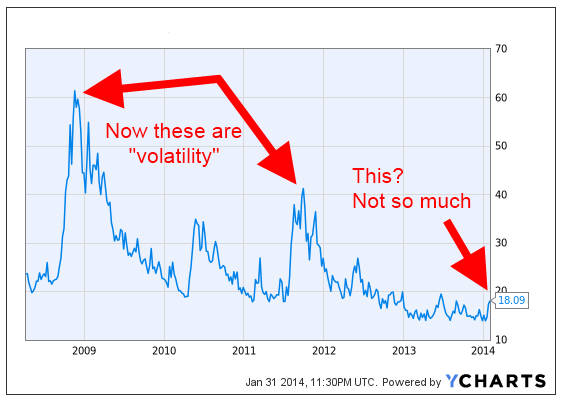
In the meantime volatility, which I always harp about in the hopes that it will increase, has done so, having gone slightly more than 50% higher in the past month and still having a long way to go until it returns even to 2011’s levels, which in turn were quite a bit lower than a couple of years prior.

With the possibility of increasing volatility will come greater reliance on monthly options rather than weekly.

The reasons for that are because the monthly options will finally be returning a decent premium in exchange for the additional time and also the longer term options give some opportunity to perhaps ride out any short term market decline that could occur when you blink your eyes.

With low volatility there is greater use of weekly options because it provides a better premium, but also because it doesn’t tie you down during a higher moving market. The downside is that if the share price moves against you you won’t have coverage for very long.

That’s the trade-off.

With increasing volatility usually comes a decrease in the number of new positions opened as it reflects a market that isn’t consistently continuing higher and higher and resulting in an unending stream of assignments.

But that increasing volatility also makes it easier to get a decent premium even using out of the money strikes. Coupled with longer term options even the orphaned positions suddenly have some hope of at least becoming contributing members to a portfolio.

In so many ways, even though at first blush it may seem as increasing volatility is a decided negative, there are many more opportunities that present themselves, especially if the increase in volatility isn’t accompanied by a rapidly plunging market. A slow decline in the broad index punctuated with some large moves up and down is all it takes to start seeing the volatility increase and the premiums follow right along.

We’ve certainly seen more of those large moves in the first month of 2014 than we saw in all of 2013.

This week starts off with cash reserves replenished a bit, but again, not as much as I would have liked.

This will likely mark another week when I’m not going to dip too deeply into those reserves, but I am probably willing to go from 30% to about 20%, which might leave room for 5 or so new positions, although if Apple, which goes ex-dividend this week is one of them, I may end up with fewer.

As a reminder, if Apple is a possibility, the mini-options are available for those that don’t want a full 100 share position. The mini-options allow contracts to be written on every 10 share lot and trades with good liquidity.

As with last week I’m going to sit back and see whether any early gains can persist after the first 60-90 minutes of trading. That has been a key for the past two weeks. Opening strength has been hard to maintain and there has been a price to be paid for jumping in trying to get ahead of the curve or thinking that value was about to disappear.

With only a handful of positions set to expire this Friday, despite starting to think more long term, if volatility continues higher, I w
ill also be looking to have more positions in play to expire this week, if the market looks as if it can sustain prices for those few days.

Lately, that hasn’t been a sure thing as week end fades have become the norm.


  Access prior Daily Market Updates by clicking here

 OTP Sector Distribution* as of January 31, 2014

 * Assumes equal number of shares in positions


Posting of trades is not a recommendation to execute trades


Monday through Thursday? See “Daily Market Update” with first edition published by 12 Noon and Closing Update published by 4:30 PM

Friday? See Week in Review for summary statistics and performance

Sunday? See Weekend Update for potential stock choices for coming week

Any day? See Performance for open and closed positions

Subscribers may see  ROI statistics  on all new, existing and closed positions on a daily updated basis


See all Trade Alerts for this monthly option cycle


Weekly Prospects (February 3 – 7, 2014)


MONDAY: Nikkei now officially in correction territory, but we start the week looking like an indifferent opening is in the works. Lots of earnings this week, but most big names already in the record books

TUESDAY:     Huge sell-off in Japan, but not seeming to translate here as the market prepares to open and Nikkei futures now also pointing broadly higher. We’ll see.

WEDNESDAY:  Nikkei has small rebound on same order as our own yesterday, signifying nothing. All eyes will be on ADP Report and then Friday’s Employment Situation Report

THURSDAY:    As long as Twitter and Green Mountain Coffee Roasters is able to keep everyone’s interest today could be another quiet day awaiting tomorrow’s Employment Report

FRIDAY:  Was yesterday’s advance justified? Not based on the first reaction to the disappointing Employment Report. Much weaker than expected.


” *SNEAK PEEK AT NEXT WEEK” APPEARS ON FRIDAYS *

Sneak Peek

* Sneak Peek selections subject to change before final Sunday posting


Daily Market Update – February 2, 2014

  
(see all trades this option cycle)
 
Daily Market Update – February 2, 2014 (Close)
The Week in Review and the Weekend Update are now posted, in addition to an accompanying article on potential earnings related trades this week.


Access prior Daily Market Updates by clicking here
OTP Sector Distribution* as of January 31, 2014
 * Assumes equal number of shares in positions


Posting of trades is not a recommendation to execute trades
 
Monday through Thursday? See “Daily Market Update” with first edition published by 12 Noon and Closing Update published by 4:30 PM
Friday? See Week in Review for summary statistics and performance
Sunday? See Weekend Update for potential stock choices for coming week
Any day? See Performance for open and closed positions

Subscribers may see  ROI statistics  on all new, existing and closed positions on a daily updated basis


See all Trade Alerts for this monthly option cycle


Weekend Update – February 2, 2014

Volatility is back!
That’s all you heard this week as the S&P 500 dropped 0.4% to end the unrequited January Rally that we had all been told was the historical norm.
As a covered option seller I have learned to embrace the uncertainty that ushers in a period of volatility, although I make no pretense of really understanding exactly how “volatility works. Like many things in life sometimes it’s simply easier to take one’s word for it.


 Just like when you’re told that volatility is back.

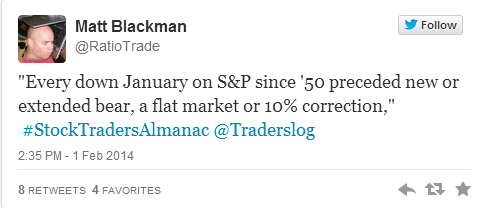
Or when social media suggests a relationship that isn’t borne out in historical fact, such as very notably in 2010 or about 50% of the other times January opened the year with a loss in the past 63 years.

While the expression “greed is good,” may be far more memorable, there’s not much debate for those who follow it that “volatility is good.” Not only does it create enhanced option premiums but it may also be the ultimate portfolio insurance.
For many people hearing that volatility has returned the only reasonable course of action is to head for the exits, because the very mention of the word is associated with wild rides, mostly in the wrong direction. For them volatility is far from good and is something to be feared and avoided.
That picture isn’t entirely accurate. Volatility is simply a measure of uncertainty and size. 2013 was a year of low volatility as there was a high degree of certainty when you arose each morning that the stock market would move higher on any given day. Additionally, it did so in a largely non-dramatic fashion. The movements were small, but consistent and sustained.
Suddenly the movements are now larger and can just as easily go in one direction as in the opposite one. The range has expanded, too. You don’t need a complex formula to have a qualitative sense that something is different. Not necessarily bad, just different.
But as long as we were talking about historical norms and how disappointing it was waiting for the historically predicted January Rally that never came, the cries welcoming back volatility may have lost track of what historical levels of volatility have been.

The volatility of this past week hasn’t even reached the levels seen in October 2013 back when the S&P 500 stood at 1655, which represented a loss similar to that currently at hand. The current level of volatility is certainly dwarfed by that seen in 2011, which itself was far smaller than that seen in late 2008.
2011 which was one of my favorite years saw the S&P 500 end the year precisely unchanged. However, during the course of the year there were regular triple digit moves, often in alternating direction and ultimately accomplishing nothing. That was a covered option seller’s greatest fantasy come true.
Yet the cries of the return of volatility weren’t making the rounds in October and spreading the specter of an imminent collapse of all that has preceded the market’s climb. While so many have spoken of a 5-10% decline being a healthy thing, some began to utter an heretofore unheard 15-20% range correction in the making.
For those that have been counting on an inflow of money that has been said to still reside on the sidelines to continue fueling the market’s rise the past week’s $12 billion in outflows from equity funds represented the highest level in two years. That represents selling that won’t likely be put back at risk very quickly, but it also represents money that won’t contribute to downward pressure on prices any time soon.
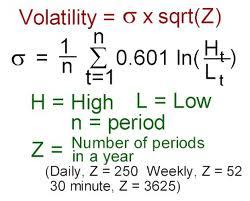
While volatility has risen significantly in the past week it has done so from 5 year lows. There is also certainly more upside to volatility than there is downside. It is with an understanding of the mathematical basis for volatility that there comes an appreciation for the manner in which volatility may be quickly magnified far beyond the seeming disruption in the market.
So no. Volatility isn’t back yet, but it can be in an imperceptible instant.
With the uncertainty that awaits low beta stocks may have special value and the sale of options may increasingly become inviting even at out of the money strike levels, something that hasn’t been the case in quite a while. The market may be said to not like uncertainty but it does have its rewards.
As usual, the week’s potential stock selections are classified as being in Traditional, Double Dip Dividend, Momentum and “PEE” categories this week (see details).
Apple (AAPL) briefly closed below $500 this week. Since not too many stocks occupy that kind of rarefied neighborhood it’s not too surprising that the last couple of times a big fuss was made about a stock falling below $500 it was Apple eliciting the anguish. While there has certainly been lots of debate following Apple’s recent disappointing sales, especially of its iPhone franchise, it does go ex-dividend this week and in its short history of paying a dividend it has generally performed well in its short term aftermath. That alone has me interested in addition to Apple’s low beta and head start on any market inspired drop. Others can debate Apple’s near term future and product cycles and innovations, but the combination of dividend and volatility enhanced premiums makes it look especially good as a choice for this week. The fact that Carl Icahn seems to have made a longer term commitment and has increasingly increased that commitment at least allows for misery to have company if the short term thesis is incorrect.
Another stock that has taken quite a significant fall in the past two weeks has been Starbucks (SBUX) down nearly 10% YTD and even down 4% since its earnings related jump in share price on a day when the market itself tumbled. Perhaps the market is concerned that CEO Howard Schultz may be removing himself more from daily operations, recalling the last time that occurred. However, the root cause of Starbucks’ difficulties earlier last decade, the unbridled expansion during a period of economic contraction, isn’t likely to be repeated. Starbucks is ex-dividend this week and may also be ahead of the curve of any further market declines. It too is showing some enhancement of its option premiums, particularly when dividend capture is also considered.
EMC Corporation (EMC) and its spin off VMWare (VMW) both reported earnings last week. Both declined as a result, with EMC suffering its own disappointment and also bearing some of the VMWare burden, owing to its continuing 80% ownership. While much attention was directed toward Microsoft (MSFT) this week as speculation heated up that an insider, whose own emphasis was on cloud based strategies would be the new CEO, EMC stock continues to languish in relative obscurity and trades in a fairly defined range. A low beta, despite its connection to VMWare,a decent dividend and option premium makes EMC an ever present consideration when seeking to round out the technology sector of my portfolio without wanting to take on undue risk.
On January 8th Transocean (RIG) was cut to “sector perform” from “sector outperform.” A week later it started a decline from the $48 level but without any company specific news, although similar companies, such as Seadrill (SDRL) and ENSCO (ESV) moved in unison. Transocean, after its decline is sitting at an 18 month low which occurred at the time of the temporary suspension of its dividend. With a dividend rate now standing at over 5% and a miniscule payout ratio, combined with its option premium it is one of those few stocks that I would consider owning at this moment without concomitant call sales on shares.
Mondelez (MDLZ) is most everyone’s idea of a lackluster and unexciting company. Because of its perceived mediocrity and uninspired leadership it has gotten the attention of the activist investment community. Unfortunately for pre-existing shareholders the ascension of Nelson Peltz to the Board of Directors was accompanied by the statement that he wouldn’t pursue a deal with PepsiCo (PEP) and subsequently shares significantly under-performed the S&P 500, despite a very low beta. As a result of its recent increased volatility its option premium is beginning to perk up and is getting interesting as it share price is returning to a more manageable level.
Joy Global (JOY) and Las Vegas Sands (LVS) speak to the differing fortunes found in China. While construction and infrastructure projects are slowing, as is the manufacturing index, apparently gaming is alive and well in Macao. After an initial plunge in shares in the after hours as Las Vegas Sands reported its earnings a better understanding of the details behind the report saw a quick reversal.
Las Vegas Sands was frequently owned stock in 2012, but less so in 2013 as I had been waiting for a price retreat that never came. The recent drop from $82 may be the best such drop to be had. While shares do trade at a higher beta than I am interested in pursuing to broadly round out my existing portfolio, indications are that the engines running Las Vegas Sands’ operations aren’t going to slow down in response to Chinese economic woes.
Joy Global on the other hand has engines that literally could be stalled by a faltering Chinese economy. Like many other companies highlighted this week it has greatly underperformed the broad market of late. While doing so shares have returned to near the mid-point of a very comfortable trading range and continues to offer an option premium in line with its volatility.
The coming week is another busy one for earnings. A more detailed look at this week’s earnings related trade considerations is available in an accompanying article. This week more candidates stand out as opportunities by virtue of meeting my ROI and risk criteria in addition to Twitter (TWTR) and Green Mountain Coffee Roasters (GMCR) identified in this article.
Green Mountain Coffee Roasters somehow continues to confound everyone by remaining relevant. While shrouded in controversy it has to be hailed as one of the great share comebacks in recent years, although it is throwing so many concepts into the air these days one has to wonder whether focus is getting dissipated as its core product lines increasingly become commodities and held hostage by agreements with other companies, such as Starbucks.
However, for an earnings related trade those issues may share a lack of relevancy with the company’s future prospects. Always volatile around earnings, with 20% price moves not unusual, the options market is implying an 11% earnings related move. For those content with a 1% ROI for a trade that may last a week or less, a price move of less than 15% lower could fulfill that objective.
Twitter reports its first earnings since its IPO this week.
That thought should be enough to convince people to stay away from shares even had it not had such a surge in share price since a shaky start. Last week it held onto Facebook’s earnings coattails and rose even higher. This week as it faces its first real scrutiny and potential pressure on shares, the options market is implying a 15.8% move in either direction. Again, for those content with a 1% ROI a strike price 22% below Friday’s close can deliver the reward. With at least one good support level and a couple of additional minor ones below that, the risk appears attenuated enough for at least consideration. That is until the next real challenge in mid-February when the first lock-up period comes to an end.
Finally, what’s a week without owning shares of eBay (EBAY)? After announcing earnings the week before last which were widely expected to be disappointing came the announcement from eBay itself that Carl Icahn had taken a position and was putting forward some ideas. The initial reaction was to propel shares toward the high point of its trading range, but eBay CEO Donahoe was quick to dismiss the idea of separating the PayPal unit from eBay and he seemed to have convinced the world that Icahn offered nothing new. He also convinced the world to give back the knee jerk gains.
While shares fared reasonably well this past week they are back in the range that I like to consider ownership, albeit at the upper end of that range. However, eBay, for all of the reasons people have disparaged its ownership has consistently been an excellent covered option purchase and wouldn’t be expected to melt under the pressure of a market at siege.
In the absence of any market moving international news particularly in the currency or debt markets I don’t expect much in the way of increasing volatility this coming week, but I wouldn’t mind the opportunity to party like it’s 2011.
Traditional Stocks: eBay, EMC, Mondelez, Transocean
Momentum Stocks: Joy Global, Las Vegas Sands
Double Dip Dividend: Apple (ex-div 2/6), Starbucks (ex-div 2/4)
Premiums Enhanced by Earnings: Green Mountain Coffee Roasters (2/5 PM), Twitter (2/5 PM)
Remember, these are just guidelines for the coming week. The above selections may become actionable, most often coupling a share purchase with call option sales or the sale of covered put contracts, in adjustment to and consideration of market movements. The overriding objective is to create a healthy income stream for the week with reduction of trading risk.

Earnings Still Matter

Last week confirmed that I still like earnings season, which as behavioral adaptations go, is a good idea, as it never seems to end. Better to learn to like it than to fight it.

Based upon comments heard over the past few weeks, approximately 25% of the year represent critical earnings weeks. You simply can’t escape the news, nor more importantly the impact.

Or the opportunity.

Of the earnings related trades examined last week, I made trades in two: Facebook (FB) and Seagate Technolgy (STX). The former trade being before earnings and the latter after, both involving the sale of out of the money puts. Both of those trades met my criteria, as in hindsight, did Chipotle Mexican Grill (CMG), but there’s always next quarter.

While hearing stellar numbers from Netflix (NFLX) and Facebook are nice, they are not likely to lead an economy and its capital markets forward, although they can lead your personal assets forward, as long as you’re willing to accept the risks that may be heightened during a weakening market.

Withimplied volatilitycontinuing to serve as my guide there are a number of companies that are expected to make large earnings related moves this week and they have certainly done so in the past.

Again, while I seek a 1% ROI on an investment that is hoped to last only
for the week, the individual investor can always adjust the risk and the reward. My preference continues to be to locate a strike price that is outside the range suggested by the implied volatility, yet still offers a 1% or greater ROI.

Typically, the stocks that will satisfy that demand already trade with a high degree of volatility and see enhanced volatility as earnings and guidance are issued.

The coming week is another busy one and presents more companies that may fit the above criteria. Among the companies that I am considering this coming week are Anadarko (APC), British Petroleum (BP), Green Mountain Coffee Roasters (GMCR), International Paper (IP), Michael Kors (KORS), LinkedIn (LNKD), Twitter (TWTR), Yelp (YELP) and YUM Brands (YUM).

As with all earnings related trades I don’t focus on fundamental issues. It is entirely an analysis of whether the options market has provided an opportunity to take advantage of the perceived risk. A quick glance at those names indicates a wide range of inherent volatility and relative fortunes during the most recent market downturn.

Since my preference is to sell puts when there is already an indication of price weakness this past week has seen many such positions trading lower in advance of earnings. While they may certainly go lower on disappointing news or along with broad market currents, the antecedent decline in share price may serve to limit earnings related declines as previous resistance points may be encountered and serve as brakes to downward movement. Additionally, the increasing volatility accompanying the market’s recent weakness is enhancing premiums, particularly if sentiment is further eroding on a particular stock.

Alternatively, rather than following the need for greed, one may decide to lower the strike price at which puts are sold in order to get additional protection wile still aiming for the ROI objective.

As always when considering these trades, especially through the sale of put options, the investor must be prepared to own the shares if assigned or to manage the options contract until some other resolution is achieved.

Strategies to achieve an exit include rolling the option contract forward and ideally to a lower strike or accepting assignment and then selling calls until assignment of shares.

The table above may be used as a guide for determining which of selected companies may meet the riskreward parameters that an individual sets, understanding that adjustments may need to be made as prices and, therefore, strike prices and premiums may change.

The decision as to whether to make the trade before or after earnings is one that I make based on perceived market risk. During a period of uncertainty, such as we are presently navigating, I’m more inclined to look at the opportunities after earnings are announced, particularly for those positions that do see their shares declining sharply.

While it may be difficult to find the courage to enter into new positions during what may be the early stages of a market correction, the sale of puts is a mechanism to still be part of the action, while offering some additional downside protection if using out of the money puts, while also providing some income.

That’s not an altogether bad combination, but it may require some antacids along the way.

Week in Review (January 27 – 31, 2014)


Option to Profit Week in Review
January 27 – 31, 2014
 
NEW POSITIONS/STO NEW STO ROLLOVERS CALLS ASSIGNED/PUTS EXPIRED CALLS EXPIRED/PUTS ASSIGNED CLOSED
5 / 5 1 3 4 / 0 4 / 0 0

    
Weekly Up to Date Performance
January 27 – 31, 2014
New purchases beat the time adjusted S&P 500 this week by 1.6% and also surpassed the unadjusted index by 1.8% during a week that saw the end to the worst performing month since 2010.
The market showed a small adjusted loss for the week of 0.2% and unadjusted loss of 0.4% for the week, while new positions gained  1.3%.
For the 25 positions positions closed in 2014, performance exceeded that of the S&P 500 by an unexpectedly large 1.5%. They were up 3.5% out-performing the market by 81%.  While my expectation is for the difference to be greater than 1% in a flat or down market, I don’t expect it to continue at that great of a difference as the year continues.
If you’re looking for a positive spin it’s hard to find one as the market ended a bleak January 2014.
Okay, but there were a few positives despite the lack of a January Rally.
On a positive note, despite a third successive down Friday the market made a great recovery, as it was looking as if it would be another 200 point range loss. Unfortunately, that recovery gave way in the final 30 minutes, but I wouldn’t get overly concerned about that, as there’s little value for big players to stay long over the weekend when there is international risk.
On another positive note some may have noticed that of the three rollovers this week two actually rolled up to higher strikes as suddenly the premiums are beginning to show some life as volatility perked up.
But that’s enough spinning.
This was another of those weeks that creates nervousness. You can’t rely on good earnings from Netflix and Facebook to carry an industrial economy forward.
Next week’s Employment Situation Report will be more important than usual, coming off of last month’s abysmal report.
As earnings season starts to wind down, with most of the important barometers now having reported, we may simply fall prey more to economic reports and the developing issues in the rest of the world.
While it remains counter-intuitive more of this churning back and forth, especially as it develops nervousness, is really a good thing for those selling options. The most humane way to arrive at a good place as far as getting those fatter premiums would be a slow and methodical decline. That would make it much easier to rollover positions and would likely require fewer new purchases, as assignments would be less frequent.
Having been in bear markets and corrections before, that’s really a good place to be.
The problem though, is that declines are rarely methodical. They tend to be swift and they tend to have given plenty of clues, yet everyone acts surprised when it does finally occur.
Human nature makes it difficult to learn, because, at heart, we’re all optimists.
What’s nice about a market decline if you have some degree of hedging going on is that you can still be an optimist or at least not feel the pressure as much as the next guy.
I don’t think that next week will necessarily be a continuation of the past week or January, for that matter.
While I really dislike adding to the list of uncovered positions I think that a number are well positioned to gain back some ground in order to restore their cover. That may also be made a little easier if volatility continues to increase, as the premiums will improve and make it more likely to be worthwhile to make some of the hedging trades.
While I would have liked even more assignments this week, it was an improvement over the situation the previous two weeks and opens up the possibility of staying in the game.
Next week is another earnings busy week and I’ll have another separate article focused on some of the potential earnings plays.
I’ve been somewhat reluctant to recommend some of those earnings related trades, as they usually are done through the sale of puts. The concept of puts isn’t always intuitively grasped by all and sometimes requires greater oversight. However, I’ve been making those trades for my own account and have been, for the most part, pleased.
Sometimes frustrated, but overall, pleased.
For those that haven’t considered those trades as part of their arsenal, consider reading this article on the role of puts in a conservative investing strategy  I’ve evloved quite a bit over the years regarding the role of puts and am glad that has been the case.
For those that communicate with me you know that I always welcome the communication. For those that don’t if you have any questions or want some clarification, fire away. Some of the best opportunities may come with otherwise risky trades that have their risk understood and attenuated.
Understanding the various tools, as well as considering a different mindset as spelled out in the “D’oh Strategy” are especially useful at a time when the market may finally be ready for a little bit of a break.


This week’s details may be seen in the Weekly Performance spreadsheet * or in the PDF file, as well as as in the summary.below
(Note: Duplicate mention of positions reflects different priced lots):

New Positions Opened:  BMY, CHK, FAST, IP, TXN
Puts Closed in order to take profits:  none
Calls Rolled over, taking profits, into the next weekly cycleANF, TXN
Calls Rolled over, taking profits, into extended weekly cycle:  none
CallsRolled over, taking profits, into the monthly cycle: MSFT
Calls Rolled Over, taking profits, into a future monthly cycle:  none
Calls Rolled Up, taking net profits into same cyclenone
New STO:  HFC
Put contracts sold and still open: none
Put contracts expired: none
Put contract rolled over: none
Long term call contracts sold:  none
Calls Assigned:  BMY, EBAY, IP, VZ
Calls Expired: C, HAL, INTC, LOW
Puts Assigned:  none
Stock positions Closed to take profits:  none
Stock positions Closed to take losses: none
Calls Closed to Take Profits: none
Ex-dividend Positions:  FAST (1/29 $0.25), TXN* (1/29 $0.30), C (1/30 $0.01)
* some reported early assignment of TXN shares
 
.


For the coming week the existing positions have lots that still require the sale of contracts:   AGQ, APC, C, CLF, DRI, FCX,  GPS,  HAL, INTC, LB, JCP, LOW, LULU, MCP, MOS,  MRO, NEM, PBR, PM, RIG, TGT, WAG, WFM, WLT (See “Weekly Performance” spreadsheet or PDF file)

* If you don’t have a program to read or modify spreadsheets, you can download the OpenOffice Suite at no cost.

Daily Market Update – January 31, 2014 (Close)

  
(see all trades this option cycle)
 
Daily Market Update – January 31, 2014 (Close)
The Week in Review is now posted  and the Weekend Update will be posted by 12 Noon on Sunday.


Access prior Daily Market Updates by clicking here
OTP Sector Distribution* as of January 31, 2014
 * Assumes equal number of shares in positions


Posting of trades is not a recommendation to execute trades
 
Monday through Thursday? See “Daily Market Update” with first edition published by 12 Noon and Closing Update published by 4:30 PM
Friday? See Week in Review for summary statistics and performance
Sunday? See Weekend Update for potential stock choices for coming week
Any day? See Performance for open and closed positions

Subscribers may see  ROI statistics  on all new, existing and closed positions on a daily updated basis


See all Trade Alerts for this monthly option cycle


Daily Market Update – January 31, 2014

  
(see all trades this option cycle)
 
Daily Market Update – January 31, 2014 (9:00 AM)
The Week in Review will be posted by 6 PM and the Weekend Update will be posted by 12 Noon on Sunday.
 
Today looks to be a tumultuous day. Possible trades include:
Assignments: BMY, EBAY, IP, TXN, VZ
RolloversANF, INTC, MSFT
Expirations: C, HAL, LOW
Trades, if any, will be attempted to be made prior to 3:30 PM (EST)


OTP Sector Distribution* as of January 30, 2014
 * Assumes equal number of shares in positions


Posting of trades is not a recommendation to execute trades
 
Monday through Thursday? See “Daily Market Update” with first edition published by 12 Noon and Closing Update published by 4:30 PM
Friday? See Week in Review for summary statistics and performance
Sunday? See Weekend Update for potential stock choices for coming week
Any day? See Performance for open and closed positions

Subscribers may see  ROI statistics  on all new, existing and closed positions on a daily updated basis


Daily Market Update – January 30, 2014 (Close)


(see all trades this option cycle)


Daily Market Update – January 30, 2014 (Close)

One nice thing about the market is that it doesn’t always hold a grudge.

It can lose 200 points one day and give indications of having totally forgotten about that blow out the very next morning.

For investors that often leads to confusion because human nature prefers to see continuity and slow transition. The market, on the other hand, although it is very much a product of human behavior, doesn’t always respond in the way that we are able to grasp.

Sometimes life would be much easier if we were all able to just move forward and not be weighed down by the past and our own prejudices. On the other hand, while we may occasionally take steps backward, for the most part we are forward moving beings. The market is anything but, although the past year it has behaved in a human fashion, by only taking small steps backwards and otherwise forging ahead.

Lately, however, the market has been acting like a human in the midst of a tail spin with predominant steps backwards and only an occasional gasp of life.

Was today’s 50% recovery of yesterday’s 200 point decline a gasp or a return to life?

That split in behavior, going from a forward charging entity to one that is tentative at best and manifests great nervousness with news doesn’t generate very much short term confidence.

Wouldn’t you rather know whether something is in the throes of a death spiral or simply taking a needed rest before continuing with a vibrant life?

The underlying components of the stock market, that is the companies that comprise the market are expressing some pessimism regarding their own future prospects for growth. Record level share buy backs are reflective of record levels of cash, but also of an inability to recognize opportunities to use that cash in a constructive fashion. A number of companies, such as Caterpillar and Cisco have been accused of having buyback programs that have been purchasing shares at values much too high,just so the cash wouldn’t be on the books and to use that cash to artificially prop up share price by simple supply and demand laws.

Since cash basically has a P/E of just 1, while it may be non-intuitive, may actually serve to keep a lid on share price. The more cash you have relative to your market capitalization the lower your P/E will be.

The reason that Cisco and Caterpillar’s actions are important is that in the past share buybacks were viewed as a reflection of the company’s opinion that its shares were bargain priced and was a sign to the rest of the world that investment in those was a good idea.

Now you can’t be quite as certain, although the optics of the situation result in better earnings per share and in the short term may move shares higher on that basis, as well as a shrinking supply of shares floating in the face of stable or increasing demand can still send shares higher.

As this week is coming to an end and earnings have been somewhat better than the previous week, hopefully we will end on an up note for a change and see some acceptable combination of rollovers and assignments.

However, placing lots of trickle down hope on the basis of earnings from Facebook and Netflix and other such companies that really don’t add great economic value across the spectrum is probably not a good idea.

While cutting edge is great for growth and creation of new markets, it’s still retail, construction, infrastructure that really moves us forward with confidence.

I can’t wait to be able to Tweet out that kind of good news when it actually happens and maybe increase GDP at the same time.


  Access prior Daily Market Updates by clicking here

 OTP Sector Distribution* as of January 30, 2014

 * Assumes equal number of shares in positions


Posting of trades is not a recommendation to execute trades


Monday through Thursday? See “Daily Market Update” with first edition published by 12 Noon and Closing Update published by 4:30 PM

Friday? See Week in Review for summary statistics and performance

Sunday? See Weekend Update for potential stock choices for coming week

Any day? See Performance for open and closed positions

Subscribers may see  ROI statistics  on all new, existing and closed positions on a daily updated basis


See all Trade Alerts for this monthly option cycle


Daily Market Update – January 30, 2014


(see all trades this option cycle)


Daily Market Update – January 30, 2014 (9:15 AM)

One nice thing about the market is that it doesn’t always hold a grudge.

It can lose 200 points one day and give indications of having totally forgotten about that blow out the very next morning.

For investors that often leads to confusion because human nature prefers to see continuity and slow transition. The market, on the other hand, although it is very much a product of human behavior, doesn’t always respond in the way that we are able to grasp.

Sometimes life would be much easier if we were all able to just move forward and not be weighed down by the past and our own prejudices. On the other hand, while we may occasionally take steps backward, for the most part we are forward moving beings. The market is anything but, although the past year it has behaved in a human fashion, by only taking small steps backwards and otherwise forging ahead.

Lately, however, the market has been acting like a human in the midst of a tail spin with predominant steps backwards and only an occasional gasp of life.

That split in behavior, going from a forward charging entity to one that is tentative at best and manifests great nervousness with news doesn’t generate very much short term confidence.

The underlying components of the stock market, that is the companies that comprise the market are expressing some pessimism regarding their own future prospects for growth. Record level share buy backs are reflective of record levels of cash, but also of an inability to recognize opportunities to use that cash in a constructive fashion. A number of companies, such as Caterpillar and Cisco have been accused of having buyback programs that have been purchasing shares at values much too high,just so the cash wouldn’t be on the books and to artificially prop up share price.

Since cash basically has a P/E of just 1, while it may be non-intuitive, may actually serve to keep a lid on share price. The more cash you have relative to your market capitalization the lower your P/E will be.

The reason that Cisco and Caterpillar’s actions are important is that in the past share buybacks were viewed as a reflection of the company’s opinion that its shares were bargain priced and was a sign to the rest of the world that investment in those was a good idea.

Now you can’t be quite as certain, although the optics of the situation results in better earnings per share and in the short term may move shares higher on that basis, as well as a shrinking supply of shares floating in the face of stable or increasing demand can still send shares higher.

As this week is coming to an end and earnings have been somewhat better than the previous week, hopefully we will end on an up note for a change and see some acceptable combination of rollovers and assignments.

However, placing lots of trickle down hope on the basis of earnings from Facebook and Netflix and other such companies that really don’t add great economic value across the spectrum is probably not a good idea.

While cutting edge is great for growth and creation of new markets, it’s still retail, construction, infrastructure that really moves us forward with confidence.

I can’t wait to be able to Tweet out that kind of good news when it actually happens.


  Access prior Daily Market Updates by clicking here

 OTP Sector Distribution* as of January 29, 2014

 * Assumes equal number of shares in positions


Posting of trades is not a recommendation to execute trades


Monday through Thursday? See “Daily Market Update” with first edition published by 12 Noon and Closing Update published by 4:30 PM

Friday? See Week in Review for summary statistics and performance

Sunday? See Weekend Update for potential stock choices for coming week

Any day? See Performance for open and closed positions

Subscribers may see  ROI statistics  on all new, existing and closed positions on a daily updated basis


See all Trade Alerts for this monthly option cycle