
Picking a Winner in the Pfizer-Zoetis Divorce

Strictly speaking, Pfizer’s (PFE) decision to separate from Zoetis (ZTS) is called a spin-off.

It did so initially on February 1, 2013 and there was much excitement about the prospects of being able to invest in the pets and livestock healthcare business, which was being touted as that portion of Pfizer that had the greater growth potential and by inference the greatest likelihood of out-performing the market and certainly out-performing stodgy old Pfizer, itself.

Certainly, if you are able to remember back to the heady days of Pfizer when Viagra was brought to an eager consumer demographic, there isn’t much reason to believe that sort of growth is in Pfizer’s future. From every logical point of view the best way to unlock shareholder value was to unleash hidden gems that were buried inside of a behemoth.

Additionally, if you look at the recent experience of the spin off by Conoco Phillips (COP) of its refiner arm, Phillips 66 (PSX) you might be of the belief that such spin-offs are akin to a license to print money.

By now Pfizer shareholders may have received the offer to exchange shares of Pfizer for Zoetis. With consummation of this offer, the separation of the two entities will be complete.

Pfizer refers to it as an “exchange offer to separate the Zoetis animal health business from Pfizer’s bio-pharmaceutical businesses in a tax-efficient manner, thereby enhancing stockholder value and better positioning Pfizer to focus on its core bio-pharmaceutical business.”I call that a divorce.

In some situations, I suppose that the children of divorce could see themselves as winners, particularly if they are able to leverage their parents against one another, but that sort of thing may be more common in situational comedies than in real life.

Perhaps shareholders of Pfizer see themselves as winners, as well, although, Zoetis shareholders may have a very different view of melding families.

On the surface, the offer looks very attractive. In a nutshell Pfizer shareholders are being given the opportunity to exchange $100 worth of their Pfizer shares for approximately $107.52 of Zoetis shares.

When in a red hot stock market, that kind of exchange is actually more than just appealing. Where else can you get a 7.52% return from one minute to the next?

For me, the decision isn’t quite so straightforward, as I have sold Pfizer calls with an expiration of June 22, 2013, while the deadline to respond to the offer is on June 17, 2013. There is no mechanism in the option market, particularly for contracts that may be exercised to identify those Pfizer shares that have been offered for tender.

There may, in fact, be some liability if, having sold calls and accepted the tender offer, the shares are subsequently assigned as a result of option exercise. That would be potentially onerous, especially if Zoetis shares were to go on a run higher, but I’m not overly concerned about that occurring.

But forget about me and my problems, or the problems of an option buyer. For the ordinary buy and hold investor the decision should be a fairly easy one to make.

Right?

Well not so fast.

For starters, the likelihood of being able to exchange all of your shares is small. There are over 7 billion shares of Pfizer and only about 400 million shares of Zoetis being offered. That’s good enough reason to inform shareholders that the exchange may be made on a pro-rata basis. Unlike a Facebook (FB) IPO offering you’re not likely to get more shares than you imagined.

Incidentally, about 75% of Pfizer’s shares are institutionally owned. The greatest likelihood is that those holdings are in excess of 100 shares per institution, but more on that later.

Assuming that everyone in the world salivates at the prospect of that 7.52% premium and the ability to cash in by selling shares of Zoetis, there are a number of considerations before counting your profits.

Among those considerations is that institutions, which currently only own approximately 18% of Zoetis shares, would be more facile in being able to unload shares quickly, as they are freely transferable upon exchange. That 7.52% premium may not be destined to withstand a lack of buyers, even if some discipline existed and there was an attempt to create orderly selling.

With the differential in the number of shares between the two companies, assuming that all shares were tendered, each shareholder would receive an allocation of about 6% of their request.

Before you get exp
osed to too much math, you should also know that there is a $30 fee to exchange shares. As with all investing transactions, there is an economy achieved in volume, especially when there’s a fixed price involved.

In the event that someone holds 100 shares of Pfizer, approximately 6 of those would be eligible for exchange, based on the assumption that all outstanding Pfizer shares would be offered for tender. The final number of shares of Zoetis received in exchange for Pfizer shares will be based upon an exchange rate as determined by the 3 day weighted closing price as announced on June 19, 2013, or after, if the deadline is extended by Pfizer.

For illustrative purposes, let’s assume the final Pfizer share price was $29. That would entitle the shareholder to $31.18 worth of Zoetis shares.

Your 6 share allocation would mean a profit on the exchange of $13.08, less the $30 transaction fee, leaving you with a loss of nearly $17.

That is an example of snatching defeat from the jaws of victory.

Of course if less than all shares are tendered the 100 share stock owner would fare better. If only 3 billion shares are offered for exchange he would break even.

Or would he?

The next part of the equation is what happens to Zoetis. At the moment the float is approximately 500 million shares, which will increase from one moment to the next to 900 million shares.

Then comes the real fun as there will certainly be those looking to quickly capitalize on that 7.52% differential before the opportunity disappears.

One can only imagine that would put some downward pressure on share price, which incidentally hasn’t fared terribly well since the initial spin-off.

Zoetis became a publicly traded company in a successful IPO, having been priced above expectations and closing up 19% on its first day of trading, from an IPO price of $26. Unlike Phillips 66, however, it hasn’t left its parent in the dust.
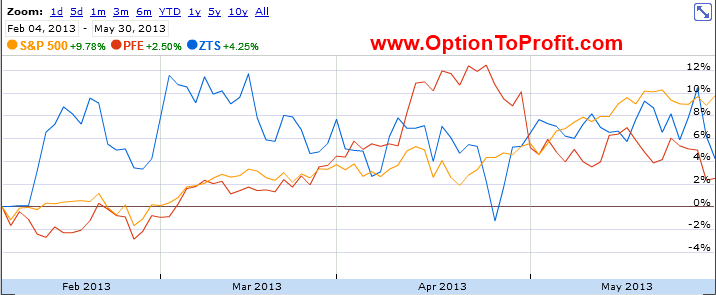
In fact, despite an early positive showing, Zoetis has lagged Pfizer in its performance, while both have trailed the S&P 500.

As with many stocks that hold the promise of growth, Zoetis doesn’t offer a terribly appealing dividend, although that could change as it has already been increased for Phillips 66. Currently the Zoetis yield is 0.8%. Compare that to the stodgy Pfizer that is yielding 3.4%

Ultimately. in terms of the offer itself, the fewer that express an interest, the far better the offer would likely be as allocations would be increased and pricing pressure on Zoetis would be decreased.

A classic battle of greed versus common sense.

As an inveterate option seller, I have an additional consideration. Zoetis does offer option contracts, but unlike Pfizer it does not offer weekly contracts, nor does it have a multitude of unit denominated strike prices, making the prospects of holding shares less attractive for me.

With a bit more than two weeks until a decision is required my initial reaction to the offer has undergone quite a transformation, but I’ll still end up following the numbers and determining whether some additional return can be squeezed out of the transaction owing to the size of my Pfizer position

While I now anticipate the possibility of continuing to hold onto my Pfizer shares, I do hope that perhaps someone who hasn’t given the subject too much thought may end up exercising their $29 option early, at a price below the strike, as they may perceive Pfizer priced at anything greater than $27 to be the equivalent of Zoetis priced at $29 and hope to make a killing in what they believe to be an arbitrage opportunity.

Maybe divorce isn’t that bad? At least if you don’t think about it too much.


Picking a Winner in the Pfizer-Zoetis Divorce

Strictly speaking, Pfizer’s (PFE) decision to separate from Zoetis (ZTS) is called a spin-off.

It did so initially on February 1, 2013 and there was much excitement about the prospects of being able to invest in the pets and livestock healthcare business, which was being touted as that portion of Pfizer that had the greater growth potential and by inference the greatest likelihood of out-performing the market and certainly out-performing stodgy old Pfizer, itself.

Certainly, if you are able to remember back to the heady days of Pfizer when Viagra was brought to an eager consumer demographic, there isn’t much reason to believe that sort of growth is in Pfizer’s future. From every logical point of view the best way to unlock shareholder value was to unleash hidden gems that were buried inside of a behemoth.

Additionally, if you look at the recent experience of the spin off by Conoco Phillips (COP) of its refiner arm, Phillips 66 (PSX) you might be of the belief that such spin-offs are akin to a license to print money.

By now Pfizer shareholders may have received the offer to exchange shares of Pfizer for Zoetis. With consummation of this offer, the separation of the two entities will be complete.

Pfizer refers to it as an “exchange offer to separate the Zoetis animal health business from Pfizer’s bio-pharmaceutical businesses in a tax-efficient manner, thereby enhancing stockholder value and better positioning Pfizer to focus on its core bio-pharmaceutical business.”I call that a divorce.

Finish reading this Article on Seeking Alpha


That was the Crash, Dummy

That was the crash, dummy.

“I’ll know it when I see it,” is a common refrain when you’re at a loss for just the right descriptors or just can’t quite define what it is that should be obvious to everyone.

While there are definitions for what constitutes a recession, for example, an individual may have a very good sense of personally being in one before anyone else recognizes or confirms its existence.

Certainly there’s also a distinction between a depression and a recession, but it’s not really necessary to know the details, because you’ll probably know when you’ve transitioned from one to another.

The same is probably true when thinking about the difference between a market crash and a market correction. While people may not agree on a standard definition of what constitutes either, a look at your own portfolio balance can be all the definition that you need.

I’ve been waiting, even hoping for a correction for over two months now. That hoping came to a crescendo as a covered option writer with the expiration of many May 2013 contracts and finding more cash than I would have liked faced with the aspects of either being re-invested at a top or sitting idly.

Then came Federal Reserve Chairman Ben Bernanke’s congressional testimony and the mixed signals people perceived. Was it tapering or not tapering? Was it now or later?

Finish reading this article on Seeking Alpha


Weekend Update – May 26, 2013

That was the crash, dummy.

“I’ll know it when I see it,” is a common refrain when you’re at a loss for just the right descriptors or just can’t quite define what it is that should be obvious to everyone.

While there are definitions for what constitutes a recession, for example, an individual may have a very good sense of personally being in one before anyone else recognizes or confirms its existence.

Certainly there’s also a distinction between a depression and a recession, but it’s not really necessary to know the details, because you’ll probably know when you’ve transitioned from one to another.

The same is probably true when thinking about the difference between a market crash and a market correction. While people may not agree on a standard definition of what constitutes either, a look at your own portfolio balance can be all the definition that you need.

I’ve been waiting, even hoping for a correction for over two months now. That hoping came to a crescendo as a covered option writer with the expiration of many May 2013 contracts and finding more cash than I would have liked faced with the aspects of either being re-invested at a top or sitting idly.

Then came Federal Reserve Chairman Ben Bernanke’s congressional testimony and the mixed signals people perceived. Was it tapering or not tapering? Was it now or later?

What came as a result was what some called a “Key Reversal Day.” That is a day when the market reaches new highs and then suddenly reverses to go even lower than the previous day’s low. It’s thought that the greater the range of movement and the greater the trading volume the more reliable of an indicator is the reversal,

On both counts the aftermath of the reaction to Bernanke’s words, or as the “Bond King” Bill Gross of PIMCO called “talking out of both sides of his mouth” was significant.

Was that the beginning of the long over-due correction? After all we are now in the 52nd month of the current bull run, which has been the duration of the past two.

With news that the Japanese market lost more than 7% overnight following our own key reversal day was the sense that the correction may take on crash-like qualities, but instead our own markets almost had another key reversal day, but this time in the other direction. After an early 150 point drop and subsequent recovery all that was missing was to have exceeded the previous day’s high point.

Correction? Crash? That was so yesterday. It’s time to move on, dummy

While hopeful that some kind of correction might bring some meaningful opportunities to pick up some bargains, the correction was too shallow and the correction to the correction was too quick.

So this week is more of the same. Nearly 50% cash and no place to go other than to be mindful of a great 1995 article by Herb Greenberg that has some very timeless investing advice in the event of a crash, having drawn upon some Warren Buffett, Bob Stovall and Jeremy Siegel wisdom.

As usual, the week’s potential stock selections are classified as being in Traditional, Double Dip Dividend, Momentum or the “PEE” category (see details).

Already owning shares of both Deere (DE) and Caterpillar (CAT), as I often do, a frequent companion is their more volatile counter-part, Joy Global (JOY). Always sensitive to news regarding the Chinese economy, Joy Global reports earnings this week, as well, which certainly adds to its risk profile. Most recently the news coming out of China has pointed toward slowing growth, although historically the Chinese data have demonstrated as much ability to contradict themselves longitudinally as the US data. I believe bad news is already incorporated into the current prices of the heavy machinery sector and all three of these companies are trading within a long established price range that provides me some level of comfort, even in a declining market. For that reason, I may also add shares of Deere, particularly if it approaches $85.

Morgan Stanley (MS) has gone along the uphill ride with the rest of the financial sector in recent weeks. It was among the many stocks whose shares I lost to assignment at the end of the May 2013 cycle, but it too, has been a constant portfolio companion. It tends to have greater European exposure than its US competitors, but for the time being it appears as if much of the European drama is abating. Over the past year it’s shares have traded in a wide range but has shown great resilience when the price has been challenged and has offered very attractive premiums to help during the periods of challenge.

Unlike the prior week, this past week wasn’t very good for the retailers. WIth earnings now past, one of the elite, JW Nordstrom (JWN) goes ex-dividend this week. While it still has downside room, even after a 3% earnings related drop along with the rest of the more “high end” oriented retailer sector, it will likely out-perform other lesser retailers in the event of a market pause.

Also in the higher end range, Michael Kors (KORS) has been one of my recent favorites, although I must admit I didn’t see the reason for the excitement on a retail level during a recent early morning trip to the mall. No matter, I’m not in their demographic. What I do know is that their shares move with great ease in either direction, other reversing course during the trading session and it offers an appealing option premium. That premium is a bit more enhanced as it reports earnings this week and I may look to establish a position after having shares also assigned recently.

I approach any purchases in the Technology sector with some concern for being over-invested in such shares. Although Cypress Semiconductor (CY) is now trading 10% higher from where I had shares recently assigned on two previous occasions it continues to offer a reasonably attractive options premium and trades in a stable price range.

Lexmark (LXK) is now well above the strike price that I had shares recently assigned. It’s appeal is enhanced by being ex-dividend this week and the knowledge that it appears to have gotten beyond the initial shock that this “printer maker” was getting out of the “Printer maker” business. Thus far, it appears as if the transition to a more content management and solutions oriented company is proceeding smoothly.

Also going ex-dividend this week is one of the little known, but largest owner of television stations around the nation. Sinclair Broadcasting (SBGI). It may be in position to pick up a rare gem as an ABC station in Washington, DC is rumored to be available for purchase. While it has appreciated significantly in the past two months, it’s shares are down approximately 7% from recent highs.

Not that I would suggest lighting up one of their products while watching a fine situation comedy being broadcast by SInclair, but Lorillard (LO), which assuages some of its health related guilt by offering a rich dividend, does go ex-dividend this week. It too, has been trading higher of late, but is down just a bit from its recent high.

Finally, Salesforce.com (CRM) reported earnings after this past Thursday’s (May 23, 2013) closing bell. The market assessed an 8% penalty for its disappointing numbers, but that should just be a minor bump in their road and not likely a deep pothole. Unfortunately, I didn’t execute the earnings related put sale trade last week as I thought I might, which would have returned 1% even in the face on an 8% drop in share price, but this week brings new opportunity, only on the share purchase and option sale side.

In fact, I was so convinced by the previous paragraph that I sent out that Trading Alert on Friday rather than waiting for Tuesday.


Traditional Stocks: Cypress Semiconductor, Deere, Morgan Stanley, Salesforce.com

Momentum Stocks: none

Double Dip Dividend: JW Nordstrom (ex-div 5/29), Lexmark (ex-div 5/29), Lorillard (ex-div 5/29), Sinclair Broadcasting ex-div 5/29)

Premiums Enhanced by Earnings: Joy Global (5/30 AM), Michael Kors (5/29 AM)

Remember, these are just guidelines for the coming week. Some of the above selections may be sent to Option to Profit subscribers as actionable Trading Alerts, most often coupling a share purchase with call option sales or the sale of covered put contracts. Alerts are sent in adjustment to and consideration of market movements, in an attempt to create a healthy income stream for the week with reduction of trading risk.


Weekend Update – May 19, 2013

Shades of 1999.

I’m not certain that I understand the chorus of those claiming that our current market reminds them of 1999.

Mind you, I’m as cautious, maybe much more so than the next guy and have been awaiting some kind of a correction for more than 2 months now, but I just don’t see the resemblance.

Much has also been made of the fact that the S&P 500 is now some 12% above its 200 Day Moving Average, which in the past has been an untenable position, other than back when sock puppets were ruling the markets. Back then that metric was breached for years.

Back in 1999 and the years preceding it, the catalyst was known as the “dot com boom” or “dot com bubble” or the “dot com bust,” depending on what point you entered. The catalyst was clear, perhaps best exemplified by the ubiquitous sock puppet and the short lived PSINet Stadium, back then home to the world Champion Baltimore Ravens. The Ravens survived, perhaps even thrived since then, while PSINet was a casualty of the excesses of the era. When it was all said and done you could stuff PSINet’s assets into a sock.

During the height of that era the catalyst was thought to be in endless supply. But in the current market, what is the catalyst? Most would agree that if anything could be identified it would likely be the Federal Reserve’s policy of Quantitative Easing.

But as last week’s rumor of its upcoming end and then an article suggesting that the Federal Reserve already has an exit plan, the catalyst is clearly not thought to be unending. Unless the economy is much worse than we all believe it to be the fuel will be depleted sooner rather than later.

Now if you’re really trying to find a year comparable to this one, look no further than 1995, when the market ended the year 34% higher and never even had anything more than a 2% correction.

If llke me, and you’re selling covered options; let’s hope not.

For me, this Friday marked the end of the May 2013 option cycle. As I had been cautious since the end of February and transitioned into more monthly option contract sales, I am faced with a large number of assignments. Considering that the market has essentially been following a straight line higher having so many assignments isn’t the best of all worlds.

While I now find myself with lots of available cash the prevailing feeling that I have is that there is a need to protect those assets more than before in anticipation of some kind of correction, or at least an opportunity to discover some temporary bargains.

This week I have more than the usual number of potential new positions, however, I’m unlikely to commit wholeheartedly to their purchase, as I would like to maintain about a 40% cash position by the end of next week. I’m also more likely to continue looking at monthly option sales rather than the weekly contracts.

As usual, the week’s potential stock selections are classified as being in Traditional, Double Dip Dividend, Momentum or the “PEE” category (see details). Additionally, although the height of earnings season has passed there may still be some more opportunity to sell well out of the money puts prior to earnings on some reasonably high profile names..

There’s no doubt that the tone for the week was changed by the down to earth utterances of David Tepper, founder of the Appaloosa Hedge Fund. He has a long term enviable record and when he speaks, which isn’t often, people do take notice. Apparently markets do, as well.

However, among the things that he mentioned was that he had lightened up on his position in Apple (AAPL). It didn’t take long for others to chime in and Apple shares fell substantially even when the market was going higher. Although I was waiting for Apple to get back into the $410-420 range, the rebound in share price following news of reduced positions by high profile investors is a good sign and I believe warrants consideration toward the purchase of new shares.

I recently purchased shares of Sunoco Logistics (SXL) in order to capture its generous and reliable dividend. My shares were assigned this past Friday, but I’m willing to repurchase, even at a higher price and even with a monthly option contract to tie me down. In the oil services business it is a lesser known entity and trades with low volume, however, it will share in sector strength, just in a much more low profile manner.

Pfizer (PFE) is another stock that was recently purchased in order to capture it’s dividend and premium and was also assigned this past week. However, it is among the “defensive” stocks that I think would fare relatively well regardless of near term market direction. Like many others that do offer weekly options, my inclination is to consider the selling monthly contracts for the time being.

While healthcare has certainly already had its time in the sun in 2013 and Bristol Myers Squibb (BMY) has had its share of that glory, after some recent tumult in its price and most recently its next day reversal of a strong move the previous day, I find the option premium appealing. However, as opposed to Pfizer, which I’m more inclined to consider a monthly option, Bristol Myers has too much downside potential for me to want to commit for longer periods.

Although I already own shares of Petrobras (PBR) and am not a big fan of adding additional shares after such a strong climb hig
her off of its rapidly achieved lows, Petrobras recently and quietly had quite an achievement. WHile everyone was talking about Apple’s $17 Billion bond offering that had about $50 Billion in bids, Petrobras just closed an $11 Billion offering with more than $40 Billion in bids.

Caterpillar (CAT), which I also currently own, is a perennial member of my portfolio. To a very large degree it has been recently held hostage to rumors of contraction and slowing in the Chinese economy. It has, however, shown great resiliency at the current price level and has been an excellent vehicle upon which to sell call options.

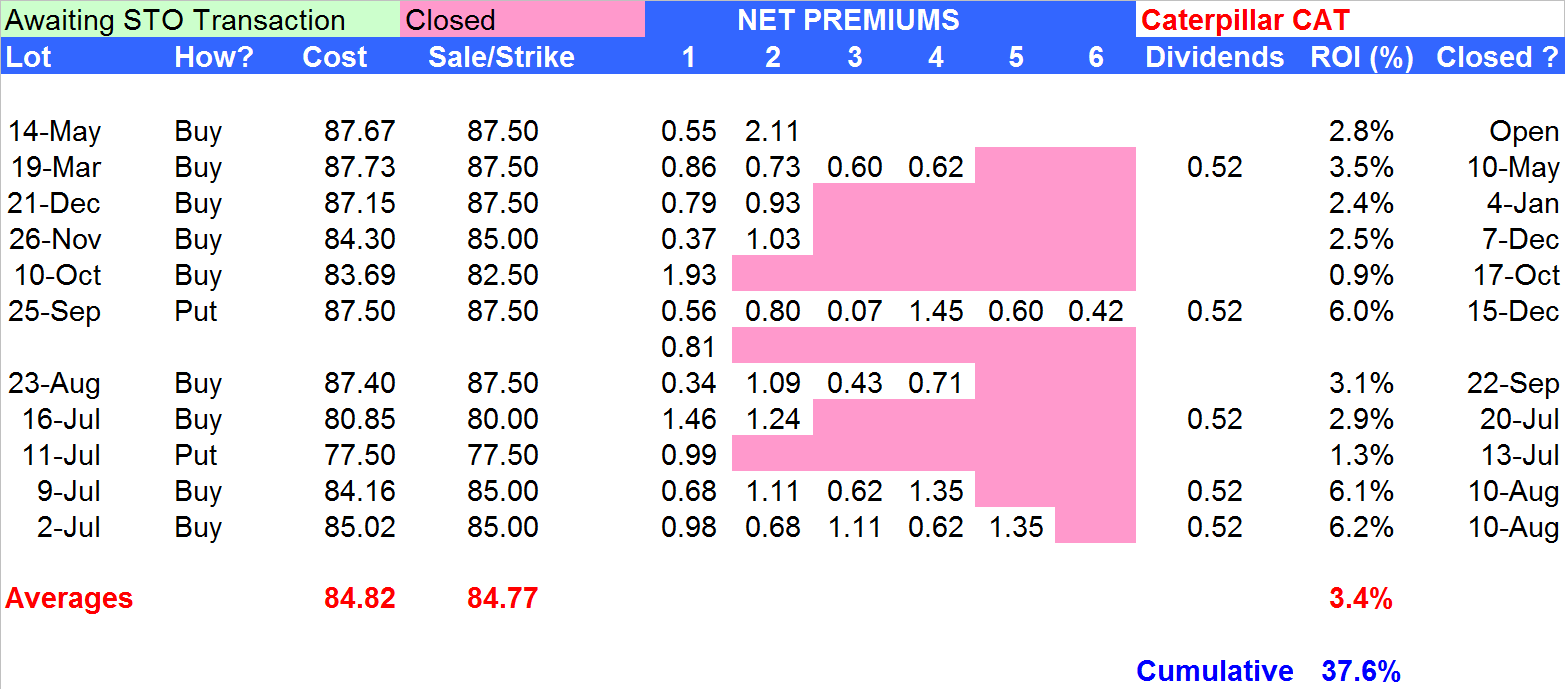
As shown in the table above, I’ve owned shares of Caterpillar on 11 separate occasions in less than a year. While the price has barely moved in that period, the net result of the in and out trades, as a result of share assignments has been a gain in excess of 35%.

The more ambiguity and equivocation there is in understanding the direction of the Chinese economy the better it has been to own Caterpillar as it just bounces around in a fairly well defined price range, making it an ideal situation for covered call strategies.

Continuing the theme of shares that I currently own, but am considering adding more shares, is British Petroleum (BP). With much of its Deepwater Horizon liabilities either behind it or well defined, shares appear to have a floor. However, in the past year, that has already been the case, as my experience with British Petroleum ownership has paralleled that of Caterpillar in both the number of separate times owning shares and in return – only better.

Of course, better than either Caterpillar or British Petroleum has been Chesapeake Energy (CHK). I’ve owned it 18 times in a year. It too has had much of its liability removed as Aubrey McClendon has left the scene and it is already well known that Chesapeake will be selling assets under a degree of duress. With its turnaround on Thursday and dip below $20, I am ready to add even more shares.

I’ve probably not owned Conoco Phillips (COP) as much as I would have imagined over the past year probably As a result of owning British Petroleum and Chesapeake Energy so often. Shares do go ex-dividend this week which always adds to the appeal, particularly when I’m in a defensive mode.

Salesforce.com (CRM) was a recommendation last week. I did make that purchase and subsequently had shares assigned. This week it reports earnings and as many of the earnings related trades that I prefer, it offers what I believe to be a good option premium even in the event of a large downward move. In this case a 1% return for the week may be achieved if share price doesn’t exceed 8%

Sears Holdings (SHLD) always seems like a ghost town when I enter one of its stores, although perhaps a moment of introspection would indicate that I drive shoppers away. I’m aware of other story lines revolving around Sears and its real estate holdings, but tend not to think in terms of what has been playing out a s a very, very long term potential. Instead, I like Sears as a hopefully quick earnings trade.

In a week that saw beautiful price action from Macys (M), Kohls (KSS) and others, perhaps even Sears can pull out good numbers and even provide some positive guidance. However, what appeals to me is a put sale approximately 8% below Friday’s close that could offer a 4% ROI for the month or shorter.

Another retailer, The Gap (GPS), has certainly been an example of the ability to arise from the ashes and how a brand can be revitalized. Along with it, so too can its share price. The Gap reports earnings this week and has already had an impressive price run. As opposed to most other earnings related trades, I’m not looking for a significant downward move and the market isn’t expecting such a move either. Based on some of the strong retail earnings announced this past week I think The Gap may be an outright purchase, but I would be more likely to look at a weekly option sale and hope for quick assignment of shares.

TIVO (TIVO) is one of those technologies that I’ve never adopted. Maybe that’s because I never leave the house and the television is always on and I rarely see a need to change the station. But here, too, I believe TIVO offers a good short term opportunity even if shares go down as much as 20% following Monday’s earnings release. In the event that shares go appreciably higher, it is the ideal kind of earnings trade, in that coming during the first day of a monthly option contract, it could likely be quickly closed out and the money then used for another investment vehicle.

Om the other hand, Dunkin Brands (DNKN) is definitely one of those technologies that I’ve adopted, especially when having lived in New England. Fast forward 20 years and they are now everywhere in the Mid-Atlantic and spreading across the country as their new offerings also spread waists around the country. Going ex-dividend this coming week and offering a nice monthly option premium, I may bite at more than a jelly donut. However, it is trading at the upper end of its recent price range, like all too many other stocks.

Finally, Carnival (CCL) hasn’t exactly been the recipient of much good news lately. Although it’s up from its recent woes and lows. It does report earnings at the end of the June 2013 option cycle, but it also goes ex-dividend in the first week of the cycle, in addition to a offering a reasonable option premium

Traditional Stocks: Bristol Myers, Caterpillar, Pfizer, Sunoco Logistics

Momentum Stocks: Apple, Chesapeake Energy, Petrobras

Double Dip Dividend: Carnival Line (ex-div 5/22), Conoco Phillips (ex-div 5/22), Dunkin Brands (ex-div 5/23)

Premiums Enhanced by Earnings: Salesforce.com (5/23 PM), Sears Holdings (5/23 AM), The Gap (5/23 PM), TIVO (5/20 PM)

Remember, these are just guidelines for the coming week. Some of the above selections may be sent to Option to Profit subscribers as actionable Trading Alerts, most often coupling a share purchase with call option sales or the sale of covered put contracts. Alerts are sent in adjustment to and consideration of market movements, in an attempt to create a healthy income stream for the week with reduction of trading risk.


Weekend Update – May 12, 2013

There’s certainly no way to deny the fact that this has been an impressive first 4 months of the year. The recently touted statistic was that after 4 months and one week the market had gone up 13%.

To put that into the perspective the statistic wanted you to have, the statistical factoid added that for all of 2012 the market was up only 7.2%. That certainly tells you not only how impressive this gain has been but how 2013 will undoubtedly leave 2012 in the dust.

What is left unmentioned is that in 2012, in a period of only 3 months and 1 week the market was up 12.9%.

What happened? Could that happen again? Those are questions asked by someone who turned cautious when the market was up less than 8% in 2013 and wasn’t adequately cautious in 2012.

SInce 1970, the S&P 500 has finished the year with gains of greater than 14% on a total of 16 occasions, so there could easily be more to come. That can easily be a justifiable perspective to hold unless you also look at the margins by which 14% was exceeded. In that event, the perspective becomes less compelling. It’s still possible to end the year substantially higher than 14%, just not as likely as such a great start might suggest.

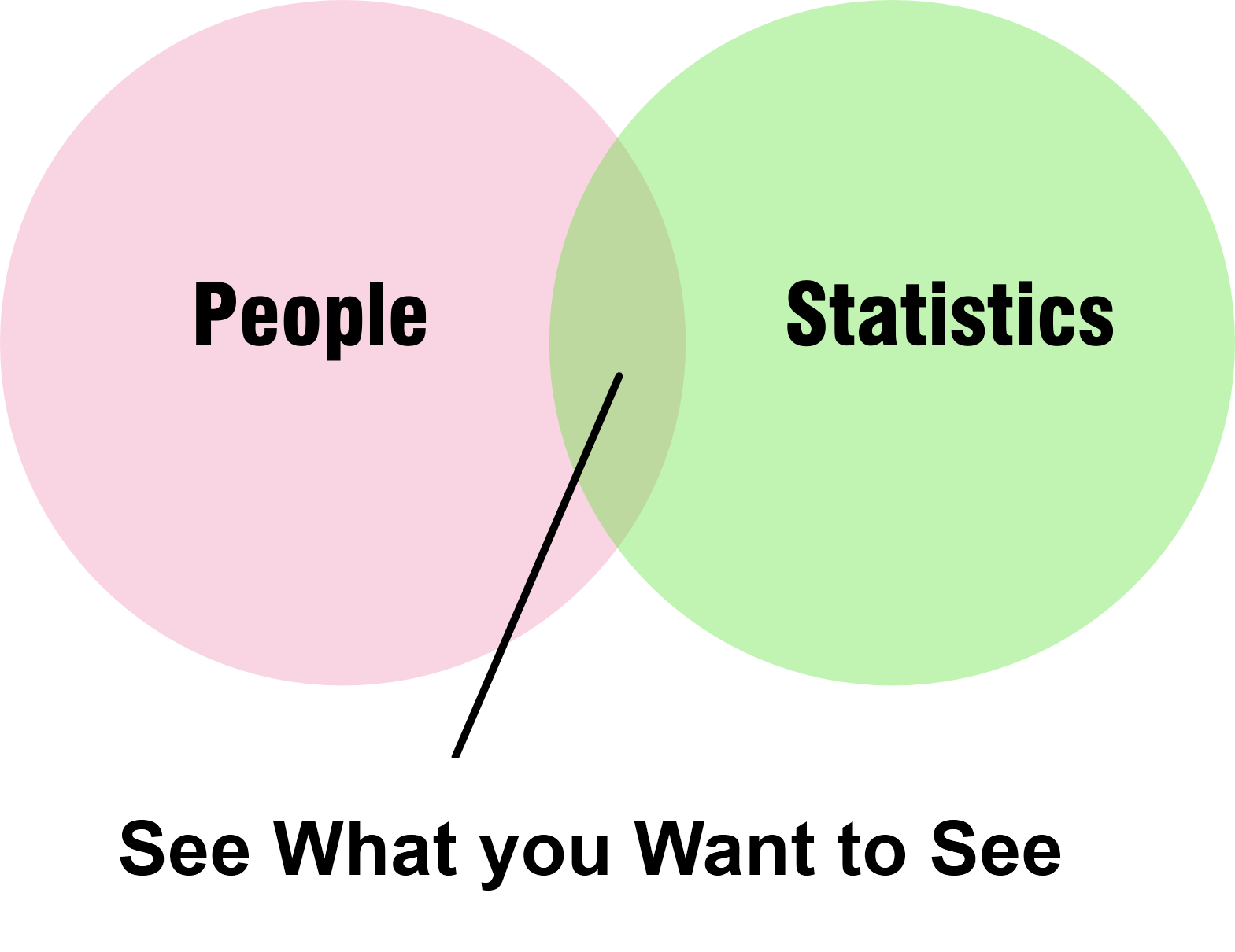
But remember, statistics don’t mislead people. People mislead people.

There was little to no substantive news this past week as the market just continued on auto-pilot. If you owned shares of any of the stocks that had super-sized moves after earnings, such as Tesla (TSLA) or Green Mountain Coffee Roasters (GMCR), that was news enough. But for the rest of us it was quiet.

What was interesting, however, was the behavior of the market during the final hour of Thursday’s trading.

That period marked a turnaround sending the market quite a bit lower, at least based on recent standards when only higher seems to be the order of the day. Initially, the drop was ascribed to a strengthening of the dollar and further drop in gold. Those, however, had been going on for a while, having started earlier in the trading session.

What came to light and whose timing was curiously coincident with the market change in direction was a rumor of a rumor that someone from within JP Morgan (JPM) was suggesting that the Federal Reserve was ready to begin tapering its Treasury purchases, those signaling the beginning of an end to Quantitative Easing.

For the growing throng that believe that QE has been responsible for the market’s climb higher, life after QE couldn’t possibly be rosy.

First comes an errant AP Tweet, then an unconfirmed rumor of a rumor. Those incidents would seem to indicate vulnerability or at least an Achilles heel that could stand in the way of this year becoming the 17th in the list.

Easily said, but otherwise, there’s really not much else on the radar screen that appears poised to interfere with the market’s manifest destiny. Unless of course, Saturday’s Wall Street Journal report that the Federal Reserve has indeed mapped out a strategy for winding down QE, transforms rumor into potential reality.

As usual, the week’s potential stock selections are classified as being in Traditional, Double Dip Dividend, Momentum or “PEE” categories (see details). Additionally, as the week unwinds, I may place relatively greater emphasis on dividend paying stocks and give greater consideration to monthly contracts, in order to lock into option premiums for a longer period in the event that 2012 is the order of the day.

This week’s selections seem to have more healthcare stocks than usual. I know that healthcare may have already run its course as it was a market leader through the first 4 months of 2012, but some individual names haven’t been to the party or have recently fallen on hard times.

Amgen (AMGN) didn’t react terribly well following its recent earnings report, having fallen 6%. That’s not to say that it hadn’t enjoyed a nice gain in 2013. However, it does offer an attractive short term option premium, despite also being ex-dividend this week. That’s a combination that I like, especially when I still remain somewhat defensive in considering opening new positions.

Eli Lilly (LLY) is also trading ex-dividend this coming week. It has under-performed the S&P 500 this year, but still, a 10% gain YTD isn’t a bad four months of work. It has fallen about 7% since reporting its most recent quarter’s earnings.

Merck (MRK) isn’t joining the ex-dividend parade this week, but will do so during the June 2013 option cycle for those a little more long term oriented than I typically tend to be. However, during a period of having repositioned myself defensively, the longer term options have utility and can provide a better price cushion in the event of adverse market moves.

I’ve owned shares of Conoco Phillips (COP) only once since the spin-off of its refinery arm, Phillips 66 (PSX). It used to be a very regular part of my portfolio prior to that occasion. The parent certainly hasn’t fared as well as the child in the 15 months since Phillips 66 has traded as a public company. The 80% difference in return is glaring. But like so many stocks, I think Phillips 66 isn’t priced for a new purchase, while Conoco Phillips represents some opportunity. Additionally, though not yet announced, there should be a dividend forthcoming in the next week or two.

I don’t recall why I didn’t purchase shares of Marathon Oil (MRO) last week after a discussion of its merits, but it probably had to do with the limited buying I was doing across the board. It reported earnings last week, perhaps that was a risk factor that didn’t have commensurate reward in the option premiums offered. But this week, with that risk removed, it goes ex-dividend and the consideration begins anew.

Although I already own shares of JP Morgan, I would consider adding to that position. Regardless of what your opinion is on the issue of separating the roles of Chairman and CEO, there’s not too much disagreement that Jamie Dimon will forever be remembered as one of the supporting pillars during and in the immediate aftermath of our financial meltdown. The recent spate of diversions has kept JP Morgan from keeping pace with the S&P 500 during 2013, but I believe it is capable of cutting that gap.

Autodesk (ADSK) reports earnings this week and is down about 4% from its recent high. I often like to consider earnings trades on shares that are already down somewhat, however, shares are up quite a bit in the past 3 weeks. While the options market was implying about a 6% move upon earnings, anything less than a 7% move downward could offer a 1.1% option premium for the week’s exposure to risk.

Salesforce.com (CRM) is another of those rare companies that haven’t kept up with market lately. That’s been especially true since its recent stock split. Although it does offer a an attractive weekly premium, the challenge may lie the possibility that shares are not assigned as the May 2013 option cycle ends, because earnings are reported during the first week of the June 2013 cycle. Barring a large downward move prior to earnings, there would certainly be ample time to re-position with another weekly or even monthly option contract prior to earning’s release.

To round off my over-exposure to the technology sector, I may consider either adding more shares of Cisco (CSCO) or selling puts in advance of this week’s earning’s report. I’ve added shares in each of three successive weeks and don’t believe that Cisco’s earnings will reflect some of the woes expressed by Oracle (ORCL). My only personal concern is related to the issue of diversification, but for the moment, technology may be the sector in which to throw caution to the wind.

US Steel (X) has been one of those stocks that I’m not terribly happy about, although that really only pertains to the current lot that I hold. Along with pretty much everything in the metals complex, US Steel hasn’t fared very well the past few months. However, I think that I am ready for a resurgence in the sector and am hoping that the sector agrees with me, or at least continues to show some strength as it has this past week.

Finally, despite having owned Facebook (FB) since the IPO and currently owning two individual lots, priced at $29 and $27.17, it remains one of my favorite new stocks. Not because I can count on it going to $30, but because I can count on it staying in a reasonable pricing neighborhood and becoming a recurrent stream of option income.

Traditional Stocks: Cisco, Conoco Phillips, Merck, Salesforce.com

Momentum Stocks: Facebook, US Steel

Double Dip Dividend: Amgen (ex-div 5/14), Eli Lilly (ex-div 5/14), Marathon Oil (ex-div 5/14)

Premiums Enhanced by Earnings: Autodesk (5/16 PM)

Remember, these are just guidelines for the coming week. Some of the above selections may be sent to Option to Profit subscribers as actionable Trading Alerts, most often coupling a share purchase with call option sales or the sale of covered put contracts. Alerts are sent in adjustment to and consideration of market movements, in an attempt to create a healthy income stream for the week with reduction of trading risk.


Weekend Update – May 5, 2013

ADP. ISM. FOMC. ECB

They came one after another at us last week. Not to mention the Jobless Report and the Employment Situation Reports to end the week.

Following the previous week where I had temporarily gone on one of my wild and drunken spending ways buying new shares with assignment proceeds, I returned to a more cautious note this past week.

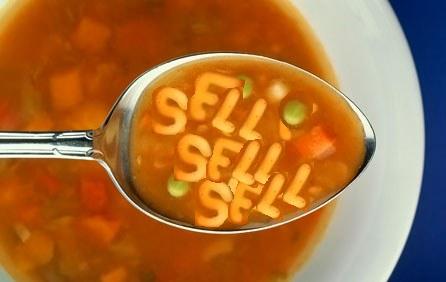
Maybe it was the soup. While I have much greater comfort when on a shopping spree, usually borne out of a bullish view of the world, this week even the comfort food was sending me some kind of misleading message, spoonful after spoonful. I don’t always listen to my soup, but when I do, I know that things are serious. This week’s message wasn’t exactly cryptic in nature. For certain, the message wasn’t “Buy, Buy, Buy.”

But to simply assume the message is correct is bordering on lunacy, so I just decided not to buy quite as much, proving that we can all get along. Besides, “sell, sell, sell,” seemed so draconian.

Although so often a drastically sharp move downward comes from unexpected or lightly regarded catalysts, there’s not too much of an excuse to overlook some potentially obvious catalysts when the market appears to be in an overbought condition. For me, already sensitized to a possible drop, the FOMC, ECB and Employment Situation were individually capable of initiating and speeding a sudden descent.

Aligned? Had the Federal Reserve given a strong hint of an end to Quantitative Easing, had they suggested an earlier timetable for interest rate hikes, or had the European Central Bank not lowered rates that combination had the makings of a nasty punch. Throw a second successive month of disappointing employment numbers, perhaps with downward revisions of previous months and now you’ve got a party.

For short sellers, at least.

While the market did have a slightly delayed reaction to the FOMC minutes, it was fairly mute, despite doubling the early losses. The following day, which is often the day the real action occurs after an FOMC meeting, had its tone already set earlier by the ECB decision to drop rates.

That just left Friday, with a little hint from Wednesday’s release of the ADP statistics. that job growth may be slowing due to some headwinds in the economy. Much of the talk on Wednesday was how fearful everyone was that the number on Friday would be terribly negative.

The fact that the number was, in fact, an indication of a growing economy and there were massive upward revisions to earlier months was the surprise that should never have been a surprise, as thesis changing revisions are routine.

So all of the important letters were aligned, as no one really cares about ISM, and there was reason for a party. The order of the day on Friday was “buy, buy, buy,” once again delaying the “Sell in May” crowd’s ascent and giving me cause to reflect as the majority of my monthly covered call positions are now in the money and do not stand to further profit in the event of a continued market rise.

Of course, if I wanted to continue the lunacy, I would simply rationalize it all and convince myself that I now have a nice cushion between share and strike prices to withstand a fall between now and May 18, 2013. Sooner or later my call for a significant market drop will have to take on broken clock qualities.

Yet, the rationalizations aren’t working. Maybe I need another spoonful of soup.

As usual, the week’s potential stock selections are classified as being in Traditional, Double Dip Dividend or Momentum categories, with no selections in the “PEE” category, despite earnings season still going strong (see details). Additionally, this week the emphasis is once again on dividend paying stocks and still giving greater consideration to monthly contracts, in order to lock into option premiums for a longer period in order to ride out any pauses in the runaway train. Of course, after Friday’s run higher capping off a week when the S&P 500 moved 2% higher, good luck finding any bargain priced shares. Bargains may be justifiably so. Sometimes there’s a reason no one asks you to dance. You just refuse to look in the mirror, justifiably so.

I jumped the gun a bit on Friday afternoon and purchased shares of Pfizer (PFE). After a very impressive share run higher, which hasn’t really occurred in the post-Viagra era, Pfizer reported earnings last week and continued the weakness that immediately preceded the report, after some European regulatory disappointments. A case of too much and too fast from my perspective, but the shares appear as a reasonably low risk over the coming weeks, particularly with a safe and healthy dividend and an upcoming ex-dividend date this week.

Wells Fargo (WFC) has been a frequent purchase target. While I do like shares, it along with so many others is more expensive than I would like. However, it has proven resilient in defending its share price when tested and the test levels have been slowly climbing higher. That’s certainly a more healthy way to see appreciation and I think offers less risk in what may become a risky environment. Additionally, their new ad campaign, “At least we’re not JP Morgan” (JPM) speaks volumes with regard to superfluous risk. As often before, my entry point is not so coincidentally synchronized with an ex-dividend date.

Weyerhauser (WY) is not a stock that I buy very often, but in hindsight I wonder why. Not because it does anything spectacular, but rather because it is so unspectacular that it has the core requirements of being an ideal covered call stock. It generally trades in a narrow range, has an options premium that is more than symbolic and pays a competitive dividend. What’s not to like, especially this week as it also goes ex-dividend.

Although I don’t have any “PEE” selections this week, Marathon Oil (MRO) does report earnings on May 7, 2013. However, unlike the usual earnings related plays that I prefer, it isn’t expected to trade in a wide range after the announcement. It’s implied move is far less than the 10% or greater that I usually look for while still offering a 1% ROI. Instead, it’s just like any other stock that happens to be reporting earnings, except that it’s approximately 5% off of its recent high, satisfying another of the criteria I look for when considering the risk associated with trading around earnings season.

I already own shares of St. Jude Medical (STJ) at a price slightly higher than Friday’s close. I rarely think about adding additional shares unless the price has had a significant drop. However, St. Judes Medical has had a fall relative to the market and certainly to the heath care sector. I don’t envision it as being at undue risk in the event of a market downturn, due to its modest existence during the upturn.

Parker Hannefin (PH) and W.W. Grainger (GWW) both go ex-dividend this week. Although their share rise on Friday adds to some reluctance to add them to the portfolio next week, if the Employment Situation statistics and the revisions are any guide, there may be very good reason to suspect that industrials and the companies that support the industrials may be ready for a little bit of a resurgence. Neither offer incredibly exciting dividends, but share appreciation may be more a part of the equation than it is for most stocks that I consider due to their option and dividend income potential.

I’ve been looking for a re-entry point in Goldman Sachs (GS) for a while. Again, hindsight told me that may have been a couple of weeks ago as shares were a relative bargain. The fact that shares have greatly under-performed the S&P 500 over the past 12 weeks has appeal for me, as I believe it marks a company that may be better equipped to out-perform going forward, particularly in a downturn.

Finally, Abercrombie and FItch (ANF) is an always exciting stock to own, especially as earnings are approaching. In this case earnings aren’t expected until May 15, 2013, so there is a little bit of breathing space to consider shares before the added volatility kicks in. When it moves, the moves are spectacular and certainly the option premiums reflect that kind of risk. My bias at the moment is that if an opportunity will arise it will likely take the form of put sales. However, that is only something that I would do if emotionally prepared to hold shares going into earnings if assigned. If so, a bit of luck may be necessary to turn the tables and sell call contracts going into earnings or sell additional puts if you’re really adventurous.

Traditional Stocks: Goldman Sachs, Marathon Oil, St. Jude Medical

Momentum Stocks: Abercrombie and Fitch

Double Dip Dividend: W.W. Grainger (ex-div 5/9), Parker-Hannefin (ex-div 5/8), Pfizer (ex-div 5/8), Wells Fargo (ex-div 5/8), Weyerhauser (ex-div 5/8)

Premiums Enhanced by Earnings: none

Remember, these are just guidelines for the coming week. Some of the above selections may be sent to Option to Profit subscribers as actionable Trading Alerts, most often coupling a share purchase with call option sales or the sale of covered put contracts. Alerts are sent in adjustment to and consideration of market movements, in an attempt to create a healthy income stream for the week with reduction of trading risk.


Shame on you, Apple

Oh, and congratulations, too.

Shame and congratulations on you for completing the world’s most successful corporate issuance of bonds. $52 Billion in bids clamoring for $17 Billion of product.

Remember when Apple (AAPL) products had that kind of demand?

Remember when its stock had that kind of demand?

Remember, the cynics say that dividends and stock buybacks are the sort of things that you do when you can’t propel the business forward.

A few years ago, in a ruling that will forever remain controversial, the United States Supreme Court essentially ruled, that in at least a narrow definition, corporations were people.

For most purposes that designation is somewhat non-sensical, but for the all important world of campaign financing making corporations animate objects had a great benefit. Namely, the privilege of donating obscene amounts of money to political campaigns.

But along with all of the great privileges of belonging to the human race, there have to be some downsides, as well. Social obligations and the burdens and joys of human emotions come to mind.

Like Adam and Eve in the Garden of Eden, one of the very first human traits that they exhibited after they had done something very wrong and against the “rules” was to feel shame. Ironically, what they did wrong was to have eaten from “The Apple.”

This week, Apple should feel shame.

They borrowed money, as much as 75 basis points above US Treasuries in order to fund a planned $50 Billion buyback and the costs of three years worth of dividend payments.

From a business perspective, Apple should be congratulated, having found a way to satisfy increasingly noisy shareholders and hold the tax man at bay. Although I do wonder why they even had to go 75 basis points above US Treasuries, you can’t argue with the success of the initiative. You would, however, think that Apple was more credit worthy than our own government, but apparently they don’t even measure up to Microsoft (MSFT) in that regard.

While the interest payments are a deductible expense, the real beauty is that Apple is able to put cash directly and perhaps indirectly back in the hands of shareholders without the need to repatriate tons of foreign cash and pay US taxes once having done so. Of course, they also figured out a way to turn down the heat on Tim Cook, just a bit.

Having been an Apple shareholder as recently as last week, I suppose I would have lauded that move by Tim Cook, but now, I find it shameful.

Firstly, not that I expect any devastating news at Apple, but suddenly shareholders have taken a subordinate position to new bond buying stakeholders. The risk to shareholders is certainly small in that regard, but it is also certainly unnecessary.

Secondly, what happened to the ideals?

Although he was a ruthless competitor, the late Steve Jobs had ideals. First and foremost, they related to the products offered by Apple. But they also extended to the financial practices that eschewed capital markets and were ruggedly self-reliant in order to meet its corporate objectives.

While Apple still has exquisite products, among my previous critiques of the company quality of products has never been at issue, they are straying from the founder’s ideals on all counts.

While it can be safely said that the last time Apple ventured into the bond market, it did so to save itself from financial ruination, Steve Jobs had not yet returned to the company. We’ll never know whether Apple under Jobs’ leadership would have been driven to the point of desperation, but we do know that in the 25 subsequent years that source was never tapped again.

Whatever the basis for his ideals, they included a disdain for share buybacks and dividends. As recently as a 2010 shareholder meeting, Jobs stated that Apple needed to keep its cash for growth opportunities and further said that paying a dividend or buying back stock would not change the stock price. You can argue those points, but what you can’t argue is that Jobs’ idealism exchanged the illusory effects of dividends and buybacks for the real effects of stock appreciation.

So here we are. Shares had fallen in excess of $300, the pipeline appears dry and questions regarding TIm Cook’s continuing leadership have popped up.

In response, Apple has gone where the beleaguered go. They have gone the route of buybacks and dividends. Nothing terribly creative, but a step designed to quiet some of the complaints from shareholders and activists.

Yet, they went to the bond markets to get the necessary cash to perform what may in and of itself been unnecessary. By all reports they did so to avoid repatriation of foreign held cash and to avoid paying U.S. taxes upon those funds.

Remember the 2012 elections? Remember candidate Romney and the controversy surrounding his taxes? There was never a question as to whether Romney had broken the law or done anything illegal. It was an issue of his taking advantage of every loophole in the tax code that was imaginable. Not illegal, but most people innately believed that there was just something wrong about navigating a path that no one creating regulation or legislation could have imagined would exist.

Bill Gates and Warren Buffett believe that to be the case. I suppose that’s another way that Apple doesn’t measure up to Microsoft.< /p>

On its surface you know that there is something wrong when an individual can have an IRA valued in excess of $100 Million. Not because the amount is so large, but rather because of the annual contribution thresholds. For example, assuming Mr. Romney made a maximum $5,000 contribution each year for 30 years and achieved an annual 35% return, he would still only have $40 million.

Shameful.

Yet here Apple has garnered its own shame. Exploiting the tax code in a way that the average person, perhaps even investors in Apple, intuitively know is wrong. Maintaining a significant cash reserve overseas to avoid paying taxes just doesn’t pass the smell test for most people, despite being legal.

But by so doing, they are also not re-investing any significant portion of their $150 Billion cash reserve into the business, nor are they pursuing meaningful acquisitions. The money sits in a low interest environment.

Given that shameful disregard for shareholders,you could understand why there was a growing chorus for something substantive to be done.

While corporations traditionally did not have social responsibilities, that too is a burden of now joining the human race. Among the social responsibilities is to put their money to work and to pay taxes, without hiding behind the loopholes or the unanticipated escape routes found in existing regulations and legislation.

I’m not really certain whatever happened to Adam and Eve after their banishment from the Garden of Eden. Their expulsion was swift, and perhaps the entire human race paid a steep price for their actions.

I think Apple’s recent action will result in the same steep price for its shareholders as the euphoria around the offering has already disappeared. The future looks less optimistic as Apple settles into a state where they are no different from the rest and beginning to rely on smoke, mirrors and lapses in tax policy to perpetuate their leadership.

In the meantime, without anything substantive in its future, Apple will remain a trading vehicle that may offer risk to those looking at it as a long term value.

While I can’t hold Apple in esteem for their anti-social behavior, and blatant thumbing of its corporate nose at its responsibilities, I do think that if offers some exceptional short term opportunities, especially when coupled with a covered call program.

I look forward to more of those positions as shares come back down in price to the $410-420 range, which I anticipate occurring prior to next week’s ex-dividend date.

As long as they’ve already made a deal with the devil, I may as well get my piece.


Weekend Update – April 28, 2013

Schadenfreude suits me just fine.

Is it really “schadefreude” when you don’t really know or see the people upon whom misfortune has been heaped?

For those that aren’t familiar with the word, “schadenfreude” is the strangely good feeling that some people derive when others fail or are subject to misfortune.

In Talmudic teaching the highest form of charity is when neither the donor nor the recipient are aware of one another’s identity. Complete ignorance raises the act of charity to a higher level.

Of course, we will never be able to answer the question of whether there is really a sound produced when a tree falls in the forest and there is no one present to lay witness. A single degree of separation can completely call into question that which seems patently obvious. Ignorance of an event can be is as if it doesn’t even exist.

Being a covered option seller, I do take some perverse pleasure and satisfaction when the market goes lower, even though I know that the vast majority of investors, especially the individual investor, fares well only when the markets are moving higher.

When I sell longer term call options, such as the monthly variety, I just love seeing the share price exceed my strike level early during the term of the contract, only to watch those gains dissipate as the term nears its end, especially if the end returns right to the strike price.

Somewhere, I just know that someone is asking themselves why they didn’t take their profits when they had the chance.

That’s pretty bad, right? But I never see that person. I’m not really certain that they even exist, except for the fact that I was once that person. To a large degree I believe that I was deeply ignorant back in those days with regard to the discipline of securing profits. These days I’ve simply added ignorance to the fortunes of those on the other end of trades to the list of things unknowable. Additionally, not knowing who they are is the highest form of ignorance.

As this past week was one that I immensely enjoyed and briefly put away my short term pessimism in order to trade at levels that reflect a more bullish tone, I’m now on the fence as to whether the bullish feeling can be sustained given what the past may be revealing.

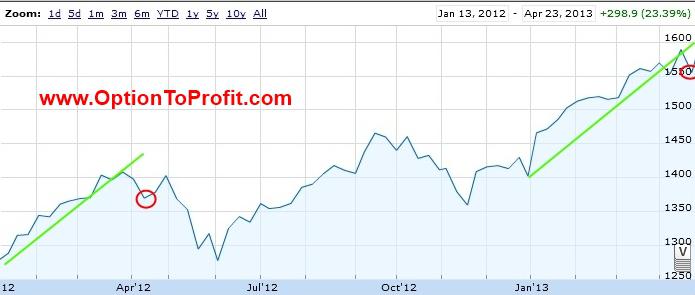
After hitting market peaks 2 weeks ago and then alternatively going from the worst week of 2013 to one of the best weeks of 2013, I continue to believe that we are replicating the first 5 months of 2012.

So while I’m very happy with the higher tract that stocks took this past week, I’m especially happy to see assignments take place and have the cash settle in my account, to hold or to invest, as the market reveals itself.

Although I would much rather be fully invested, I really do want to see give backs of many gains at this point. Having a sizeable portion in cash and evolving from the use of weekly contracts to monthly ones, or even the occasional June 2013 cycle, makes it easy to make that wish.

If history is a guide, the last correction we experienced lasted just one month and then was completely recovered 2 months after it ended.

I can live with that, at least while cash is on the sidelines. If it happens, and assuming that it’s within tolerable levels, such as 10%, I’ll be reasonably happy, but not in a schadenfreude kind of way, although that kind of admission would certainly get me much more attention. Everyone notices the misanthropic guy and wishing that stock prices retreat may be the highest form of misanthrope, especially if it disproportionately impacts widows and orphans.

As usual, the week’s potential stock selections are classified as being in Traditional, Double Dip Dividend, Momentum or the “PEE” category (see details). Additionally, as in previous weeks there is a greater emphasis on stocks that offer monthly contracts only, eschewing the usual preference for the relatively higher ROI of weekly options for the guarantee of premiums for a longer period in order to ride out any turbulence. Additionally, as with the previous week, we are at the height of earnings season and thus far there have been some surprises, perhaps offering more opportunity to sell well out of the money puts prior to earnings.

I really can’t recall the last time I owned shares of ExxonMobil (XOM). Although it is one of the shares that I consistently follow, it rarely has piqued my short term interest. That may be changing a bit as I look at its upcoming and increased dividend. At a time that I’m expecting to be on the precipice of a market decline that is technically driven, rather than fundamentally, I would be more inclined to limit new investments to more defensive stocks that are likely to outperform a falling market during a period of economic stability or growth.

Although Apple (AAPL) was a potential earnings related trade last week, I ultimately waited for earnings and instead purchased shares the next day. Those were assigned, but if shares open the week near the $410 level, I am interested in establishing a new position and using an out of the money monthly contract in order to have an opportunity to also secure the newly increased dividend. I believe that Apple will out-perform the market in the near term and will offer trading opportunities in addition to appealing option premiums.

With last week’s selection Cisco (CSCO) among those assigned, Oracle (ORCL) also one of last week’s potential picks went unrequited. It also under-performed Cisco as some of the networking companies were depressed following Broadcom’s (BRCM) earnings. I’ll be looking to Oracle as a potential purchase this week as well, as the technology sector may be showing some signs of catching up to the overall market with Microsoft (MSFT) and Intel (INTC) showing strength.

As news related to the Chinese economy seems to wag our own stock market, the heavy machinery titans have been slammed back and forth as what is called “news” is so often re-interpreted or presented in different lights that create an alternation between good economic news and bad economic news on a near daily basis. Very often the sector moves in unison even when the exposure to China is limited. While Joy Global (JOY) has significant exposure, PACCAR (PCAR)certainly has less so. Both have recovered a bit this past week as have Caterpillar (CAT) and Deere (DE). ALl, however, continue to trail the S&P 500 in 2013.

Petrobras (PBR) suspended its regular dividend payment in 2012. I’m somewhat embarrassed to still be holding shares priced in the $19-20 range, purchased just before a slew of bad news. Having held onto shares even as they sank as much as almost 25%, it has been clawing its way back. Among the positive signs are the recent announcement of two special dividends. With the hope for some stability in its share price after bad news regarding pricing and production issues have now been digested, it may be time to restart accumulating shares.

Last week playing earnings related trades was a very timely strategy. I don’t know if the pleasant surprises will continue, but I think there may again be some very reasonable risk-reward propositions available, as long as you don’t mind the possibility of owning shares after it’s all said and done.

Among those reporting is Facebook (FB), which despite having received an IPO allocation and currently owning shares at various price points, has become one of my favorite stocks. The existence of extended weekly options opens up many more opportunities to generate option premiums and mitigate the potential impact of sudden adverse moves in share price. At Friday’s closing price, a weekly put sale at a strike price 12.5% below the close could return a 0.7% ROI. For those more adventurous, a strike price only 9% lower could yield a 1.4% return.

Pfizer (PFE) reports earnings this week and fits into the profile that appeals to me the most when considering an earnings related trade. This past week it sustained a large price drop, which is usually the signal that clears me to sell puts on shares. However, in this case, I more likely to consider an outright purchase on shares, not only for some capital appreciation and option premium income, but also in order to capture the May 8, 2013 dividend payment.

Humana (HUM) has been on a true rollercoaster ride. As often happens with health care stocks the various interpretations of how changing legislation or pricing structure may impact share price sends the shares in irrational and alternating directions. With earnings approaching and shares down almost 10% from its 2 week ago high, it represents a potentially acceptable risk-reward offer. If it falls less than another7% the ROI is approximately 1%. That, however, is for the time remaining on a monthly contract, which makes it a little less appealing to me, but still under consideration.

Finally, I’m not certain how much longer the world needs an independent Open Table (OPEN) but it has the kind of pricing volatility at the time of earnings release to make it worth considering a purchase of shares and the sale of deep in the money calls or simply a sale of deep out of the money puts.

Traditional Stocks: ExxonMobil, Oracle, Paccar, Pfizer

Momentum Stocks: Apple, Joy Global

Double Dip Dividend: Petrobras (ex-div 4/30)

Premiums Enhanced by Earnings: Facebook (5/1 PM), Humana (5/1 AM), Open Table (5/2 PM)

Remember, these are just guidelines for the coming week. Some of the above selections may be sent to Option to Profit subscribers as actionable Trading Alerts, most often coupling a share purchase with call option sales or the sale of covered put contracts. Alerts are sent in adjustment to and consideration of market movements, in an attempt to create a healthy income stream for the week with reduction of trading risk.