

Weekend Update – December 29, 2013

How do you follow up a year in which the market has advanced nearly 30%? If you look at the historical data the year after a great year such as the one we’ve just had tends to be quite good, too – just not as good. While comparison isn’t really worthwhile, after all, it’s the accumulation of assets that really has meaning from year to year, you can’t help but feel some disappointment when comparisons are made to a stellar year.

As I look at charts I’m struck by how similar so many charts look as the year draws to a close. So many stocks are at or near their highs for the year, making it hard to find any bargains and making it especially hard to find value among well regarded stocks.

From my jaded perspective that sets one up for disappointment, even if the direction is still higher.

Buying at the high isn’t a great strategy, it also tends to set you up for disappointment, but there may not be very many alternatives. Similarly, buying after a significant run higher nay not be a good strategy, but that’s how some are starting the new year as demonstrated by MolyCorp (MCP), a stock that I do own. Shares roared ahead nearly 15% to end the week, reportedly upon the rationale in an article published in Seeking Alpha, that suggested it would be the beneficiary of the “January Effect.”

Based on Molycorp’s performance in 2012, the same expectation could have been made for the January Effect this past year and it did, in fact, last all of six days, but was not preceded by a similar price surge. After that sixth day shares were below where they had ended 2012, which in turn was about 60% lower where the year had started, while this year thus far shares are down a mere 41%.

While I would love to see MolyCorp sustain and even grow that price leap, particularly since I decided not to use it as a strategic tax loss, I have a hard time understanding those that climbed aboard that runaway train late in the process. But that may be exactly the same potential fate awaiting many as the new year is ready to start.

As MolyCorp demonstrated last year, even if you get off to a good start it doesn’t preclude you from flaming out.

As usual, the week’s potential stock selections are classified as being in Traditional, Double Dip Dividend, Momentum and “PEE” categories this week (see details).

While believing in Santa Claus may be a tall order for anyone reading these pages, believing in the Santa Claus Rally and further believing in the January Rally may be far easier and offer reason to continue looking for investment opportunities. If those traditions do continue there is a certain degree of impunity even at such high levels and so I feel a little less concerned about some of this week’s selections. Due to the shortened trading week’s proportionately lower weekly option premiums I am also looking to use expanded options, where possible and hoping the January Rally continues to at least the tenth of January.

I was all set to purchase Apple (AAPL) last week, thinking that there was no real catalyst in the near term to send shares moving significantly in one direction or another. Then on Sunday came word of the China Mobile deal and shares advanced about 4% the next day and there went my plans to add shares. I mistakenly believed that the China Mobile deal had already been reflected in the share price, particularly since official web sites had heavy handedly starting taking orders for the iPhone before the deal was acknowledged. But even them the rise of 4% seemed relatively subdued, given the potential ability to add to Apple’s fortunes.

The more I look at Apple the more I now see a stock that will continue being a covered option play, just as it was not for most of 2012. I expect its rise to continue and am not deterred by this week’s gain, that was attenuated a bit as the week wore on. If Starbucks (SBUX) can rise effortlessly from $45 to $80, why can’t Apple do the same from $450 to $800?

While I don’t feel a compelling need to own any Apple products, I also don’t get excited about Starbucks’ offerings. Yet, I’ve been waiting too long for its shares to stop their ascent and return to what may have been irrationally low levels. After a small drop of about 4% over the past month that may be the best that I can hope for, at a time when discovering opportunities is increasingly challenging.

I’m currently woefully under-invested in the financial sector and have been waiting for a while to add correct that situation. However, that hasn’t been a terribly easy thing to do as financials climb higher and may be poised to add even more as interest rates begin their climb. Morgan Stanley (MS) has certainly had a transformation over the past two years and has seen its share price more than double and is near its yearly high. The latter would tend to have me shy away from shares. However, as the year begins I think the sector will get a boost if the overall market stays true to form and interest rates continue tes
ting the 3% level. Any interest I may have in Morgan Stanley are fueled by short term considerations only, as earnings are announced on the final day of the monthly option expiration.

I jumped the gun a bit by purchasing Bristol Myers Squibb (BMY) last Friday, hoping to capture a bit more in premium as both last week and this week are short trading weeks and as a result have even lower option premiums. Shares also go ex-dividend before New Years and my hope was either for quick assignment and re-investment or capturing both dividend and premium, while getting a portion of the dividend related reduction in share price underwritten by the option buyer. I had been considering the purchase of shares for a couple of weeks, but unfortunately couldn’t find the reason to do so. While within striking distance of its yearly high, the upcoming dividend and premium offset some of the concerns, especially going into the New Year.

I went from being an avid share holder of Anadarko (APC) to a disappointed one as word came out of a large judgment in a nearly decade old legal case involving a company that Anadarko had purchased. While the size of that judgment may still be reduced, it appears that the uncertainty associated with the issue has now been removed. Of course, for most people, before the judgment was announced the entire issue had already been forgotten, When looking for a difficult to find bargain, Anadarko may be the poster child for 2014. Now that shares seem to have stabilized I’m ready to consider adding more shares in an attempt to sacrifice them for their premiums and help to whittle down the paper losses on some older shares.

Marathon Oil (MRO) isn’t as exciting as Anadarko has made itself, but it, too, is a company that I look forward to owning after some price retracements. Now offering weekly and expanded weekly options it has become more appealing to me as I increasingly try to stagger expiration dates in order to not be held hostage by a sudden and sizeable market move and having too many eggs in a single basket. Marathon Oil is down approximately 5% from its recent high, which is about half the size of its largest retracements. While there may be some more downside potential the shorter term time commitment when considering the sale of options adds greater flexibility.

EMC Corporation (EMC) also isn’t terribly exciting, certainly less so after its spin-off of VMWare (VMW) several years ago. But in the world of covered call selling “exciting” is unnecessary. Boring and predictable is far more profitable, as long as there are some occasional hiccoughs along the way. EMC is one of those companies that does have those occasional hiccoughs, often courtesy of VMWare, that helps it to continue having an acceptable option premium, despite its fairly steady share performance. Additionally, while its dividend is also not terribly exciting, it does go ex-dividend the following week. For those considering the use of a monthly option the ROI can potentially be bumped up a bit, as a result.

Finally, LuLuLemon Athletica (LULU) is now two weeks post announcing its CEO succession and its disappointing earnings. Since then it has treaded water and that makes it an appealing consideration. Similar to last week’s discussion of Cree (CREE), if I purchase shares of LuLuLemon, I may not immediately write calls or may only do so on a portion of my shares, as I believe the next move will be decidedly higher. However, even if LuLuLemon continues to tread water it can be a very profitable holding for those that do write call options on their shares and then have the opportunity to repeatedly rollover from week to week while the stock is deciding what to do with its life.

Traditional Stocks: Anadarko, Apple, EMC Corp., Marathon Oil, Starbucks

Momentum Stocks: LuLuLemon Athletica, Morgan Stanley

Double Dip Dividend: Bristol Myers Squibb (ex-div 12/31)

Premiums Enhanced by Earnings: none

Remember, these are just guidelines for the coming week. The above selections may become actionable, most often coupling a share purchase with call option sales or the sale of covered put contracts, in adjustment to and consideration of market movements. The overriding objective is to create a healthy income stream for the week with reduction of trading risk.

When to Take Tax Losses

(A version of this article appeared in TheStreet.com).
Each year the ritual begins just days before New Years. Even in the best of years there are bound to be some losers. Fortunately, whatever faults there may be in the tax code, the ability to attenuate investment mistakes isn’t one of them.
Since I actively sell covered options and generate taxable premiums the thought of offsetting gains is appealing, but before jumping at the opportunity a grasp of history may be helpful.
In this case looking at the strategic tax losses taken in 2012 I’m struck by one thing. Four out of the five such sales saw shares appreciate more than the S&P 500’s gain for 2013. Not only did they gain more than 29% from their sales price, but they also gained more than 29 % from their purchase prices.
Proponents of the “Dogs of the Dow Theory” would readily understand the phenomenon, as perhaps should serial covered option writers who repeatedly write options on the same stocks as their prices regularly go up and down, sometimes even to extremes, yet so often recover.
Given the choice between taking a tax credit or a stock loss or paying more taxes because of greater gains, I would take the latter every time. However, there is a preponderance of thought that losses should be taken if they reach the 10% level. For those believing in rules, this is a useful rule, if consistently practiced.
Unfortunately, there is no guarantee that proceeds from the sale of losers will be recycled into the shares of winners. Sometimes losers simply give way to other losers, as even well devised ideas don’t alwaysbear fruit. While hindsight often has me wishing I had cut my losses, the real battle is deciding whether to follow your humble or arrogant side.
The arrogant side believes it can re-invest loser proceeds and recover losses. The humble side wonders how someone so ill-advised and having made the original investment, then sat frozenly while shares plunged, could now suddenly be deft enough to select a winner, instead of inviting ruination once again.
It’s difficult to not take the humble side’s argument. Logic trumps hope.
The decision process as to whether to take tax losses begins with understanding your tax liability, which is related to your marginal tax rate. If in the highest Federal tax bracket, the short term rate on capital gains is 39.6%, although the rate varies from 10 to 39.6%.
Next comes a look at the probabilities of various outcomes and their respective benefits.
There is a 100% probability that the loss will decrease your tax liability, if you didn’t violate the Wash Sales Rules. It’s hard to beat those odds, but if you do buy and sell the same stock repeatedly, as I often do, the 30 day window on either side of your proposed trade can scuttle your strategy.
The next step takes some calculation.
As an example, I’m going to look at Petrobras (PBR) shares that I bought on January 7, 2013 at $20.05 and currently trading at $13.48. An advanced degree is mathematics is unnecessary to recognize that represents more than a 10% decline and would violate investing rules sometimes attributed to famed financier Bernard Baruch.
The potential tax benefit is based upon your tax rate and whether the holding is a short term or long term. As a short term holding the Petrobras position is entitled up to a 39.6% credit against capital gains, meaning that credit can be worth up to $2.60 per share.
While that is an objective calculation, the next step is entirely subjective and focuses on your assessment of the probability that Petrobras shares will add $2.60 to its current share price. How likely is it that shares will gain 19.3%?  While there may be be company specific challenges, as well as broader economic challenges to consider, one may be justified in wondering whether Petrobras will be this year’s Hewlett Packard (HPQ), which was a strategic tax loss that I mistakenly took last year and is up 99% YTD.
If you believe that such lightning may strike twice in a lifetime you may decide to roll the dice and surrender the certainty of a short term tax credit.
if your educated gamble is right, even at the new higher price yomay still qualify for a tax loss, however, you’ll find yourself looking at a much ower credit, if the short term loss becomes a long term loss. As a movie character once asked, “are you feeling lucky?” If you can generate some option premiums along the way you can make your own luck, but whatever the outcome, it is deferred to 2015, which may entail further opportunity costs.
Then again, just look at your losers from last year. Unlikely as it may have seemed, recovery wasn’t outside the realm of possibility.
Bottom line? Ask your tax advisor, but do so soon.

When to Take Tax Losses

(A version of this article appeared in TheStreet.com).
Each year the ritual begins just days before New Years. Even in the best of years there are bound to be some losers. Fortunately, whatever faults there may be in the tax code, the ability to attenuate investment mistakes isn’t one of them.
Since I actively sell covered options and generate taxable premiums the thought of offsetting gains is appealing, but before jumping at the opportunity a grasp of history may be helpful.
In this case looking at the strategic tax losses taken in 2012 I’m struck by one thing. Four out of the five such sales saw shares appreciate more than the S&P 500’s gain for 2013. Not only did they gain more than 29% from their sales price, but they also gained more than 29 % from their purchase prices.
Proponents of the “Dogs of the Dow Theory” would readily understand the phenomenon, as perhaps should serial covered option writers who repeatedly write options on the same stocks as their prices regularly go up and down, sometimes even to extremes, yet so often recover.
Given the choice between taking a tax credit or a stock loss or paying more taxes because of greater gains, I would take the latter every time. However, there is a preponderance of thought that losses should be taken if they reach the 10% level. For those believing in rules, this is a useful rule, if consistently practiced.
Unfortunately, there is no guarantee that proceeds from the sale of losers will be recycled into the shares of winners. Sometimes losers simply give way to other losers, as even well devised ideas don’t alwaysbear fruit. While hindsight often has me wishing I had cut my losses, the real battle is deciding whether to follow your humble or arrogant side.
The arrogant side believes it can re-invest loser proceeds and recover losses. The humble side wonders how someone so ill-advised and having made the original investment, then sat frozenly while shares plunged, could now suddenly be deft enough to select a winner, instead of inviting ruination once again.
It’s difficult to not take the humble side’s argument. Logic trumps hope.
The decision process as to whether to take tax losses begins with understanding your tax liability, which is related to your marginal tax rate. If in the highest Federal tax bracket, the short term rate on capital gains is 39.6%, although the rate varies from 10 to 39.6%.
Next comes a look at the probabilities of various outcomes and their respective benefits.
There is a 100% probability that the loss will decrease your tax liability, if you didn’t violate the Wash Sales Rules. It’s hard to beat those odds, but if you do buy and sell the same stock repeatedly, as I often do, the 30 day window on either side of your proposed trade can scuttle your strategy.
The next step takes some calculation.
As an example, I’m going to look at Petrobras (PBR) shares that I bought on January 7, 2013 at $20.05 and currently trading at $13.48. An advanced degree is mathematics is unnecessary to recognize that represents more than a 10% decline and would violate investing rules sometimes attributed to famed financier Bernard Baruch.
The potential tax benefit is based upon your tax rate and whether the holding is a short term or long term. As a short term holding the Petrobras position is entitled up to a 39.6% credit against capital gains, meaning that credit can be worth up to $2.60 per share.
While that is an objective calculation, the next step is entirely subjective and focuses on your assessment of the probability that Petrobras shares will add $2.60 to its current share price. How likely is it that shares will gain 19.3%?  While there may be be company specific challenges, as well as broader economic challenges to consider, one may be justified in wondering whether Petrobras will be this year’s Hewlett Packard (HPQ), which was a strategic tax loss that I mistakenly took last year and is up 99% YTD.
If you believe that such lightning may strike twice in a lifetime you may decide to roll the dice and surrender the certainty of a short term tax credit.
if your educated gamble is right, even at the new higher price yomay still qualify for a tax loss, however, you’ll find yourself looking at a much ower credit, if the short term loss becomes a long term loss. As a movie character once asked, “are you feeling lucky?” If you can generate some option premiums along the way you can make your own luck, but whatever the outcome, it is deferred to 2015, which may entail further opportunity costs.
Then again, just look at your losers from last year. Unlikely as it may have seemed, recovery wasn’t outside the realm of possibility.
Bottom line? Ask your tax advisor, but do so soon.

2013 Strategic Tax Losses

It’s that time of the year to sadly sit and accept some reality and see if there are any strategic tax losses to offset trading gains. That is a gift in the tax code and just about the only thing that makes taking a loss palatable for me.

Before I go on, I’m not an accountant. I’m not even a Pediatric Dentist anymore. I’m not really certain what I am, other than to be someone faced with the same pragmatic issues as most investors, even in a year that everything seemed to just go higher and higher in share price.

Before considering what strategic tax losses I may decide to take this year, as the calendar is growing short, I find it useful to look back in time at the tax loss selections in 2012. .

The strategic tax loss sales I sustained last year were  on specific lots of Chesapeake Energy ($17.36),  Hewlett Packard ($13.66), ProShares UltraShort Silver ($51.09), Groupon ($4.79) and Potash ($40.07). The fact that other lots of those stocks may have delivered profits in 2012 is irrelevant and didn’t soothe the angst of parting under such sad circumstances. (CHK), (HPQ), (ZSL), (GRPN), (POT)

So where are they now after a year that has seen about a 28.5% gain in the S&P 500? Is there life after loss?

Their closing prices on December 24, 2013 were: Chesapeake Energy ($27.61), Hewlett Packard ($28.18), ProSharesUltraShort Silver ($90.02), Groupon ($11.83) and Potash ($32.82).

With the exception of Potash, all of those have had more than a 28% gain from their sales price and, in fact, more than a 28% gain from their purchase prices, as well.

The reason this isn’t too surprising is for the same reason that the “Dogs of the Dow” theory has been a reasonably reliable prediction tool. In general, if you invest in a company that isn’t likely to disappear in the near future or go bankrupt, there’s a very good chance that it will rebound strongly after a period of abysmal performance. Decent companies tend not to stay at depressed levels if the market around them is healthy. There are obviously exceptions to that generality, but how many stocks don’t display regular ups and downs in the charts, even to the point of periodic extremes?

Having looked, over about 30 years of investing results, very few “losers” failed to redeem themselves. That may be due in part to serendipity, but also from shunning really speculative issues. Back in the days when I had a stock broker, and I really did like and respect him, it was actually maddening to see how frequently stocks that had been sold for a loss had recovered. Given the choice between taking a tax credit or a stock loss or paying more taxes because of greater gains, I would take the latter every time.

However, my broker was a firm believer in taking losses if they hit the 10% level, which is a very traditional approach. To his credit, he followed his rules and was consistent in his application of those rules.

Consistency is what is ultimately one of the most important things when managing investments, even though there may be other paths to the same destination.

What I had also noticed was that there was no guarantee that the proceeds from the sale of losers past would then be recycled into shares of winners. Sometimes losers begat losers and sometimes losers begat winners. To a large degree the direction of the overall market was a factor in where individual stocks would go, especially if looking at an entire portfolio. However, even beautifully woven theses didn’t always go as envisioned and occasionally losses mounted, even though the intentions were honorable, but restricted by protocol.

In hindsight I always believe that when holding a loser I should have followed that 10% rule, but then you realize that the real dynamic at play is deciding whether to follow your humble or arrogant side into battle.

The arrogant side believes that it can take the money from the sale of a loser, re-invest it and recover the losses. The humble side wonders how it could be that someone so stupid as to have made the original investment in the first place and then watch it go down so much, could now possibly be smart enough to immediately pick a winner, instead of doing the same thing all over again.

For me, it’s hard not to take the humble side’s argument. Logic prevails in that argument over blind hope.

So where to begin?

Assuming that you are in the highest Federal tax brackets in 2013, the short term tax rate is 39.6%, although the rate will vary from 10 to 39.6% and doesn’t include state tax rates, if any. 

As always, your losses are limited to $3,000 in excess of your reported gains, with the ability to carry over additional losses to subsequent tax years. I’m desperately hoping that no one is reporting net losses, but rather looking to reduce their taxable liability.

That means that selling a losing stock gives you a credit against your gains, which includes option premium derived income, which is always taxed at the short term rate. If you do a lot of covered option selling you then may very well have a need or at least a desire to see whether there are any steps that can be taken to reduce your tax liability.

To make the decision of whether to take a strategic loss you have to look at the probabilities of various outcomes.

The first is the 100% probabil
ity that if taking the loss you will get a credit to your tax liability, subject to Wash Sales Rules. It’s hard to beat those odds, but if you do practice the serial kind of buy/write trades, as I often do, you also need to have a very good understanding of the wash sales rule and be very mindful of the 30 day window on either side of your strategic tax loss trade.

The next step takes some calculation.

As an example, I’m going to look at JC Penney (JCP) shares that I bought on July 30, 2013 at $16.16 and currently trading at $8.75. These values are not adjusted to reflect any option premiums collected. It doesn’t take a mathematics savant to know that is a loss well in excess of 10%. If Bernard Baruch were still alive he would slap me silly, as corporal punishment was still acceptable in his day.

The potential tax related advantage is based upon your tax rate and whether the holding is a short term or long term holding, with a one year period being the dividing line between the two. As a short term holding the JC Penney position is entitled up to a 39.6% credit against capital gains. In this case that credit can be worth up to $2.93 per share.

However, the next step involves the second probability in the equation. What do you believe is the chance that JC Penney shares will of their own trading add $2.93 to its current share price. How likely is it that shares will gain 33.5%? There may be company specific challenges, as well as broader economic challenges to consider. But there is also that thought that this could be the year to atone for past performance. Redemption, after all, isn’t limited to Hewlett Packard.

If you believe that may happen within your lifetime or an acceptable portion of that lifetime, you may decide to forego the certainty of a short term tax credit.

Similar considerations may be applied to shares of Petrobras (PBR) and Mosaic (MOS), both of which I’m considering selling for their tax benefits. However, as compared to JC Penney, the hurdle for price recovery to match the tax benefit is quite a bit lower, at 18.5% and 11.7%, respectively. 

Of course, if you’re right, even at that new higher price you can still qualify for a tax loss, however, you may find yourself looking at a much lower credit, if the short term loss becomes a long term loss. As Clint Eastwood might have said, “are you feeling lucky?” If you can grab some option premiums along the way you can help to make your own luck, but whatever the outcome, it is also deferred by a year to 2015, which itself may entail further opportunity costs.

Then again, just look at last year’s losers. Unlikely as it may have seemed at the time, recovery wasn’t outside the realm of possibility.


Bottom line? Ask your tax advisor, but do so soon.


Addendum:  An additional factor that I utilize in determining which losing positions to sell is related to another rule that I follow. That is the rule to not hold more than three individual lots of a specific stock. There is no hard science to that rule, but it is related to the desire to not have a specific stock be over-represented in the portfolio.

Occasionally, I will elect to sell a second or third lot of a specific stock because I believe there is greater opportunity for picking up replacement lots at lower prices (after the 30 day period required by the Wash Sales Rule has passed) and selling calls at the lower strikes, than there is in waiting for shares to rebound. In such cases I hope that the cumulative tax benefit and recurring option premiums on lower priced shares will be greater than the benefit derived from continuing to hold original shares.

That is why I included Mosaic and Petrobras shares in the illustrative table. However, individuals should look at their own annual profits and see which of their holdings may allow them the greatest certainty for benefit if sold for a loss, as compared to their own expectations for share price recovery. While JC Penney may be a strategic tax loss for one, it may not be so for another.

This year I will not make official “Tax Loss” sales recommendations, in recognition of the fact that some subscribers also have positions inside of tax deferred accounts. Additionally, as opposed to the past, I will continue, therefore, to follow those positions and track their performance.

Weekend Update – December 22, 2013

With word this week of the passing of a famedend of the worldprophet, it may be logical to wonderwhat now?”

Is there life after the destruction of the world is canceled?

As far as we know even after the most dire of events there is a future yet to come, but like anything in the future it can never be known, even if clues abound, but that won’t stop the predictions

The overwhelming opinion whenever thought of the end of Quantitative Easing was considered was negative, as it alone was thought to be propping up the stock market. As with those preparing for earthly catastrophe, investors of that belief took the opportunity to sell positions, because as we all know in the postapocalyptic world, cash is king.

But the clarion call announcing the coming of the dreaded taper finally came and it turns out not to be the end of the world. However, as opposed to that now deceased selfanointed prophet, after two recent failed predictions of the earth’s destruction, he decided to get out of the prophesy business. That’s not likely to be the case for those who prophesied market doom in the event that the Federal Reserve punch bowl was depleted.

Those predictions will keep coming.


I don’t know what challenges are on the near term horizon but I’m hopeful that there will be a sea of calm for a while, as the DJIA is again at an all time high. Strictly speaking there is still tim
e
for a Santa Claus Rally this week, although Ben Bernanke may have provided the rally last week, helping the market recover from the depths of a less than 2% decline.

As usual, the week’s potential stock selections are classified as being in Traditional, Double Dip Dividend, Momentum andPEEcategories this week (see details).

I don’t really know what the next catalyst will be to propel shares of Apple (AAPL) higher, even as there are renewed calls for $700. Ever since Carl Icahn entered into the equation shares have fared very nicely, despite having given up some of those gains over the past few days. What I do know is that for those that bought shares at their price peak the last day to have qualified for short term capital losses was nearly 3 months ago. At that time a sale would have resulted in a loss of about $225. However, another way to look at it is that the sale afforded as much as a nearly $90 tax credit for some investors on the Federal side alone. Adding that credit to the sale price brings shares above Friday’s closing price. To a large degree selling pressure has been greatly relieved going forward. That’s good enough for me to consider adding shares going into the final week’s of trading for the year, particularly since the last three quarters have predictably seen a rise in shares in the 6 weeks prior to its exdividend date.

Annaly Mortgage (NLY) is one of the first companies I bought when starting to manage my own portfolio, but I haven’t owned shares in more than 5 years. I don’t think I ever really understood the strategy behind Annaly, as I’ve never really understood bonds, other than to know that bond traders are probably the smartest of all, even if performance doesn’t always indicate that to be the case. For most, the appeal of Annaly has been its dividend, which was just reduced, as its stock price has fallen on hard times in the year since the passing of its cofounder and CEO.

Although I don’t spend too much time looking at charts, for those that follow MACD as an indicator, Annaly’s share price crossed over the signal line, providing a bullish signal. For me, the signal is this week’s dividend, some share price stability and an option premium enhancing the dividend. Less leveraged and more hedged than in the past this may be a good time to begin interest in Annaly once again, despite a rising rate environment.

As long as I’m not going to spend too much time looking at charts, I may as well mention that Cree (CREE) did catch my attention, as it too crossed over the MACD signal line. It’s price chart is also interesting as it demonstrates some significant and sudden moves up and down over the past few months. I think that the stock is poised for a sharp move higher and this may be one of those infrequent occasions that I don’t immediately sell call options on shares, or may not cover all shares. Its lighting products are increasingly capturing aisle space and newspaper mention as incandescent bulbs fade away.

Despite still owning a much more expensive lot of Walter Energy (WLT), it has become a favorite stock of late as it has regularly bounced higher and then dropped lower, helping to create attractive option premiums at a time when those are rare finds. Of course, with those premiums comes significant risk. For those that have the tolerance it’s shares can be rewarding, but I would temper some of the reward by greatly reducing the risk by using deeper in the money strike prices and short term contracts, although expanded contracts may actually level out some of the day to day risk and still provide a meaningful premium.

Target (TGT) hasn’t recovered quite as quickly from its recent earnings drop as many, including me, believed would be the case. A strong day Wednesday, undoubtedly buoyed by the postFOMC buying hysteria, was quickly quelled the following day on news of Target customers having their credit card security breached. What I find encouraging is how quickly Target has responded and how they are using the incident as an excuse for an additional 10% discount in the days before Christmas, hoping to lure even more shoppers for price cuts that probably would have been offered even without the security breach.

A subtopic this week is food as represented by YUM Brands (YUM), Campbell Soup (CPB), Whole Foods (WFM) and Darden Restaurants (DRI).

YUM Brands has continued to show
great
resilience to news, which invariably is greeted with negative reactions that prove to have been short sighted. Whatever the obstacle or whatever the Chinacentric thesis, YUM has shown that once people get a taste for fast food it’s really difficult to break the addiction. Short of widespread public health outbreaks in China, there are few barriers to performance. YUM Brands, besides offering a nice option premium and going exdividend later in the month, has continued seeing its beta fall and may offer less risk than before if facing a general market decline.

Whole Foods (WFM) which had been on a one way upward climb since its shares split has come down about 5% since its recent earnings report. It is embarking on a more mainstream expansion strategy while also reenforcing its perceived commitment to a higher standard, as it announced plans to remove a very popular yogurt brand from its stores. While the exit of Jim Chanos from a long position last month may be a signal to some, the performances of stocks he sold and bought since the filing date has been mixed, at best. I’ve grown somewhat tired of waiting for shares to retreat and now think that its recent earnings related drop may be all in store, especially in an otherwise flat or rising market. Like a number of other positions this week its MACD indicates a recent buy signal which may complement an otherwise weak option premium and dividend.

Campbell Soup (CPB) may be an anachronism. Once ubiquitous in households, a panoply of alternatives, including those perceived t
o
be more consistent with healthy lifestyles are available and come without cobwebs. On the positive side of the ledger Campbell has an appealing dividend right after New Years, offers an attractive option premium, low beta and it too, has recently crossed the MACD signal line. Since you don’t have to buy the product to qualify for share ownership

Finally, Among the conversations these past weeks has been talk of the worst CEO of 2013. While Clarence Otis of Darden Restaurants. was only a runner up he has fallen a long way in recent years. Shares moved up nicely several months ago when news of an activist investor’s interest became known. Shares did less well after announcing disappointing earnings at its flagship Red Lobster and Olive Garden units. However, under activist pressure Darden plans to spin off its low growth properties. Their plan may not be enough to satisfy the activists and Darden may need to explore more measures, including exploiting its real estate holdings. The good news is that Darden goes exdividend during the January 2014 cycle and appears to be able to maintain that dividend.

Traditional Stocks: Apple, Campbell Soup, Darden Restaurants, Target, Whole Foods

Momentum Stocks: Cree, Walter Energy, Yum Brands

Double Dip Dividend: Annaly Mortgage (exdiv 12/27)

Premiums Enhanced by Earnings: none

Remember, these are just guidelines for the coming week. The above selections may become actionable, most often coupling a share purchase with call option sales or the sale o
f
covered put contracts, in adjustment to and consideration of market movements. The overriding objective is to create a healthy income stream for the week with reduction of trading risk.

Turn DRIP Into Flow with PRIP

(A version of this article appeared in TheStreet.com)

The idea of utilizing a DRIP strategy toward achieving asset growth is an appealing one. Dividend Re-investment Plans offer the opportunity to take an income stream and convert it into more shares without cost. For the inveterate buy and hold investor the appeal may be compounded by the thought of actual compounding.

For most investors, at least those of moderate means, that would mean adding fractional shares and certainly odd lot shares. It might also mean adding shares in a company at a time that you wouldn’t ordinarily want to be adding shares of that particular company. Regardless of those advocating a dollar cost averaging approach, it would take a large portfolio of dividend paying stocks with payment dates broadly distributed to achieve a sufficient sampling of the market’s ups and downs to really cost average. Otherwise one is at the mercy of timing if dividend dates are clustered on a quarterly basis.

Using the 2013 S&P 500 average for dividend yields that also means a quarterly income stream of approximately 0.5% per eligible position. For example, anyone re-investing quarterly dividends on 1000 shares of Microsoft (MSFT), which offers a dividend yield nearly 51.7% higher than the S&P 500 average, would be able to add approximately 7.6 shares.

While there is certainly a body of evidence that suggests the out-performance of dividend paying stocks, I have never fully understood the allure of dividends. The opportunity to pay taxes in exchange for the privilege of being able to reduce your stock’s cost basis may be an apt summary of the transaction. But for many the dividend represents a tangible expression of ownership and sharing of good fortune. What better way to reciprocate that good fortune than by re-investing the dividend for even more shares?

However, quarterly distributions, small distributions, and being held hostage by timing of dividend payments conspire to make the DRIP strategy inefficient for those interested in compounded growth, or for those that don’t have the patience to wait many years.

While Albert Einstein purportedly referred to compounding as the greatest of inventions, he would have added some additional superlatives had he known about the use of premiums derived from option sales to fuel share purchases and asset growth.

Rather than relying on the muted power of dividends, selling options, on core holdings, such as Microsoft can return a nice weekly, monthly or yearly premium and can form the basis for anyone to design their own “Premium Reinvestment Plan (PRIP).”

In general, I prefer the use of weekly options, but that may require more maintenance and attention than many individual investors are willing to dedicate. However, as an example, anyone purchasing 1000 shares of Microsoft at Friday’s close of $36.69 could have sold 10 weekly contracts at a $37 strike price for $490. Compare that to the $280 quarterly dividend. Of course the shares may be assigned or the contract may expire, allowing the holder to look for additional opportunities to sell new contracts, perhaps even holding shares at the time of the ex-dividend date and doubly reaping rewards.

While the option premium income can’t be re-invested in additional shares at no cost, what it can do is serve as a building block for additional share purchases in any position desired, not just the income producing stock. Furthermore, that purchase of new or additional shares can be done at a time that seems most propitious, rather than being on a pre-determined date. The cumulative impact of selling option contracts on portfolio holdings can be to generate enough income to purchase entirely new positions and in sufficient quantity to have their own income producing option contracts sold.

Income producing income.

If you’re a buy and hold kind of an investor and don’t really like the idea of being subject to assignment on a short term basis then look at the longer term option contracts. The beauty of the derivatives market is that there is no shortage of time frames nor of strike levels available for the investor that wants to customize risk and reward, as well as the time frame in which to invite exposure..

An option contract expiring January 18, 2014, also with a $37 strike price affords a premium of $1120, in addition to possible gains on shares if assigned. To put that into perspective, the premium yield of 3.0% for a 5 week period would be sufficient to re-purchase 30.5 shares of Microsoft. As with the weekly contract, if not assigned the opportunity to do the same is explored in an effort to generate even more income.

For those that can’t be bothered by even monthly contracts or that may want to emphasize share gains over income, consider the sale of a longer term contract, or LEAP, such as one expiring in January 2015. Not only will your $40 strike option contract sales generate an immediate receipt of $2150 in option premiums, but as the holder of shares, unless Microsoft rallies well past $40 prior to expiration you will also receive deferred income in the form of $1120 in dividends. In this instance if shares are assigned the ROI is 19.8%. If not assigned, the total income yield would be 8.9%., regardless of disposition of shares.

I know that “PRIP” doesn’t really sound appealing when said aloud, but investors can get over the unfortunate acronym once the fun starts and the Einstein inside begins to show.

eBay's Mediocrity is the Gift that Keeps Giving

(A version of this article appeared on TheStreet.com)

December 26th will be the one year anniversay of my having purchased shares of eBay (EBAY).

During that time not much positive has been said about the company and just a few short weeks ago Ladenburg issued a downgrade, stating “until eBay can reclaim the $54 level, we believe eBay will be range-bound.”

Shares then dutifully traded down to the lower end of that range and have since been nestled near the mid-point.

The words “range-bound” are absolutely music to my ears, despite the fact that they may scream of mediocrity and lost opportunity to many others. It is as good of an example of the aphorism “one man’s trash is another man’s treasure,” as I can imagine.

While this has been one of my slowest trading weeks in a long time and everyone, including myself was eagerly awaiting the release of the FOMC minutes and Chairman Bernanke’s likely last press conference, I bought shares of eBay. Having done so marked the 15th occasion in the nearly one year period, with those shares always serving to create an opportunity to sell call options, usually utilizing short term and near the money strike levels

During that time eBay has indeed traded in a range. That $10 range from the yearly high to yearly low would have represented a 21% return for that very special investor who was able to purchase shares at the low and then exercise perfect timing by selling shares at their high. Even then that would have under-performed the S&P 500 for the year.

But for anyone practicing a buy and hold approach to stocks and entering a position at the time as did I, 2013 has been a lost year, with shares almost unchanged in that time. I’m certainly not that perfect investor who is able to time tops and bottoms. Instead, eBay is an example of why the imperfect trash is worth re-evaluating on a recurring basis. It is also an example of why there may be no particular advantage to over-thinking the many issues that everyone else has already considered.

EBAY ChartI don’t think very much about eBay’s ability to compete with Amazon (AMZN) or about challenges that may be faced by its profitable PayPal division. It’s not very likely that I would have any great or undiscovered insights. What I care about is illustrated in its chart that demonstrates the horizontal performance for much of 2013 that Ladenburg highlighted. (EBAY data by YCharts)
 

The average cost of the 15 lots of shares was $51.41, while the average strike price utilized was $51.43. Since eBay doesn’t offer a dividend, the net results for the past year have been almost exclusively derived from call option premiums and have delivered a nearly 34% return, subject to today’s sole open lot being assigned.

While eBay has given up much of the glory of its past as a market leader, there’s still glory to be had by making it a workhorse part of a portfolio that utilizes a covered option strategy.

eBay’s Mediocrity is the Gift that Keeps Giving

(A version of this article appeared on TheStreet.com)

December 26th will be the one year anniversay of my having purchased shares of eBay (EBAY).

During that time not much positive has been said about the company and just a few short weeks ago Ladenburg issued a downgrade, stating “until eBay can reclaim the $54 level, we believe eBay will be range-bound.”

Shares then dutifully traded down to the lower end of that range and have since been nestled near the mid-point.

The words “range-bound” are absolutely music to my ears, despite the fact that they may scream of mediocrity and lost opportunity to many others. It is as good of an example of the aphorism “one man’s trash is another man’s treasure,” as I can imagine.

While this has been one of my slowest trading weeks in a long time and everyone, including myself was eagerly awaiting the release of the FOMC minutes and Chairman Bernanke’s likely last press conference, I bought shares of eBay. Having done so marked the 15th occasion in the nearly one year period, with those shares always serving to create an opportunity to sell call options, usually utilizing short term and near the money strike levels

During that time eBay has indeed traded in a range. That $10 range from the yearly high to yearly low would have represented a 21% return for that very special investor who was able to purchase shares at the low and then exercise perfect timing by selling shares at their high. Even then that would have under-performed the S&P 500 for the year.

But for anyone practicing a buy and hold approach to stocks and entering a position at the time as did I, 2013 has been a lost year, with shares almost unchanged in that time. I’m certainly not that perfect investor who is able to time tops and bottoms. Instead, eBay is an example of why the imperfect trash is worth re-evaluating on a recurring basis. It is also an example of why there may be no particular advantage to over-thinking the many issues that everyone else has already considered.

EBAY ChartI don’t think very much about eBay’s ability to compete with Amazon (AMZN) or about challenges that may be faced by its profitable PayPal division. It’s not very likely that I would have any great or undiscovered insights. What I care about is illustrated in its chart that demonstrates the horizontal performance for much of 2013 that Ladenburg highlighted. (EBAY data by YCharts)
 

The average cost of the 15 lots of shares was $51.41, while the average strike price utilized was $51.43. Since eBay doesn’t offer a dividend, the net results for the past year have been almost exclusively derived from call option premiums and have delivered a nearly 34% return, subject to today’s sole open lot being assigned.

While eBay has given up much of the glory of its past as a market leader, there’s still glory to be had by making it a workhorse part of a portfolio that utilizes a covered option strategy.

Caterpillar is My Annuity

(A version of this article appeared in TheStreet.com)

Years ago I treated a teenager in the emergency room after an assault, re-implanting a tooth that had been knocked out during an assault.
His mother was so appreciative that before they left she had taken the time amd effort to sell me an annuity. Young and gullible and with discretionary cash, I signed on thinking “what a great idea.” I canceled that annuity within the three day window once I learned what an annuity actually was and soon after made my first stock investment.

When my son did an internship at a leading insurance company I refused to give him the names of any of my professional contacts, once he started telling me how great annuities would be for them. That valuable information on my enemies, however, were readily turned over I didn’t even give him my contact information.

To this day, I really dislike the idea of annuities, except if they’re unintentional and of my own making. I

‘m reasonably certain that no one on Caterpillar’s (CAT) Board of Directors thinks of it as a company in the business of providing annuities, but I do. I’m certain that their heavy equipment is excellent, but their artificial financial engineering products are even better.

My memory may be failing, but I can’t think of a company in the past year that has been disparaged more than has Caterpillar. It’s CEO, Douglas Oberhelm, has been generally pilloried and is frequently suggested as a leading candidate for “Worst CEO of 2013,” as Herb Greenberg collects nominations for that annual honor.

At this year’s Delivering Alpha Conference, famed short seller Jim Chanos presented a compelling argument for the reasons that Caterpillar was his choice as “short of the year.” While being in the running for worst CEO of the year is humbling enough, having your company in the crosshairs of someone willing to put their substantial assets to work in support of the thesis should be cause for further introspection. While perhaps true, it’s not entirely clear that Caterpillar has been engaged in any activities that are designed to help propel its shares higher, other than overpaying for shares as part of its share repurchase program.

It’s certainly not easy keeping a low profile when you’re a member of the Dow Jones Industrial Index as it spent much of the year hitting new record highs and your share price languished in a trading range. However, perhaps “Type A” personalities require a stock that is firing on all cylinders, but I prefer one that has settled into mediocrity and knows how to tread in place. Welcome to Caterpillar.

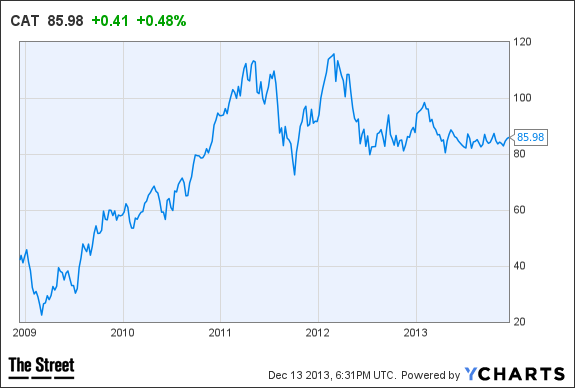
CAT ChartLet’s look at the simple 2013 YTD statistics. While the DJIA has advanced 20.2%, Caterpillar has fallen 4.0%, but only down 2.1% if you plow dividends back into the equation. Unfortunately for those 2013 Caterpillar statistics the company advanced a dividend payment from 2013 to 2012 in order to take advantage of a lower tax environment. (CAT data by YCharts)
 

While no one really cares about the sum of the absolute value of share price moves Caterpillar would be worshipped if they did. I have to admit having spent some time at the altar of Caterpillar, especially for most of 2013 as it rarely ventured far from home.

While the lack of performance is shameful, perhaps the real shame comes from exercising a buy and hold approach with a stock that has been so well suited for a covered call strategy, as it has traded in a range and has been repeatedly cited and chided for doing so.

Whenever you hear a stock criticized for being unable to break out of its trading range it’s time to think of creating your own annuity, rather than looking for an alternative investment.

Here’s why.

That range has created the opportunity to create your own annuity by serially purchasing shares when within that range and selling near the money or in the money calls. After all, why use out of the money calls in an attempt to optimize share gain when the real gain is from premiums? Collecting premiums and collecting dividends with occasional, albeit small gains or losses on shares over and over again has been an annuity in disguise. The income not only flows on a regular basis, but its accumulation can be significant and even make a celebrated short seller salivate.

In an 18 month period I have owned shares on 15 different occasions, sometimes holding different priced lots concurrently. In that time the average purchase price per share was $84.74, as compared to today’s $86.05 close. Adding dividends the 18 month return would be 5.2% for the buy and hold investor as compared to 52.7% for the aggressive covered option investor. During that same period of time the Dow Jones climbed 22.3%

Ultimately, every single argument being made against Caterpillar may be warranted and Oberhelm may, in fact, be deserving of an unwanted appellation. However, Caterpillar’s pricing behavior provides a good argument for remaining agnostic regarding the issues that others find so compelling.

Who knows, maybe even annuities can someday get beyond their “Worst Investment of 2013” status.

Weekend Update – December 15, 2013

People tend to have very strong feelings about entitlements.

Prior to this week there were so many people waiting for the so-called “Santa Claus Rally” that you would have thought that it was considered to be an entitlement.

After the week we’ve just had you can probably add it to the other market axioms that haven’t really worked out this year. If anything, so far it appears that you should have taken your vacation right now along with Santa Claus, who must have not realized that his vacation conflicted with the scheduled rally. You also should probably not taken the wizened advice to vacation months ago when the traditional prevailing attitude implored you to “sell in May and go away.”

The past week saw the S&P 500 drop 1.7% to a closing level not seen in a 22 trading sessions. This week’s drop places us a full 1.8% below the recent record high. Yet, like during a number of other smallish declines in 2013, this one is also being warily eyed as being the precursor to the long overdue, but healthy, 10% decline. We have simply become so accustomed to advances that even what would ordinarily be viewed as downward blips are hard to accept.

For those that have a hard time dealing with conflict, these are not good times, as the Santa Claus Rally is being threatened by the specter of a correction in the waiting. While there’s still time for the traditional rally it’s hard to know whether Santa Claus factored the thought of an outgoing Federal Reserve Chairman presiding over his final FOMC meeting and holding his final press conference.

Oh, and then there’s also the little matter of possibly announcing the beginning of the taper to Quantitative Easing. Just a week earlier the idea that such an announcement would come in December was considered highly unlikely. Now it seems like a real possibility and not the kind that the markets were altogether comfortable with, even as they expressed comfort with the previous week’s Employment Situation Report.

While I admire Ben Bernanke and believe that he helped to rescue the world’s financial markets, it may not be far fetched to cast him as the “Grinch” who stole the Santa Claus Rally if the markets are taken off guard. Personally, I don’t believe that he will make the decision to begin the tapering, in deference to Janet Yellen, his expected successor, privilege to decide on timing, magnitude and speed.

However, I’m not really willing to commit very much to that belief and will likely exercise the same caution as I did last week.

As usual, the week’s potential stock selections are classified as being in Traditional, Double Dip Dividend, Momentum and “PEE” categories this week (see details).

Last week was one of my slowest trading weeks in a long time. Even with cash to spend there never seemed to be a signal that price stability would temper downward risk. Moving forward to this week comes the challenge of trying to distinguish between value and value trap, as many of the stocks that I regularly follow are at more appealing prices but may be at at continued risk.

With lots of positions set to expire this week, the greatest likelihood is that whatever new positions I do establish this week will be with the concomitant use of expanded weekly options or even the January 18, 2014 option, rather than options expiring this coming Friday. The options market is certainly expecting some additional fireworks this coming week as option premiums are generally considerably higher than in recent months.

Microsoft (MSFT) is one of those stocks that has come down in the past week, but like so many still has some downside potential. Of its own weight it can easily go down another 3%, but under the burden of a market in correction its next support level is approximately 8% lower. Since the market’s recent high just a few weeks ago, Microsoft has slightly under-performed the market, but it does trade with a low beta, perhaps offering some relative down side protection. As with many other stocks this week its option premium is far more generous than in the recent past making it perhaps more difficult to resist, but with that reward comes the risk.

There’s probably not much reason or value in re-telling the story of Blackberry (BBRY). Most already have an idea of how the story is going to end, but that doesn’t quiet those who dream of a better future. For some, the future is defined by a weekly option contract and Blackberry reports earnings this week. The options market is implying about a 12% move and for the really adventurous the sale of a put with a strike level almost 17% below Friday’s close could yield a weekly ROI of 1.4%. On a note that shouldn’t be construed as being positive, as the market itself appears a bit more tenuous, Blackberry’s own beta has taken a large drop in the past 3 months. The risk, still remains, however.

Although I discussed the possibility of purchasing shares of Joy Global (JOY) in last week’s article after they reported earnings, I didn’t do so, as it fell hostage to my inactivity even after a relatively large price drop. Despite a recovery from the low point of the week, Joy Global, which has been very much a range bound trading stock of late is still in the range that has worked well for covered call sales. The same is a little less so for Caterpillar (CAT) which is approaching the upper end of its range as it has worked its way toward the $87.50 level. However, with even a mild retreat I would consider once again adding shares buoyed a little bit with the knowledge that shares do also go ex-dividend near the end of the January 2014 option cycle.

Citibank (C) was another that I considered purchasing last week and following a small price drop it continues to have some appeal, also having slightly under-performed the S&P 500 in the past three weeks. However, despite its beta having fallen considerably, it is still potentially a stock that could respond far more so than the overall market. Its option premium for an at the money weekly strike is approximately 18% higher than last week, suggesting that the week may be somewhat more risky than of late.

While my shares of Halliburton (HAL) haven’t fared well in the past week, I am looking at reuniting my “evil troika” by considering purchases of both British Petroleum (BP) and Transocean (RIG), which are now also down from their recent highs. Following in a week in which Anadarko (APC) plunged after a bankruptcy court ruling from a nearly decade old case, the “evil troika” is proof that there is life after litigation and after jury awards, fines and clean up costs. While oil and oil services have been volatile of late, both British Petroleum and Transocean share with Microsoft the fact that they have already under-performed the S&P 500 during this latest downturn but have low betas, hopefully offering some relative downside protection in a faltering market. Perhaps even better is that they are beyond the point of significant downward movement emanating from judicial decisions.

Coach (COH) hasn’t been able to garner much respect lately, although there has been some insider buying when others have been disparaging the company. Meanwhile it has been trading in a fairly well defined range of late. It is a stock that I’ve owned eight times during 2013 and regret not having owned more frequently, particularly since it began offering weekly and then expanded options. Like a number of stocks that I’m considering this week, it too is still closer to the upper end of the range than I would normally initiate new positions and wouldn’t mind seeing a little more weakness.

Seagate Technology (STX) may have a higher beta than is warranted to consider at a time that the market may be labile, however it has recently traded well at the $47.50 level and offers an attractive reward for those willing to accept the frequent movements its shares make, even on an intraday basis. My expectation is that If I do consider a trade it would either be the sale of puts before Wednesday’s big events or otherwise waiting for the aftermath and looking at expanded option dates.

Finally, and yet again, it seems as if it may be time to consider a purchase of eBay (EBAY). While I’ll never really lose count of how many times I own a specific stock, going in and out of positions as they are assigned, eBay is just becoming the perfect example of a stock trading within a range. For anyone selling options on eBay, perhaps the best news was its recent downgrade that chided it for trading in a range and further expecting that it would continue range bound. Although you can’t necessarily trade on the basis of the absolute value of price movements of a stock, the next best way to do so is through buying shares and selling covered calls and then repeating the process as often as possible.

Traditional Stocks: British Petroleum, Caterpillar, eBay, Microsoft, Transocean

Momentum Stocks: Citibank, Coach, Joy Global, Seagate Technology

Double Dip Dividend: none

Premiums Enhanced by Earnings: Blackberry (12/20 AM)

Remember, these are just guidelines for the coming week. The above selections may become actionable, most often coupling a share purchase with call option sales or the sale of covered put contracts, in adjustment to and consideration of market movements. The overriding objective is to create a healthy income stream for the week with reduction of trading risk.